

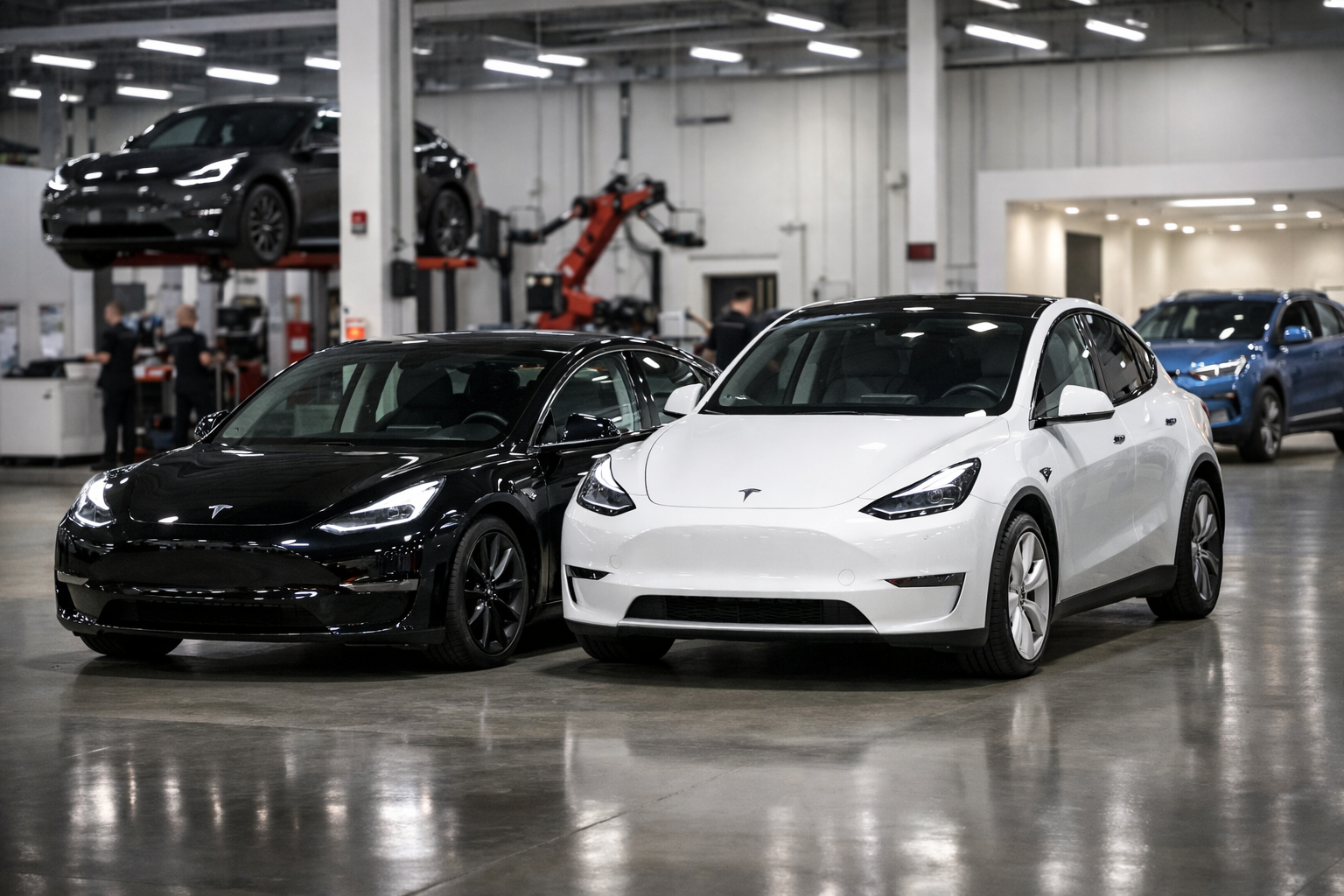
Tesla’s UK registrations fell sharply in February, even as the brand narrowly outpaced China’s BYD in a month that underscored how volatile Europe’s EV race has become. According to preliminary data from the UK’s Society of Motor Manufacturers and Traders (SMMT) released March 5, Tesla UK sales February 2026 dropped an estimated 18% year-over-year, while the broader battery-electric market grew.
Yet here’s the twist: despite the slide, Tesla still delivered more units than BYD in the UK, keeping its position as the country’s top-selling pure EV brand for the month. In a market where Chinese automakers are rapidly gaining ground—per recent European sales data showing Chinese brands surging—that’s not a trivial win.
Having covered three product cycles of Tesla’s European expansion, I can tell you this pattern is familiar: short-term dips tied to logistics and incentives, followed by sharp rebounds. The question is whether this time is different.
The Headlines
- What: Tesla’s UK February sales fell year-over-year but still topped BYD’s volume
- Who: Tesla, BYD, UK EV buyers
- When: February 2026 registrations, reported March 5, 2026
- Impact: Signals intensifying competition in the UK’s fast-growing EV market
- Key Number: ~18% estimated year-over-year drop in Tesla UK registrations
What Happened
According to SMMT data and industry trackers cited by Reuters, Tesla registered significantly fewer vehicles in the UK in February 2026 compared with February 2025. Analysts attribute the decline largely to shipment timing from Tesla’s Berlin Gigafactory and the transition between refreshed Model 3 and Model Y production batches.
Meanwhile, BYD continued its European push. The Chinese automaker, which surpassed Tesla in global EV sales in late 2024 according to company filings, expanded UK deliveries of the Atto 3, Dolphin, and Seal. However, its February UK registrations still trailed Tesla’s, based on preliminary figures.
Notably, the overall UK battery-electric vehicle (BEV) market grew year-over-year, consistent with the broader trend highlighted in Europe’s strong January 2026 EV performance. In other words, Tesla’s dip was brand-specific—not a sign of weakening EV demand.
This makes the Tesla vs BYD Europe rivalry more nuanced than headline numbers suggest. Tesla lost share month-to-month, but it hasn’t lost the crown—at least not yet.
Why It Matters
The significance of Tesla UK sales February 2026 goes beyond one month’s tally. The UK is Europe’s largest EV market after Germany, and it operates under the Zero Emission Vehicle (ZEV) mandate requiring 28% of new car sales to be zero-emission in 2026, according to the UK government. That policy effectively guarantees rising EV volumes—but not who captures them.
Additionally, Tesla’s European margins have been under pressure since its 2023–2025 price cuts, a strategy detailed in quarterly filings and covered by Bloomberg. Lower prices boosted volume but compressed profitability. If Tesla starts losing share while margins remain thin, investors will take notice.
However, BYD faces its own constraints. The European Union’s anti-subsidy investigation into Chinese EV imports, reported by Reuters, could result in additional tariffs. While the UK is no longer in the EU, supply chains and pricing strategies remain interconnected. Any cost shock on the continent ripples across the region.
For consumers, this intensifying competition is largely positive. More brands chasing market share typically means sharper financing deals, richer feature lists, and better warranty coverage.
The Bigger Picture
Zooming out, Tesla UK sales February 2026 reflect a maturing EV market. Early adopters are mostly served; now automakers compete for mainstream buyers who compare monthly payments, charging access, and resale values.
Historically, Tesla dominated Europe with limited direct competition. That’s no longer the case. Volkswagen Group holds roughly 20% of Europe’s BEV market, according to company reports. Stellantis is leveraging partnerships like Leapmotor to lower costs, as explored in our analysis of the Stellantis-Leapmotor EV strategy. Meanwhile, Hyundai-Kia continues to gain traction with the Ioniq and EV6 lineup.
In contrast to 2020–2022, when Tesla’s brand cachet alone drove demand, 2026 buyers are more pragmatic. Energy prices, public charging reliability, and insurance costs matter more than 0–60 bragging rights.
There’s also a political dimension. Trade tensions and tariff uncertainty—issues we’ve unpacked in our auto tariffs buying guide—create pricing unpredictability. Tesla builds European cars in Germany, insulating it somewhat from import duties that could hit Chinese brands harder.
What the Competition Is Doing
BYD is attacking the UK market on price and variety. The Dolphin undercuts the Model 3 significantly, while the Seal competes directly on range and performance. Moreover, BYD’s vertical integration—producing its own batteries—gives it cost flexibility Tesla once uniquely enjoyed.
Volkswagen, meanwhile, is stabilizing ID.3 and ID.4 production after software setbacks. Additionally, BMW and Mercedes-Benz are targeting the premium EV space Tesla’s Model Y Long Range occupies, emphasizing build quality and dealer support.
Interestingly, Ford is repositioning in Europe with new EV crossovers while teasing a broader product reset, as covered in Ford’s European strategy update. Every major player sees the UK as strategic because regulatory mandates effectively lock in demand growth.
The competitive field is now crowded enough that a single weak month for Tesla no longer guarantees a quick rebound in share.
What It Means for You
If you’re shopping for an EV in Britain, Tesla UK sales February 2026 suggest leverage is shifting toward buyers. Slower Tesla registrations often coincide with inventory incentives or financing offers toward quarter-end.
Therefore, compare total ownership costs—not just sticker prices. Insurance on some Teslas remains higher than rivals, while BYD and Hyundai sometimes bundle service packages. Our 2026 car buying tips guide walks through how to negotiate in this increasingly competitive market.
However, don’t assume Tesla is in retreat. Delivery timing quirks frequently distort monthly data. If you want a specific trim or color, waiting for aggressive discounts could mean longer lead times.
What to Watch Next
First, watch March and April registration data. Tesla often front-loads or back-loads European deliveries by quarter, so a rebound would reinforce the “logistics blip” theory.
Second, monitor any UK response to EU tariff moves. Even indirect supply-chain impacts could alter pricing between Tesla and BYD.
Finally, keep an eye on updated Model Y production volumes from Berlin. Higher output would strengthen Tesla’s cost position across Europe.
The Upside
- Intense Tesla-BYD rivalry drives sharper pricing and incentives
- UK ZEV mandate ensures expanding EV availability
- Berlin production buffers Tesla from some tariff risks
- More model variety across price points than ever before
The Concerns
- Tesla margin pressure could limit future price cuts
- Potential tariff escalation may raise EV prices
- Delivery timing volatility complicates resale value forecasts
- Chinese brand expansion intensifies competitive uncertainty
Ultimately, Tesla UK sales February 2026 tell a story less about decline and more about normalization. Tesla is no longer the uncontested EV default—it’s one heavyweight among many.
Over the next two to three years, expect tighter margins, smarter buyers, and fewer easy wins. For consumers, that’s healthy. For automakers, the real fight is just beginning.
Disclosure: This article may contain affiliate links. If you make a purchase through these links, we may earn a small commission at no extra cost to you. This helps support RevvedUpCars.com. Learn more.