
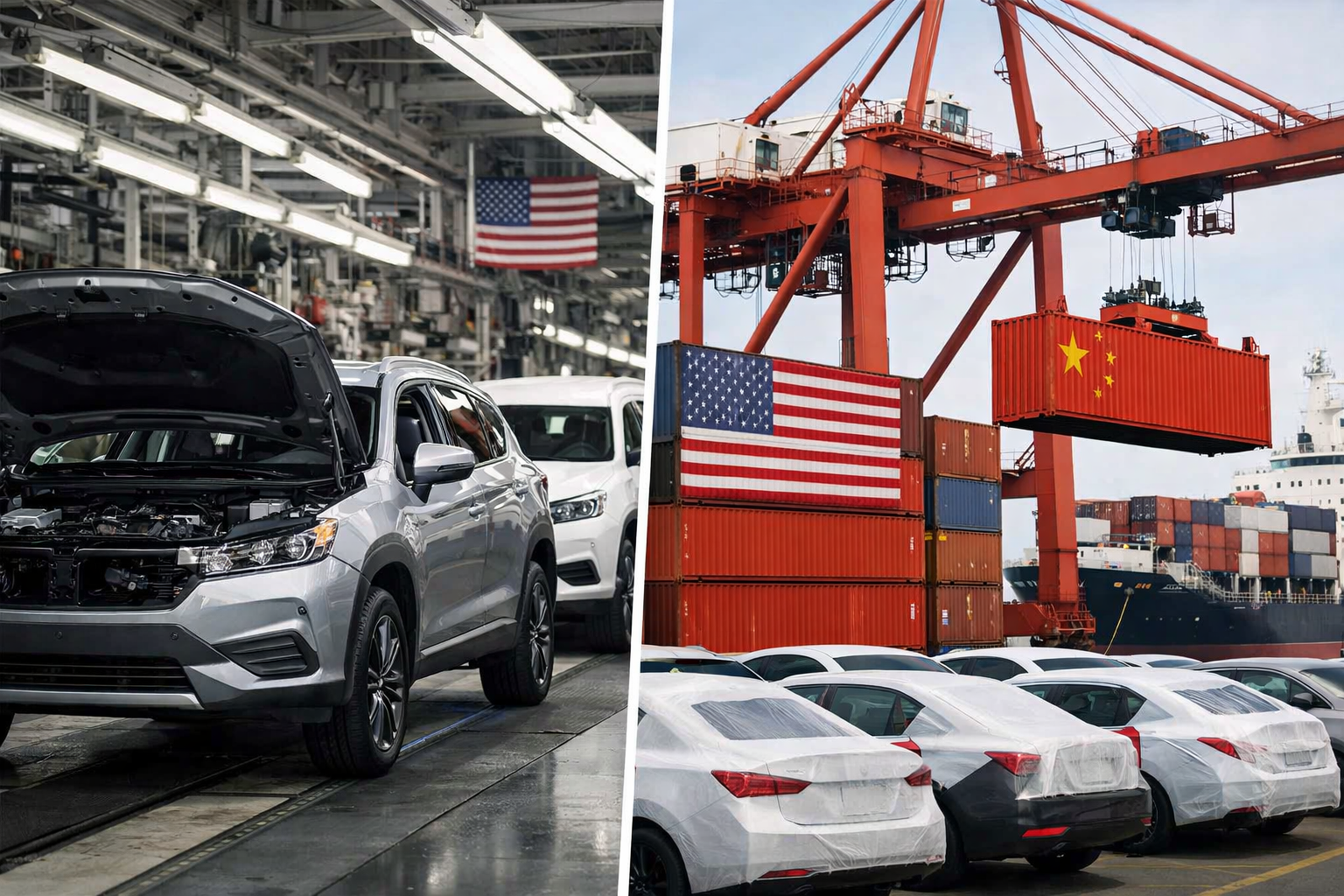
The White House confirmed sweeping new auto tariffs 2026 measures on March 27, escalating trade tensions with China and Mexico and sending shockwaves through an industry already grappling with high interest rates and slowing EV demand. The updated policy raises tariffs on Chinese-built vehicles to an effective 125% and tightens rules of origin for vehicles imported from Mexico that contain Chinese battery components.
However, this isn’t just another trade skirmish. The Biden administration’s earlier 100% tariff on Chinese EVs was largely symbolic because almost none were sold here. The new Trump auto policy framework—outlined during campaign stops and formalized through U.S. Trade Representative action this week—goes further by targeting supply chains, not just finished cars. That shift could ripple through everything from $30,000 compact SUVs to $80,000 electric pickups.
According to Reuters, automakers are already warning of billions in added compliance and sourcing costs. The reality is more nuanced than the political rhetoric: while the policy aims to shield U.S. manufacturing, it may also raise prices for American buyers in the short term.
The Headlines
- What: Expanded U.S. tariffs on Chinese vehicles and stricter content rules for North American imports
- Who: U.S. Trade Representative, Chinese automakers, U.S. and Mexican assembly plants
- When: Announced March 27, 2026; phased implementation begins June 1, 2026
- Impact: Higher compliance costs and likely vehicle price increases across multiple segments
- Key Number: Up to 125% effective tariff on Chinese-built vehicles
What Happened
The administration finalized expanded tariffs covering not only fully assembled vehicles from China but also key components, including lithium-ion battery cells, power electronics, and certain semiconductors. Additionally, vehicles assembled in Mexico must now prove that at least 75% of battery content originates outside China to avoid penalty duties.
According to a USTR fact sheet, the policy aims to “counter unfair trade practices and protect U.S. industrial capacity.” However, industry groups such as the Alliance for Automotive Innovation estimate compliance costs could exceed $4 billion annually. Automakers have until June 1 to certify supply chains.
“This is about economic security,” a senior administration official said during a March 27 briefing. “We will not allow subsidized imports to undermine domestic production.”
Notably, the move coincides with a broader crackdown on Chinese auto expansion, including scrutiny over connected vehicle data and proposed restrictions that echo concerns raised in our coverage of the BYD Formula 1 bid and U.S. trade clash. The common thread: Washington sees Chinese automakers as both economic and security competitors.
Why It Matters
The immediate impact of the auto tariffs 2026 policy is psychological as much as financial. While Chinese brands like BYD and SAIC currently have virtually zero U.S. market share, their low-cost EVs—some priced under $25,000 globally—posed a looming threat.
Meanwhile, U.S. automakers such as Ford and GM rely heavily on cross-border supply chains. Ford’s Mustang Mach-E and several GM EV components are sourced from Mexico. If battery minerals or cells trace back to China, tariffs could apply. As a result, even vehicles assembled in North America could see cost increases of $1,000 to $3,000 per unit, according to estimates cited by Bloomberg.
Consumers are already stretched. The average new car payment hovers near $800 per month, as we detailed in Why $800 Car Payment Is the New Normal. Additional tariff-driven price hikes could further suppress demand just as dealers are trying to normalize inventory levels.
The Bigger Picture
This isn’t happening in a vacuum. Global EV competition has intensified, and China now accounts for roughly 60% of global EV production, according to the International Energy Agency. At the same time, U.S. EV adoption has cooled from its 2024 peak, with growth slowing to single digits in early 2026.
Historically, tariffs protect domestic industry but rarely lower consumer prices. The 2018 steel and aluminum tariffs raised input costs for automakers by an estimated $1 billion annually, per industry analyses. However, they did encourage some localized investment.
Additionally, this policy intersects with Inflation Reduction Act incentives, which already require North American assembly and battery sourcing rules to qualify for the $7,500 tax credit. The new measures effectively double down on reshoring. The question is timing: can U.S. battery plants ramp up fast enough to replace Chinese inputs without supply disruptions?
In contrast, Europe has taken a more calibrated approach, launching anti-subsidy investigations but stopping short of blanket bans. China, for its part, has hinted at retaliatory tariffs on U.S. agricultural exports, according to AP News. Trade wars rarely stay confined to one sector.
What the Competition Is Doing
Ford is accelerating domestic battery production through its BlueOval SK joint venture in Kentucky and Tennessee. However, those plants won’t reach full capacity until late 2026 or 2027. In the interim, Ford may face higher costs on certain EV models, even as it pushes affordable options like the 2026 Ford electric truck.
General Motors, meanwhile, has diversified battery sourcing via its Ultium Cells facilities in Ohio and Michigan. Additionally, GM has reduced its exposure to Chinese imports more aggressively than Ford, giving it a relative hedge against immediate tariff shocks.
Tesla sits in a unique position. Although it produces vehicles in Shanghai for global markets, its U.S.-sold models are largely built in California and Texas. However, some battery materials still trace back to Chinese refiners. Therefore, Tesla could face modest cost pressure unless it further localizes mineral processing.
Foreign automakers such as Toyota and Volkswagen also assemble vehicles in North America but maintain globalized supply chains. Volkswagen’s EV expansion strategy, outlined in Volkswagen 2026 Models: EV Push or Overload?, depends heavily on cost efficiency. Tariffs could compress margins unless pricing adjusts upward.
What It Means for You
If you’re shopping for a 2025 or 2026 model-year vehicle, expect potential price volatility by late summer. Automakers typically adjust MSRP at the start of a new model year, making fall 2026 a key inflection point.
However, don’t assume every car will spike in price. Gas-powered vehicles with minimal Chinese content may see little change. Additionally, automakers might absorb some costs to maintain market share in a softening demand environment.
For EV buyers, verify tax credit eligibility carefully. Stricter sourcing rules could disqualify certain trims. Moreover, keep an eye on dealer pricing tactics during periods of uncertainty—our guide on how to spot dealership pricing tricks is particularly relevant in volatile markets.
What to Watch Next
First, watch automaker earnings calls in April and July. Executives will outline projected tariff exposure and pricing strategies. Second, monitor potential Chinese retaliation, which could escalate beyond autos.
Third, track U.S. battery plant ramp-ups. If domestic production scales quickly, the long-term impact of auto tariffs 2026 could be muted. If not, supply bottlenecks may persist into 2027.
The Upside
- Strengthens domestic manufacturing and battery investment
- Reduces dependence on Chinese EV imports
- Potentially protects U.S. jobs in assembly and supply chains
- Encourages long-term localization of critical minerals
The Concerns
- Higher vehicle prices in an already expensive market
- Supply chain disruptions during transition period
- Risk of retaliatory trade measures
- Slower EV adoption if affordable models are delayed
Having covered multiple trade cycles, I can tell you this pattern is familiar: tariffs promise protection, then force rapid industry adaptation. The difference this time is scale. With electrification and battery supply chains at stake, auto tariffs 2026 could accelerate the U.S. shift toward localized production—but at a tangible cost to consumers in the short term.
Over the next two to five years, the winners will be automakers that localize fastest and manage supply chains with surgical precision. For buyers, patience and research will matter more than ever.
Disclosure: This article may contain affiliate links. If you make a purchase through these links, we may earn a small commission at no extra cost to you. This helps support RevvedUpCars.com. Learn more.