
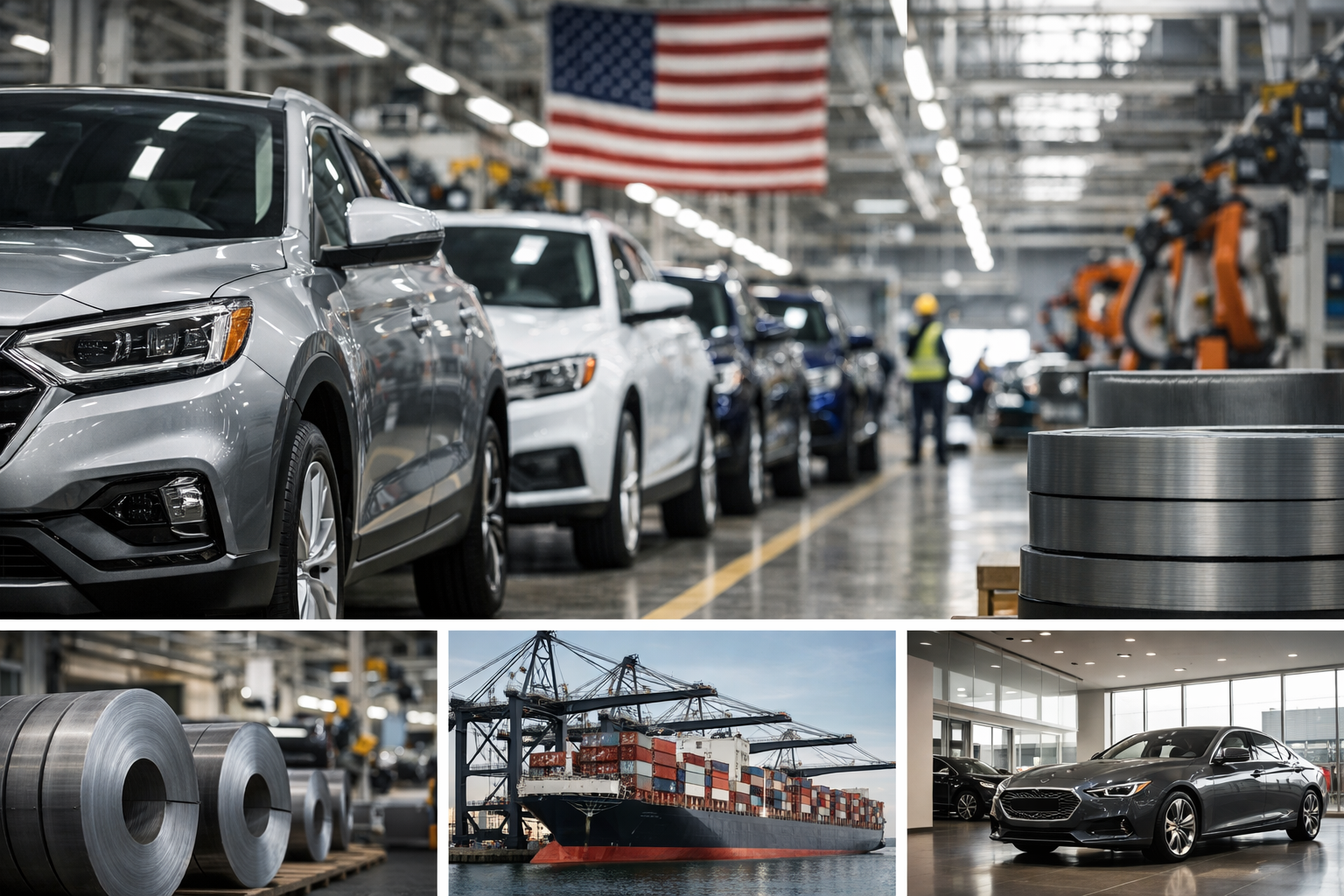
The U.S. Supreme Court on February 27, 2026 upheld the administration’s authority to impose broad-based import duties on foreign-built vehicles, clearing the way for expanded Supreme Court tariffs to remain in effect through at least 2027. The 6–3 decision resolves months of uncertainty that had frozen product planning and pricing strategies across Detroit, Tokyo, Seoul, and Wolfsburg.
This isn’t just a legal footnote. It cements a new phase of U.S. auto policy where trade tools are used as industrial policy—shaping where cars are built, what powertrains get prioritized, and ultimately what Americans pay on dealer lots in 2026.
The Headlines
- What: Supreme Court upholds federal authority to maintain expanded auto import tariffs
- Who: U.S. Supreme Court; U.S. Trade Representative; global automakers including Toyota, Volkswagen, Hyundai, BMW
- When: Ruling issued February 27, 2026; tariffs remain effective immediately
- Impact: Imported vehicles and parts face sustained cost pressure, influencing 2026 car prices
- Key Number: Up to 25% tariff on certain imported vehicles and components
What Happened
The Court ruled that the executive branch acted within its statutory authority under existing trade law to levy and maintain elevated auto tariffs, according to reporting from Reuters and Bloomberg. While the case centered on procedural challenges from importers and dealer groups, the broader implication is clear: the current tariff framework stands.
Specifically, the policy maintains tariffs of up to 25% on certain imported vehicles and selected components, with limited carve-outs for USMCA-compliant products. According to administration statements, the goal is to incentivize domestic production and reduce reliance on overseas supply chains.
Automakers had delayed some allocation decisions for 2026 model-year imports while awaiting clarity. Toyota, which imports a significant share of Lexus models from Japan, and BMW, which ships 3 Series sedans from Mexico and Germany, both flagged tariff risk in prior earnings calls. Hyundai and Kia, despite heavy U.S. production in Alabama and Georgia, still rely on Korean imports for several EV and hybrid variants.
Notably, the ruling does not create new tariffs—it locks in and legitimizes the existing structure. However, by removing legal uncertainty, it allows the administration to enforce and potentially expand the framework with less immediate risk of reversal.
Why It Matters
Supreme Court tariffs translate into dollars on a Monroney sticker. A 25% duty on a $30,000 imported vehicle theoretically adds $7,500 before shipping, dealer margin, or state taxes. In practice, automakers absorb some of that cost, but not all. Analysts at Cox Automotive estimate retail price increases of 3% to 8% on affected nameplates, depending on brand pricing power.
Meanwhile, parts tariffs ripple beyond fully imported cars. Even vehicles assembled in Kentucky or Tennessee often source transmissions, battery modules, or electronics from Europe or Asia. According to the Alliance for Automotive Innovation, roughly 40% of components in a “domestic” vehicle are imported.
For consumers, this compounds existing pricing pressure. The average new vehicle transaction price hovered around $48,000 in late 2025, per Kelley Blue Book data. Tariff-induced increases could keep average prices elevated even as interest rates stabilize.
There’s also a powertrain angle. As we’ve covered in our analysis of the EPA Emissions Repeal: What 2026 Buyers Need, regulatory shifts are already reshaping EV and hybrid strategy. Layer tariffs on top, and automakers must decide whether to localize EV battery production faster—or lean into hybrids built in North America.
The Bigger Picture
This ruling reinforces a broader shift in US auto policy from pure free trade toward strategic protectionism. Over the past decade, we’ve seen tariffs on steel and aluminum, tightened USMCA content rules, and incentives for domestic EV battery plants under federal climate legislation, according to the U.S. Department of Energy.
Historically, tariffs have produced mixed outcomes. In the 1980s, voluntary export restraints on Japanese automakers led to more U.S. assembly plants—but also higher vehicle prices. Having covered multiple product cycles, I can tell you this pattern is familiar: short-term price spikes, medium-term localization investment, long-term competitive reshuffling.
Globally, the U.S. is not alone. The European Union has pursued anti-subsidy investigations into Chinese EV imports, while China maintains its own industrial policy tools. Trade friction is becoming a structural feature of the auto industry, not a temporary headline.
Additionally, the ruling could complicate niche imports. Enthusiasts looking to bring in specialty vehicles should pay close attention to compliance and cost, as outlined in our Import JDM Land Cruiser: Costs, Paperwork & Tips guide. Tariffs may not apply uniformly, but customs scrutiny will likely increase.
What the Competition Is Doing
Ford and General Motors are relatively insulated on high-volume trucks and SUVs, which are overwhelmingly built in the U.S. However, GM imports some EV components and certain crossovers from Mexico and China, exposing it to parts-level tariffs.
Meanwhile, Toyota straddles both worlds. It builds Camry and RAV4 models in Kentucky but still imports key hybrids and Lexus vehicles. Therefore, Toyota may accelerate U.S.-based hybrid production to protect margins.
Hyundai Motor Group has aggressively expanded U.S. manufacturing, including a multi-billion-dollar EV and battery investment in Georgia. According to company filings, that plant aims for hundreds of thousands of units annually. In contrast, Volkswagen continues to rely on global platforms and could face margin pressure on German-built models.
Tesla stands out. With domestic assembly in Texas and California, it avoids direct vehicle tariffs. However, it still depends on globally sourced components, including some battery materials. The competitive irony: tariffs designed to protect domestic automakers may indirectly bolster Tesla’s pricing flexibility.
What It Means for You
For buyers shopping imported 2026 models—think BMW 5 Series, certain Mercedes-Benz SUVs, or fully imported EVs—expect less discounting and potentially higher MSRPs. Dealers have already signaled tighter inventory management, according to industry contacts.
However, domestically built vehicles may not see immediate price relief. If demand shifts toward U.S.-assembled trucks and crossovers, automakers could maintain pricing power. In other words, tariffs don’t automatically mean “buy American and save.”
Additionally, if you’re considering an imported performance or luxury vehicle, timing matters. Vehicles already on U.S. soil may be priced under prior cost assumptions. Orders placed later in 2026 could reflect fully baked-in tariff costs.
For mainstream buyers, watch hybrid and compact SUV segments closely. Automakers may prioritize local production of high-volume electrified models to hedge against ongoing Supreme Court tariffs-backed policy risk.
What to Watch Next
First, monitor automaker earnings calls in April and July. Executives will quantify tariff exposure and outline pricing strategy. Second, watch for new U.S. plant announcements or battery localization deals; capital expenditure often follows policy certainty.
Additionally, pay attention to any retaliatory measures from trade partners. Escalation could affect U.S.-built vehicles exported abroad, pressuring domestic production volumes. Finally, track monthly transaction prices to see whether predicted 3%–8% increases materialize or get diluted by incentives.
The Upside
- Encourages domestic auto and battery manufacturing investment
- Reduces policy uncertainty for long-term product planning
- Potential job growth in U.S. assembly and supplier plants
- Strengthens leverage in future trade negotiations
The Concerns
- Higher 2026 vehicle prices for imported models
- Cost pass-through from imported parts even in U.S.-built cars
- Risk of retaliatory tariffs hurting U.S. exports
- Reduced model variety if automakers trim low-margin imports
The immediate effect of the Supreme Court tariffs ruling is higher cost pressure on imported vehicles. The longer-term story is more consequential: it accelerates the decoupling and regionalization of the global auto industry.
If history is a guide, consumers will feel the pinch first, factories will follow with new investments, and the competitive hierarchy may subtly shift by 2028. For 2026 buyers, the takeaway is simple—where your car is built now matters more than it has in decades.
Disclosure: This article may contain affiliate links. If you make a purchase through these links, we may earn a small commission at no extra cost to you. This helps support RevvedUpCars.com. Learn more.