

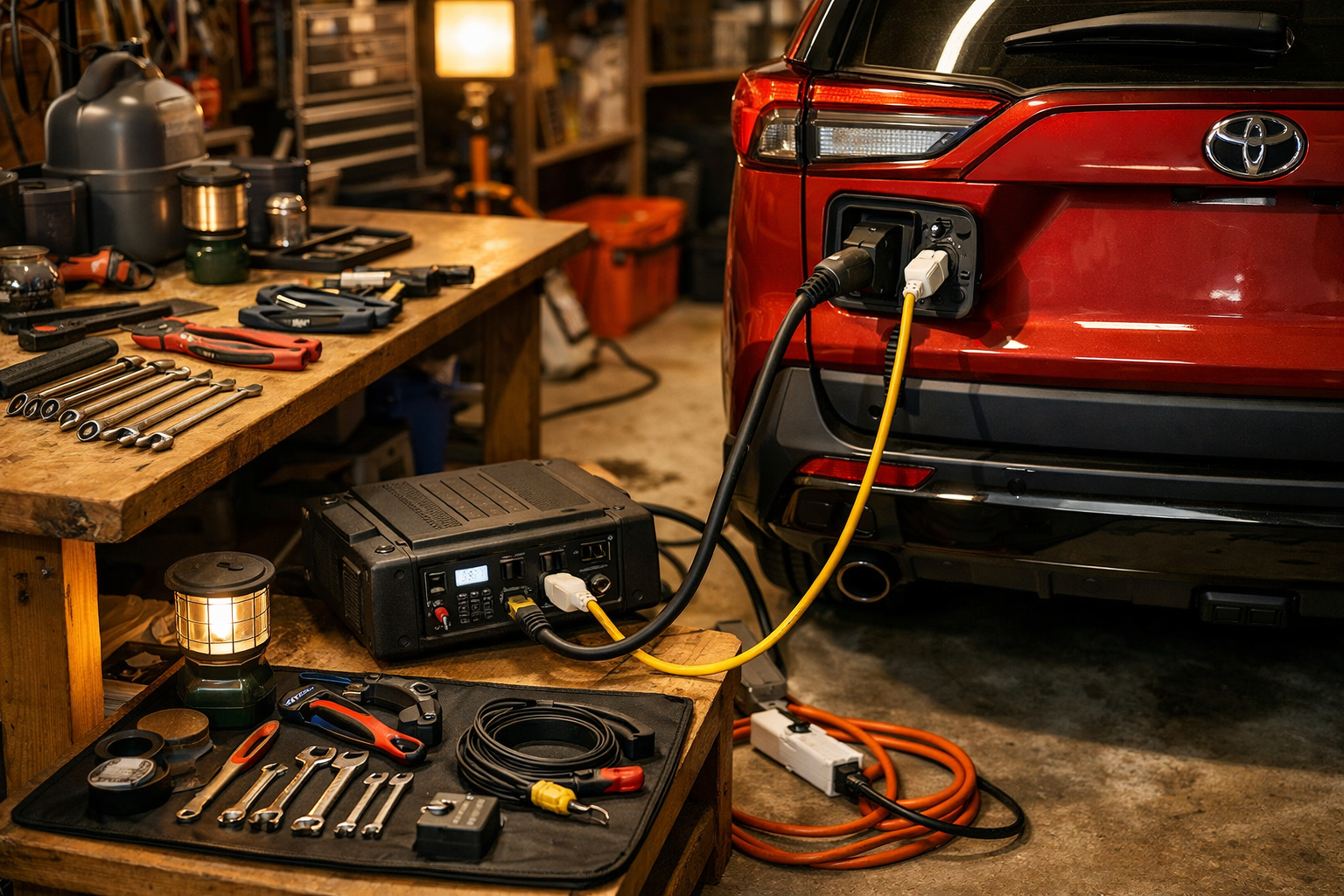
The lights just went out, the fridge is humming to a stop, and your neighbor’s dragging out a gas generator that sounds like a lawnmower from 1987. Meanwhile, you’ve got a fully charged Toyota RAV4 PHEV sitting in the driveway. Good news: your Toyota RAV4 PHEV home power setup can keep the essentials running if you do it right.
With storms getting nastier and the grid getting shakier, knowing how to use your plug-in hybrid as backup power isn’t just cool tech — it’s peace of mind. Done correctly, it can save you from spoiled food, frozen pipes, or a $1,200 hotel bill during an outage.
In this vehicle-to-home guide, I’ll walk you through what’s safe, what’s not, and how to set up your RAV4 plug-in hybrid generator mode without frying your SUV — or yourself.
What You’ll Need
- Tools: 10mm socket (for battery disconnect if needed), heavy-duty outdoor extension cords (12-gauge minimum), transfer switch or interlock kit, voltage-rated gloves
- Parts/Materials: 1500–2000W pure sine wave inverter ($150–$400), transfer switch installed by electrician ($400–$1,200), fuel stabilizer ($15)
- Time: 30 minutes setup if pre-installed; 3–4 hours if installing inverter; transfer switch install = 2–4 hours (electrician)
- Difficulty: 🔧🔧🔧 (Moderate)
- Dealer Cost: $2,500–$4,000 for “official” backup solution vs DIY Cost: $600–$1,500 — You Save: $1,500+
Why This Matters
When the power drops for 24–72 hours, your biggest concerns are refrigeration, medical devices, sump pumps, and heat. Your 2025–2026 RAV4 Prime (PHEV) has an 18.1 kWh battery plus a gasoline engine that can recharge it. That’s basically a quiet, automatic generator on wheels.
Ignore proper setup, though, and you risk electrical backfeed — which can kill a utility worker or destroy your SUV’s electronics. I’ve seen backyard wiring jobs cost $6,000 in fried modules. Not worth it.
Think of your RAV4 plug-in hybrid generator mode like using a garden hose. Controlled flow? Perfect. Hook it up wrong? You’re flooding the house. This Toyota RAV4 PHEV home power method works best when prepped before storm season.
Before You Start
⚠️ WARNING: NEVER plug your vehicle directly into a household wall outlet. That causes dangerous backfeed into the grid. People have died from this mistake.
⚠️ WARNING: Carbon monoxide kills. The RAV4’s gas engine will turn on periodically. Always run the vehicle outdoors, at least 10 feet from doors and windows, exhaust pointed away from the house.
Park on a flat surface, set the parking brake, and chock a wheel if you’re on a slope. Keep at least 1/4 tank of fuel. Check for recalls at NHTSA.gov before relying on your vehicle for emergency power.
If you’re seeing hybrid system warnings, HV battery codes, or check engine lights, stop. Read up on hybrid reliability basics here: Hybrid Car Reliability in 2026: DIY Owner Tips.
If you don’t have a transfer switch or don’t understand household wiring, this is where you call a licensed electrician. Paying $800 now beats burning down your panel.
Step-by-Step Guide
-
Install a Transfer Switch (Pre-Outage Prep)
Have a licensed electrician install a manual transfer switch or interlock kit tied to essential circuits (fridge, furnace fan, outlets). Expect $400–$1,200 installed in 2025 pricing.
Pro Tip: Label the circuits clearly. In an emergency, you don’t want guesswork. -
Choose the Right Inverter
You need a pure sine wave inverter rated 1500–2000 watts continuous. Modified sine wave units can damage electronics. Connect to the 12V battery system per manufacturer instructions.
[Photo: Inverter mounted securely near 12V battery compartment] -
Connect to the 12V Battery
Open the rear cargo area to access the 12V battery (location varies by model year — consult your owner’s manual at Toyota Owners). Use properly rated cables and tighten connections securely (consult your owner’s manual for torque specs).
⚠️ WARNING: Disconnect negative terminal with a 10mm socket before wiring. -
Start the Vehicle in READY Mode
Press brake, hit Power button. “READY” must appear on dash. This allows the DC-DC converter to maintain the 12V system from the high-voltage battery.
The gas engine will cycle automatically to recharge the HV battery. -
Plug In Through Transfer Switch
Connect inverter output to transfer switch input using a heavy-duty 12-gauge extension cord. Flip selected breakers to generator position.
Keep load under inverter rating — fridge (~600W startup), furnace blower (~400W), lights (~100W total). -
Monitor Fuel and Load
Check fuel every 8–12 hours. A full tank can often provide 2–3 days of intermittent power depending on load.
Pro Tip: Lower loads = longer runtime. Don’t try to run your central AC.
This is the core of a safe vehicle-to-home guide setup. Done right, your Toyota RAV4 PHEV home power system becomes a quiet alternative to a $900 gas generator.
Common Mistakes to Avoid
- Using a cheap inverter. I’ve seen $89 units melt internally. Buy quality — $200 minimum.
- Overloading the system. Microwaves and space heaters will trip the inverter fast.
- Running indoors or in garage. I don’t care if the door is open. Don’t.
- Skipping the transfer switch. Backfeeding can destroy your SUV’s inverter electronics — $3,000 repair.
- Letting fuel sit for a year. Add stabilizer. Stale gas gums injectors.
I’ve seen this in the shop a hundred times — good intentions, bad wiring. Respect electricity.
When to Call a Professional
If your panel is older than 1990, lacks main breaker interlock compatibility, or you don’t understand load balancing, hire an electrician. Fair price for transfer switch install? $600–$1,200 depending on region.
If a shop tries to sell you a $4,000 “OEM-approved generator package,” ask what that includes. Many times it’s just a rebranded inverter and labor. Don’t get upsold.
Ask the electrician:
- Is this interlock code-compliant locally?
- What circuits are isolated?
- What’s the max amperage rating?
Red flag: anyone who says “Just plug it into the dryer outlet.” Walk away.
Recommended Products
- Best Overall Inverter: Renogy 2000W Pure Sine Wave (~$350) — solid build, clean output.
- Budget Option: Giandel 1600W Pure Sine (~$220) — good for essentials only.
- Premium: Victron Energy 2000W (~$600) — what I’d use in my own garage.
- Transfer Switch: Reliance Controls 6-Circuit Kit (~$350 plus install).
If you’re planning long-term resilience, check out future-ready upgrades here: Future-Proof Your Car Tech Upgrades 2026. Smart planning beats panic buying.
Do This
- Install a proper transfer switch
- Use pure sine wave inverter
- Run vehicle outdoors only
- Test system before storm season
Don’t Do This
- Backfeed through wall outlet
- Overload beyond 2000W
- Ignore fuel levels
- Buy the cheapest inverter online
Your RAV4 isn’t just transportation — it’s a rolling power station if you respect its limits. Set up correctly, your Toyota RAV4 PHEV home power system can keep the lights on, the fridge cold, and the family comfortable when the grid taps out.
You can do this. It’ll take an afternoon to set up properly, and you’ll sleep better knowing you’re ready. Drop your questions in the comments if you want help sizing your setup.
Stay safe under there — and remember, a $20 repair manual saves a $2,000 repair bill.