
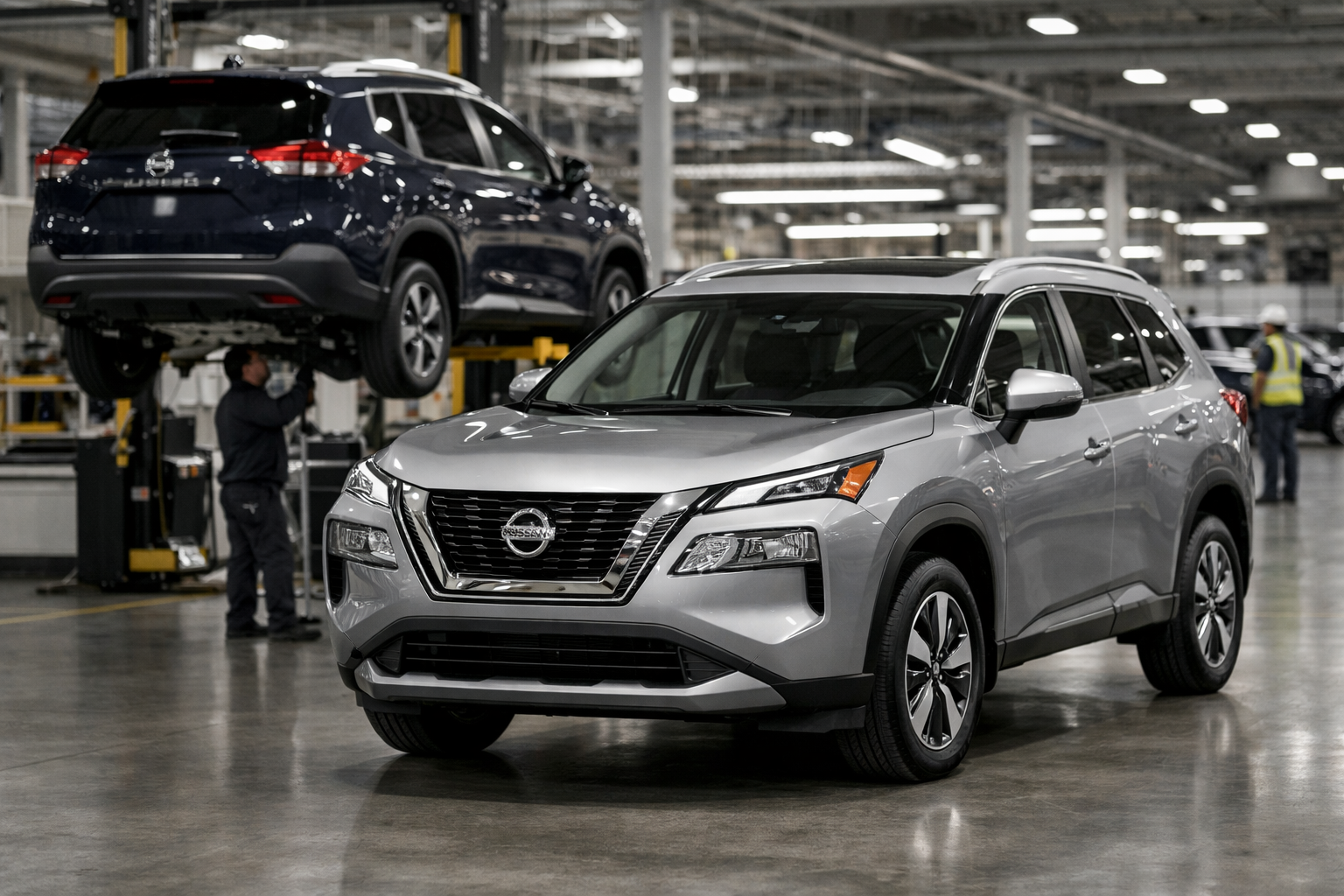
Nissan is recalling 642,000 Rogue SUVs in the U.S. over potential engine failures tied to its variable-compression turbocharged powertrain, marking one of the brand’s largest actions in years. The Nissan Rogue recall, announced March 2, 2026 and posted to the NHTSA database, covers certain 2025 and 2026 model-year vehicles equipped with the 1.5-liter VC-Turbo three-cylinder engine.
For Nissan, this is more than a routine service campaign. The Rogue is its top-selling vehicle in the U.S., accounting for roughly 30% of brand volume in 2025, according to company sales reports. Any hit to consumer confidence in this segment—the hyper-competitive compact SUV class—has outsized consequences.
The Headlines
- What: Recall of 642,000 Rogue SUVs for potential engine damage and stall risk
- Who: Nissan North America; affected owners of 2025–2026 Rogue models
- When: Announced March 2, 2026; owner notifications begin April 2026
- Impact: Free inspection and potential engine repair or replacement
- Key Number: 642,000 vehicles
What Happened
According to Nissan’s filing with NHTSA, the issue involves the 1.5 VC-Turbo engine, where reports indicate bearing wear and potential internal engine damage could lead to a loss of power or stall. A stalled vehicle increases crash risk, particularly at highway speeds.
Nissan says it has received field reports of unusual engine noise and reduced performance. However, the company told regulators it is not aware of any fatalities related to the defect. Dealers will inspect affected engines and, if necessary, repair or replace components at no cost to owners.
“Customer safety is our top priority, and we are acting quickly to address this matter,” Nissan said in a statement published in its U.S. newsroom.
The 1.5-liter three-cylinder VC-Turbo engine—first introduced in the Rogue in 2022—was designed to balance fuel efficiency with power by dynamically adjusting compression ratios. It produces 201 horsepower and up to 30 mpg combined, according to EPA estimates. The technology itself isn’t new globally, but scaling it across high-volume U.S. production appears to be the pressure point.
Why It Matters
The Rogue competes directly with the Toyota RAV4, Honda CR-V, and Chevrolet Equinox—three of the top five best-selling SUVs in America. In 2025, Toyota sold more than 430,000 RAV4s in the U.S., while Honda moved over 360,000 CR-Vs, per manufacturer filings. Nissan’s Rogue trailed but remained critical to the brand’s recovery strategy.
Therefore, a recall of this scale threatens more than short-term inconvenience. It hits Nissan’s reliability narrative at a time when buyers are already cautious about downsized turbocharged engines. The company has worked to rebuild trust after earlier CVT transmission complaints earlier in the decade.
Additionally, engine-related recalls tend to linger in consumer memory longer than software glitches or minor hardware issues. For shoppers cross-comparing, headlines about 1.5 VC Turbo engine issues can outweigh competitive pricing or incentives.
For context on navigating a volatile market, our Car Buying Tips 2026: Avoid Overpaying Smartly guide breaks down how to factor recalls into your decision without overreacting.
The Bigger Picture
This recall lands amid heightened regulatory scrutiny. NHTSA has increased investigations into engine failures and stall-related incidents industrywide, according to agency data. Meanwhile, the policy backdrop is shifting; the EPA Emissions Repeal: What 2026 Buyers Need story highlights how changing federal standards could alter automakers’ powertrain strategies.
Historically, Nissan leaned heavily into turbocharging and variable compression to meet efficiency targets without going full hybrid. In contrast, Toyota and Honda doubled down on hybridization—Toyota now offers hybrid variants on roughly half of its U.S. lineup. That divergence matters: hybrids spread mechanical stress differently and, according to multiple reliability surveys, have matured into relatively stable systems.
Globally, automakers are juggling cost pressures from tariffs and supply chains, as detailed in our analysis of the Supreme Court Tariffs: Car Price Impact 2026. As a result, warranty and recall costs land at a time when margins are already thin.
What the Competition Is Doing
Toyota continues to hedge with both gasoline and hybrid RAV4 models, reducing reliance on a single advanced engine architecture. Honda’s CR-V similarly splits volume between turbocharged gas and hybrid trims. Meanwhile, Hyundai and Kia have expanded naturally aspirated and hybrid offerings in the Tucson and Sportage.
In contrast, Nissan consolidated Rogue powertrains around the 1.5 VC-Turbo in recent model years. That strategy simplified manufacturing but concentrated risk. When one engine underpins nearly all sales, any defect scales quickly.
Chevrolet, for its part, has leaned into fleet and value positioning with the Equinox while preparing next-generation electrified options. The takeaway: competitors diversified powertrains, while Nissan optimized around a technological differentiator that now faces scrutiny.
What It Means for You
If you own a 2025 or 2026 Rogue, check your VIN on NHTSA’s recall lookup tool or wait for official notification in April. Repairs will be free, and under federal law, recall-related fixes carry no mileage limit.
If you’re shopping, don’t automatically cross the Rogue off your list. Recalls are common across the industry; Toyota, Ford, and GM each issued multiple six-figure recalls in 2025, according to Reuters reporting. The key is how quickly and transparently the automaker responds.
However, if long-term Nissan reliability is your top priority, you may want to compare hybrid alternatives or certified pre-owned options with established track records. Incentives on affected Rogue models could increase in coming months as dealers work to maintain momentum.
What to Watch Next
First, monitor whether NHTSA opens a deeper defect investigation or closes the matter after recall remedies roll out. Additionally, watch Nissan’s quarterly earnings for updated recall cost estimates; engine replacements can run into thousands per unit, and total exposure could reach hundreds of millions of dollars depending on repair rates.
Furthermore, keep an eye on resale values. Large recalls sometimes create short-term dips in auction pricing. If Nissan acts decisively and repairs prove durable, values often recover within 12 to 18 months.
The Upside
- Free repairs or engine replacement for affected owners
- Swift disclosure may limit regulatory escalation
- Potential for increased dealer incentives
- Opportunity for Nissan to reinforce transparency
The Concerns
- Engine-related recalls can damage brand trust
- Possible resale value pressure in the near term
- High warranty and recall costs for Nissan
- Competitive disadvantage versus hybrid-heavy rivals
Having covered three product cycles of the Rogue, I can tell you this pattern is familiar: bold engineering move, early acclaim, then real-world durability becomes the ultimate judge. The Nissan Rogue recall doesn’t spell disaster, but it does raise the stakes for Nissan’s turbocharged bet.
Over the next two years, watch whether Nissan pivots harder toward hybrids or doubles down on refining the VC-Turbo. For buyers, the smart move isn’t panic—it’s information. In a crowded SUV market, reliability reputation is currency, and Nissan just spent some of it.
Disclosure: This article may contain affiliate links. If you make a purchase through these links, we may earn a small commission at no extra cost to you. This helps support RevvedUpCars.com. Learn more.