
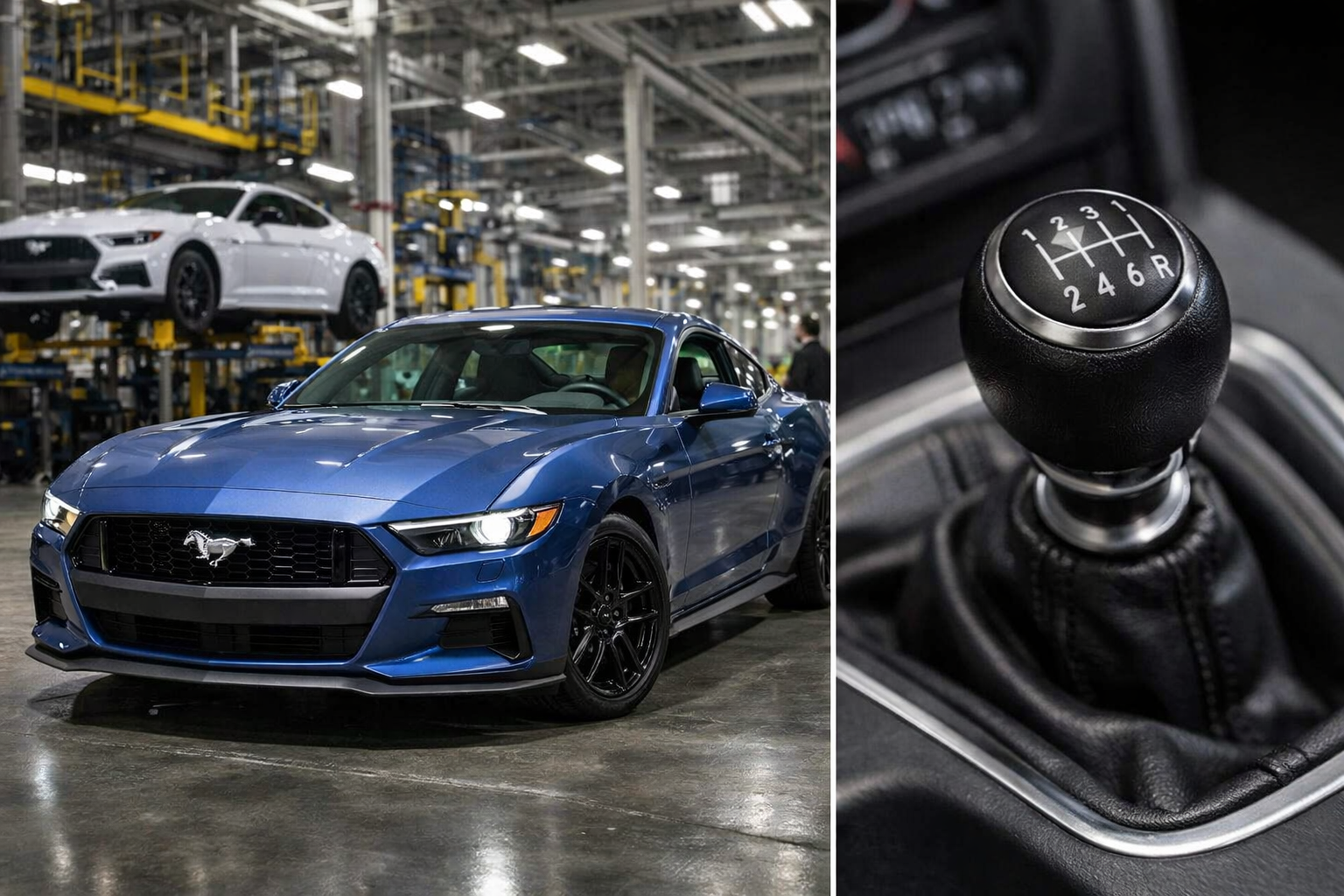
Ford is keeping the manual Mustang alive for the 2026 model year, even as most of the industry phases out three-pedal performance cars. CEO Jim Farley reaffirmed the commitment during a March 18, 2026 investor appearance, calling the manual “core to Mustang’s DNA” and confirming it will remain available on the V8-powered GT and Dark Horse.
That might sound like nostalgia marketing. However, in a market where manual transmissions account for less than 2% of U.S. light-vehicle sales, according to industry data cited by Reuters, Ford’s decision is increasingly rare. The question isn’t just whether enthusiasts cheer — it’s why Ford sees strategic value in bucking the automatic-only trend.
The Headlines
- What: Ford confirms the Mustang will continue offering a manual transmission for 2026
- Who: Ford Motor Company, CEO Jim Farley
- When: Announcement made March 18, 2026; applies to 2026 model year
- Impact: Mustang remains one of the last V8, rear-wheel-drive cars with a manual option
- Key Number: <2% — Estimated share of U.S. vehicles sold with manual transmissions
What Happened
During a fireside chat covered by Reuters and echoed in Ford’s newsroom, Farley pushed back on the idea that electrification means abandoning enthusiast hardware. He confirmed that the 2026 Mustang GT and 500-horsepower Dark Horse will continue offering a six-speed manual alongside the 10-speed automatic.
“There are still customers who want to row their own gears,” Farley said. “As long as they show up, we’ll build it.”
Notably, Ford engineers updated rev-matching software and clutch calibration for 2025, and those refinements carry into 2026. The manual is paired exclusively with the 5.0-liter Coyote V8, which remains one of the few naturally aspirated V8s left in a mainstream sports coupe.
According to Ford sales data, Mustang moved 48,605 units in the U.S. in 2025, up modestly year-over-year despite broader coupe declines. While Ford does not break out manual take rates publicly, analysts estimate between 20% and 25% of GT buyers still choose the stick — dramatically higher than the industry average.
Why It Matters
The manual Mustang matters because it signals Ford sees emotional engagement as a business strategy, not just a hobby. In contrast, Chevrolet ended the Camaro after 2024, and Dodge transitioned its Charger to a new platform that initially launched without a V8. Meanwhile, many performance trims across the industry have gone automatic-only to meet emissions, efficiency, and cost targets.
Furthermore, manuals are typically cheaper to engineer and lighter than complex dual-clutch automatics. However, they complicate emissions certification and advanced driver-assistance integration. The EPA testing cycle often yields slightly worse fuel economy for manuals, which can hurt fleet averages.
Therefore, keeping a manual transmission future alive is less about volume and more about brand equity. Mustang is Ford’s halo car globally. Even buyers who choose an F-150 or Explorer associate Ford with performance credibility — something the company needs as it balances EV investments and cost pressures.
The Bigger Picture
The industry has been steadily walking away from manuals for a decade. According to data reported by Bloomberg, more than 30% of U.S. vehicles offered a manual option in the early 2000s; today it’s closer to a dozen nameplates. Additionally, the rise of EVs — which don’t use traditional multi-speed gearboxes — makes the manual transmission future even narrower.
At the same time, Ford is navigating regulatory and pricing headwinds. Trade tensions and parts sourcing challenges have raised cost concerns, as we’ve detailed in our Auto Tariffs Buying Guide: Save on Car Prices 2026. Performance cars, with lower production volumes, feel those pressures more acutely.
However, there’s a contrarian angle: niche can be profitable. Porsche reports that roughly 40% of 911 GT3 buyers in the U.S. opt for a manual, according to company statements. Low volume plus high margins can justify keeping enthusiast configurations alive — especially when they strengthen brand loyalty.
What the Competition Is Doing
Chevrolet’s Camaro exit leaves the Mustang largely unchallenged among affordable V8 coupes. Although GM has not ruled out a future Camaro revival, no timeline exists as of March 2026. Meanwhile, Dodge’s new Charger lineup emphasizes electrified performance, and its six-cylinder Hurricane engine replaces the outgoing HEMI V8 in most trims.
Toyota and Subaru continue offering manual options in the GR86 and BRZ, but those cars compete at a lower power and price tier. BMW still provides manuals in select M2 and M3 variants, though take rates remain modest globally.
In contrast, many mainstream brands have abandoned manuals entirely. Hyundai, Volkswagen, and even Honda have narrowed stick-shift availability to a handful of trims. The competitive landscape effectively positions the manual Mustang as one of the last accessible, high-horsepower rear-wheel-drive experiences under $50,000.
Interestingly, Ford’s broader portfolio shows a willingness to zig while others zag. February sales data highlighted in our Ford February sales: Bronco bucks the SUV slump report show the company leaning into enthusiast-driven products. Mustang fits that same playbook.
What It Means for You
If you’re an enthusiast, the message is simple: you still have time. The 2026 Mustang GT with a manual starts in the mid-$40,000 range, according to Ford’s configurator, undercutting many European rivals by tens of thousands. However, rising interest rates mean financing costs matter more than ever — our Get Best Car Loan Interest Rates 2026 Today guide can help you navigate that.
Additionally, resale values for manual performance cars have strengthened as supply dwindles. Limited availability often boosts long-term desirability. That said, manuals require more driver engagement in traffic and may be harder to resell to casual buyers.
Therefore, if you want a V8 coupe with three pedals, waiting for a future redesign is risky. Regulatory shifts or emissions tightening could change the equation quickly, especially if fleet-average rules tighten again.
What to Watch Next
Watch Ford’s 2026 order bank and production mix. If manual take rates fall sharply, the business case weakens. Additionally, keep an eye on federal emissions policy and potential updates from the NHTSA that could affect certification or safety integration.
Moreover, Farley’s broader strategy will matter. Ford continues investing billions in electrification while protecting profitable nameplates. How long the manual Mustang survives depends less on sentiment and more on margins.
The Upside
- Keeps enthusiast engagement alive in an increasingly automated market
- Strengthens Mustang’s brand identity and halo effect
- Potentially stronger resale values due to rarity
- Differentiates Ford from rivals exiting the segment
The Concerns
- Low overall manual demand could erode business case
- Regulatory pressures may tighten emissions compliance
- Higher financing costs reduce discretionary sports car sales
- Long-term shift to EVs limits manual transmission future viability
Having covered three Mustang generations, I’ve seen this pattern before: every few years, someone predicts the end of the stick shift. Yet the manual Mustang persists because it represents more than a gearbox — it’s a statement about what Ford wants the brand to stand for.
The broader market will keep moving toward electrification and automation. However, as long as buyers keep ordering the manual Mustang in meaningful numbers, Ford has little incentive to walk away. In a sea of sameness, sometimes rowing your own gears is the ultimate differentiator.
Disclosure: This article may contain affiliate links. If you make a purchase through these links, we may earn a small commission at no extra cost to you. This helps support RevvedUpCars.com. Learn more.