
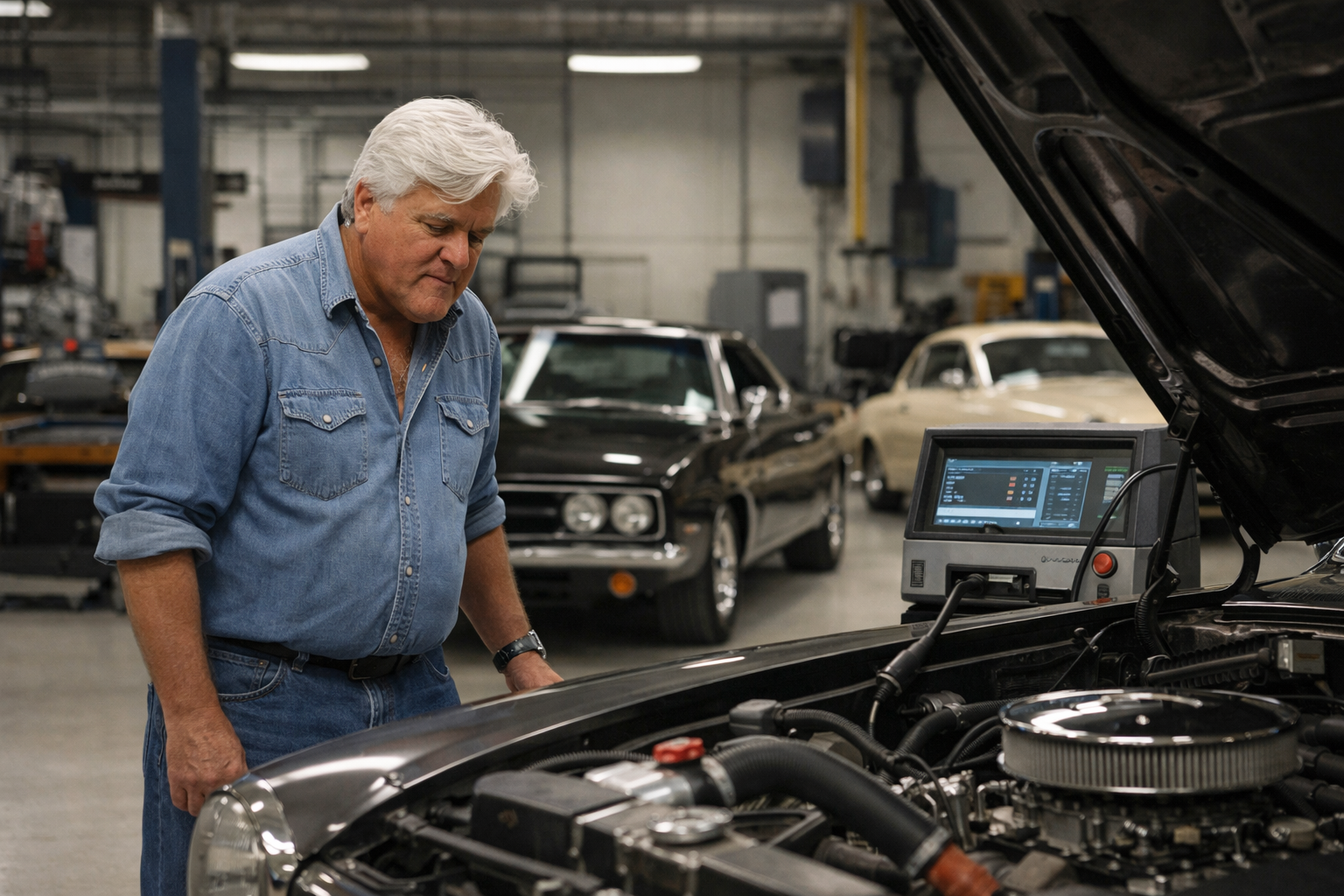
California lawmakers have revived Leno’s Law 2026, a proposal that would significantly expand the state’s classic car emissions exemption under California emissions bill 1392. The measure, reintroduced in Sacramento this week with public backing from comedian and collector Jay Leno, would allow vehicles 35 model years and older to qualify for rolling smog-check exemptions rather than the current fixed 1975 cutoff.
The April 9, 2026 committee hearing marks the third serious attempt in a decade to loosen California’s strict classic car emissions rules. However, this version arrives at a politically delicate moment: the state is simultaneously tightening zero-emission vehicle (ZEV) mandates and defending its Clean Air Act waiver authority with the EPA, according to EPA.gov. Whether lawmakers see this as a symbolic nod to enthusiasts or a regulatory contradiction will determine its fate.
The Headlines
- What: Proposed expansion of California’s rolling emissions exemption for classic cars
- Who: California Legislature, backed by Jay Leno and collector groups
- When: Committee hearing held April 9, 2026
- Impact: Could exempt thousands of pre-1991 vehicles from biennial smog checks
- Key Number: 35 years — new rolling eligibility threshold
What Happened
California emissions bill 1392 would update the state’s classic car emissions exemption to cover vehicles that are at least 35 years old and insured as collector cars. Under current law, only 1975 model-year and older vehicles are fully exempt from smog testing, a cutoff that has not moved in nearly 50 years.
Supporters argue the existing rule is outdated. According to bill sponsors, fewer than 1% of vehicles registered in California would qualify under the rolling exemption, and most are driven fewer than 2,000 miles annually. Jay Leno testified that the measure “protects automotive heritage without meaningfully impacting air quality.”
However, environmental groups counter that even limited-use vehicles can emit disproportionately high pollutants. The California Air Resources Board has historically opposed blanket exemptions, noting that pre-OBD-II vehicles lack modern emissions diagnostics and controls.
Notably, the bill includes guardrails absent from prior attempts: vehicles must carry collector insurance, cannot be used as daily transportation, and must pass a one-time compliance inspection before qualifying. Lawmakers estimate roughly 150,000 vehicles statewide could eventually become eligible.
Why It Matters
At first glance, this looks like niche legislation for hobbyists. In reality, Leno’s Law 2026 touches on a bigger debate about how California balances aggressive climate policy with automotive culture.
California accounts for about 11% of U.S. auto sales and effectively sets emissions policy for 17 other states that follow its standards. According to the EPA, transportation contributes roughly 40% of the state’s greenhouse gas emissions. Therefore, even symbolic rollbacks attract national scrutiny.
However, the measurable environmental impact may be modest. Pre-1991 vehicles represent a fraction of the 30 million-plus vehicles registered in California. In contrast, the state’s Advanced Clean Cars II rule requires 100% of new vehicle sales to be zero-emission by 2035 — a far larger lever.
There’s also an economic angle. Specialty insurers, restoration shops, and aftermarket suppliers argue that regulatory certainty supports small businesses. As new car affordability tightens — see our analysis on why new car prices in 2026 may rise again — more enthusiasts are investing in older vehicles instead of new ones.
The Bigger Picture
California’s emissions framework dates back to its unique Clean Air Act waiver, granted in 1970 and periodically reaffirmed by the EPA. That authority allows the state to set stricter standards than federal rules, a power frequently challenged in court and reshaped by changing administrations.
Historically, the fixed 1975 exemption was a political compromise. However, as 1980s and early-1990s cars gain collector status — think early Mazda Miatas, Fox-body Mustangs, and air-cooled Porsches — pressure has grown to modernize the threshold.
Meanwhile, the broader industry is navigating economic headwinds. U.S. auto sales are projected to dip 2.6% in 2026, according to our coverage of the latest sales forecast. In that context, lawmakers may see limited classic exemptions as politically easier than broader regulatory reforms.
Yet there’s a contrarian risk: granting carve-outs, even small ones, could complicate California’s legal defense of strict emissions standards. Opponents may argue that exemptions undermine claims of regulatory necessity.
What the Competition Is Doing
Texas and Florida already offer more lenient inspection regimes for classic vehicles, often exempting cars older than 25 years from emissions testing. Consequently, some California collectors register vehicles out of state, a gray area that Sacramento would prefer to limit.
At the manufacturer level, automakers like Ford, General Motors, and Stellantis have leaned into heritage branding — from continuation models to factory-backed restorations — while investing billions in EVs. GM alone has pledged $35 billion toward EV and autonomous development through mid-decade, according to company filings reported by Reuters.
In contrast, European regulators continue tightening urban emissions zones, with cities like Paris and London expanding low-emission restrictions. That makes California’s debate unusual: it’s one of the few zero-emission leaders simultaneously considering broader classic exemptions.
Notably, specialty automakers and high-end collectors — including those navigating valuations like in our look at the Koenigsegg IPO and the hypercar market — are watching closely. Regulatory treatment influences long-term asset values.
What It Means for You
If you own a 1980s or early-1990s vehicle in California, this bill could eliminate biennial smog checks once your car hits the 35-year mark. That saves time and potentially hundreds of dollars in repairs needed solely to pass inspection.
However, daily drivers won’t benefit. The collector insurance requirement effectively limits eligibility to hobby use. Therefore, if you rely on a 1992 pickup for commuting, don’t expect relief.
For buyers considering a future classic, Leno’s Law 2026 could influence purchasing decisions. Regulatory stability tends to support resale values, particularly for analog-era cars increasingly viewed as cultural artifacts.
What to Watch Next
The bill now moves to the Assembly Appropriations Committee, where fiscal impact — including administrative costs — will be scrutinized. Additionally, expect formal opposition testimony from environmental groups and possible amendments narrowing eligibility.
Meanwhile, the EPA’s posture toward California’s broader emissions authority will shape the political calculus. If federal-state tensions escalate, even small exemptions could become bargaining chips.
The Upside
- Provides regulatory certainty for classic car owners
- Supports restoration shops and specialty insurers
- Minimal projected impact on statewide emissions totals
- Reduces out-of-state registration workarounds
The Concerns
- Potentially weakens California’s legal emissions stance
- Opposition from environmental advocacy groups
- Administrative oversight challenges
- Risk of incremental erosion of strict standards
Having covered multiple iterations of this debate, I can tell you the pattern is familiar: strong grassroots enthusiasm meets institutional environmental caution. The difference in 2026 is timing. With EV mandates accelerating and affordability pressures mounting, lawmakers may see limited flexibility as politically savvy.
Ultimately, Leno’s Law 2026 won’t change the trajectory toward electrification. However, it will signal whether California believes there’s room for automotive nostalgia in a zero-emission future — or whether the regulatory line remains firmly drawn in 1975.
Disclosure: This article may contain affiliate links. If you make a purchase through these links, we may earn a small commission at no extra cost to you. This helps support RevvedUpCars.com. Learn more.