
You’re not crazy for thinking new cars have lost the plot. When a perfectly ordinary 2026 Toyota RAV4 Hybrid starts around $32,000 and a Honda CR-V can sniff $40K with options, deciding whether to buy new car 2026 feels less like shopping and more like hostage negotiation.
This matters right now because depreciation hasn’t gone back to its old, predictable self, interest rates are still doing their annoying yo-yo act, and automakers are stuffing cars with subscription features nobody asked for. I’ve driven dozens of 2025 and 2026 models this year, and here’s the uncomfortable truth: some new cars are still brilliant value, and others should be left on the dealer lot to gather dust.
So grab a pint and let’s talk honestly about how to decide if a new car is actually worth your money in 2026, or if you’re better off buying lightly used and spending the savings on tires, road trips, or therapy.
Why Buying New in 2026 Is So Complicated
The old rule was simple: new cars depreciate like dropped iPhones. In 2026, that rule is wobblier than a Tesla yoke on a pothole-ridden road. Some models, like the Toyota Prius or Mazda CX-5, still drop 20–25% in the first year, while others barely flinch.
Add to that average transaction prices hovering around $47,000 and loan terms stretching to a frankly absurd 84 months, and suddenly car affordability becomes a real concern. If you want a deeper dive on lowering monthly pain, our guide on smart strategies to lower your car payment is essential reading.
Step One: Decide Why You Want to Buy New Car 2026
If your answer is “because it smells nice,” stop reading and buy an air freshener. Buying new only makes sense if you value full warranty coverage, the latest safety tech, or a powertrain you can’t get used, like Toyota’s newest hybrid systems or GM’s Ultium-based EVs.
I’ll say something controversial: for most people, buying new for reliability alone is outdated thinking. A 2-year-old Lexus RX or Mazda3 with 15,000 miles is still going to outlast your enthusiasm for washing it.
Depreciation: The Silent Wallet Assassin
Here’s a hard number reality check. A 2026 BMW X3 starting around $49,000 can lose $10,000 in value within 24 months, while a Subaru Outback starting near $31,000 might lose half that. That difference alone can pay for fuel, insurance, and a decent set of Michelin Pilot Sport 4s.
Want proof that emotional cars don’t always hold value? Look at what’s happening with luxury coupes as discussed in the end of the Lexus LC. Gorgeous, soulful, and still a depreciation grenade.
Interest Rates Can Make or Break the Deal
Even a “good” 5.5% APR on a $45,000 loan over 60 months means you’re handing the bank roughly $6,600 in interest. Stretch that to 72 months, and congratulations, you just paid luxury-watch money for the privilege of borrowing.
Manufacturers sometimes save the day with subsidized rates, like 1.9% offers on outgoing models. Always check the manufacturer’s website for current incentives before assuming the dealer is your friend.
New Tech: Brilliant or Future Headache?
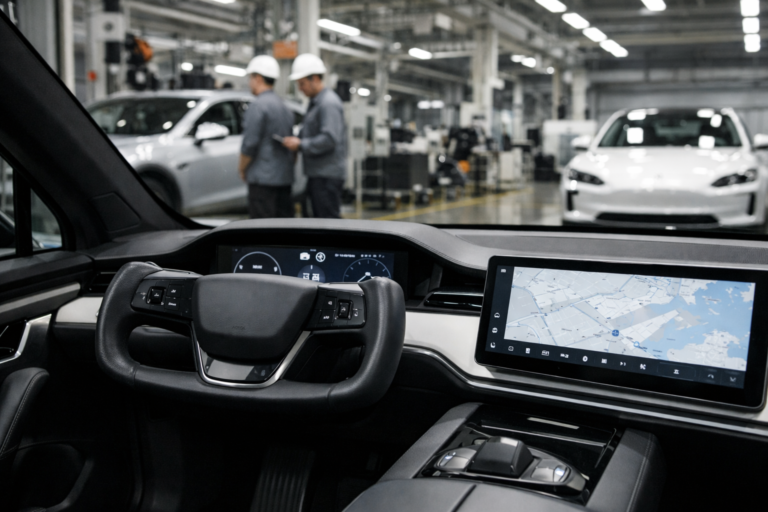
Modern cars are rolling smartphones with cupholders. Big screens, over-the-air updates, and semi-autonomous driving can be fantastic, but they also age faster than a YouTube intro sequence.
I love a good digital dash, but I’ll die on this hill: physical climate buttons are superior. Cars like the Mazda CX-50 and Volkswagen Golf GTI still get this right, while others bury basic functions in menus lazier than a cat in a sunbeam.
Safety and Efficiency: Where New Cars Still Win
This is where new cars genuinely earn their keep. Automatic emergency braking, lane-keeping assist, and adaptive cruise control are now standard on many 2026 models, and they work. According to NHTSA, these systems meaningfully reduce rear-end collisions.
Fuel economy has also improved. A 2026 Honda Accord Hybrid delivers approximately 48 mpg combined, while something like a Toyota Corolla Hybrid can touch 50 mpg. For official efficiency numbers, FuelEconomy.gov is your best friend.
When Buying New Actually Makes Sense
You should seriously consider buying new if you plan to keep the car 8–10 years, drive over 15,000 miles annually, or want a specific configuration that’s unicorn-rare used. Trucks like the 2026 Chevy Silverado, crossovers like the Honda CR-V Hybrid, and mainstream sedans like the Toyota Camry Hybrid fit this bill.
This logic also applies if you’re eyeing cutting-edge tech. We’re seeing big transitions, similar to what’s discussed in Tesla’s shifting flagship strategy, where buying new gets you the latest hardware revisions.
When You Absolutely Shouldn’t Buy New
If you swap cars every three years, buying new is financial self-sabotage. Lease instead, or buy certified pre-owned and let someone else take the initial depreciation punch.
Another hot take: luxury brands are the worst new-car buys unless heavily discounted. A 2026 Mercedes GLC, BMW X3, or Audi Q5 is brilliant to drive, but brutal on resale unless you keep it long enough to forget what you paid.
How to Decide If You Should Buy New Car 2026: A Quick Checklist
Ask yourself four questions. Can you afford the payment on a 60-month loan without stress? Will you keep it long enough to justify depreciation? Does the new tech genuinely improve your daily drive? And finally, is there a lightly used alternative that does 90% of the job for 75% of the money?
If you answer honestly, the decision usually becomes obvious. If it doesn’t, walk away and sleep on it. Dealers hate that, which is usually a good sign.
Pros
- Full warranty and peace of mind
- Latest safety and efficiency tech
- Better financing and incentive options
- No mystery history or previous abuse
Cons
- Immediate depreciation hit
- Higher purchase prices than ever
- Tech can age quickly or become obsolete
Here’s the bottom line. To buy new car 2026 isn’t madness, but it does require brutal honesty about your finances and your habits. Choose wisely, negotiate hard, and remember: the best car isn’t the newest one, it’s the one that makes you smile every time you turn the key without ruining your bank balance.