
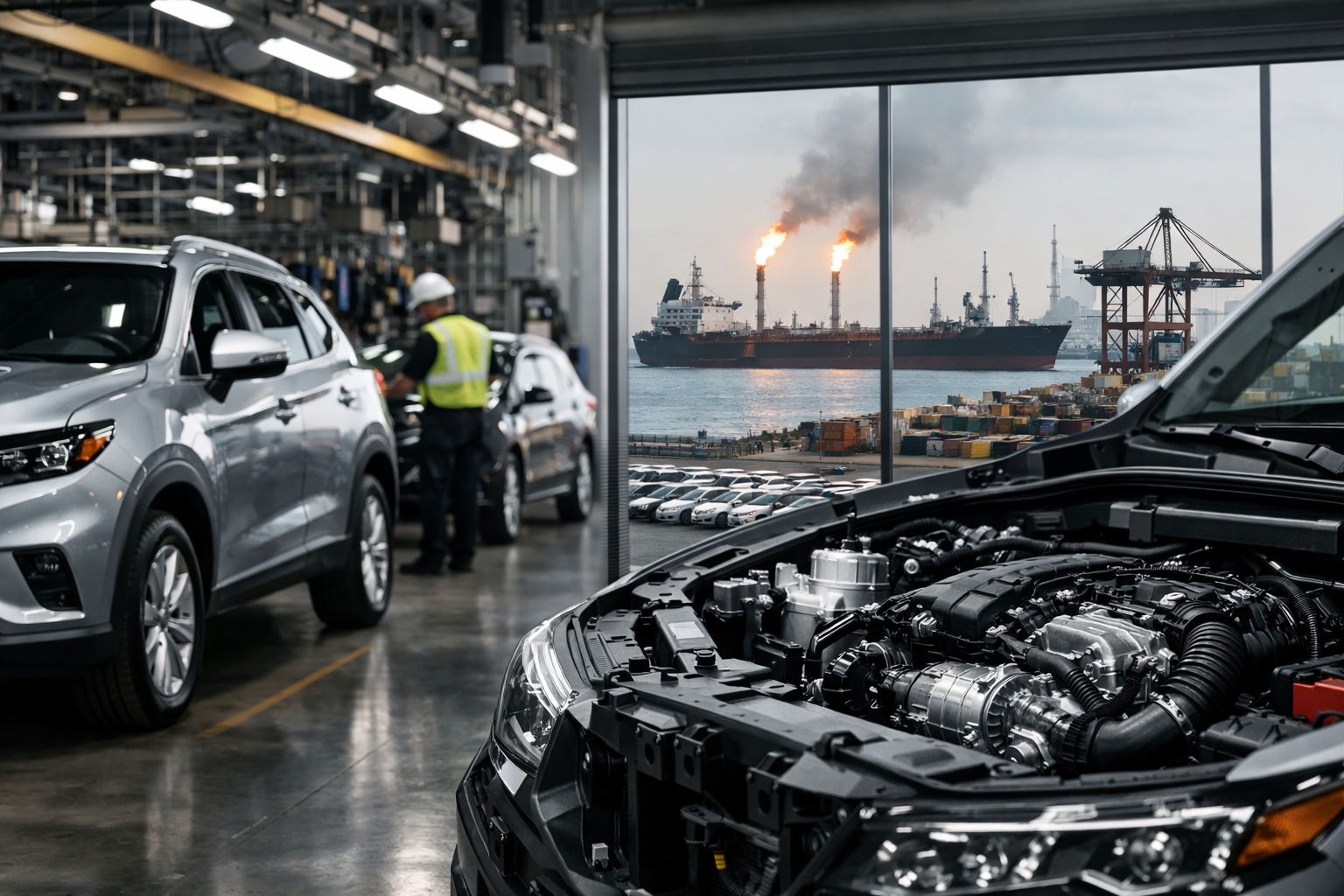
Oil markets jolted higher this week as renewed military strikes between Iran and U.S.-allied forces in the Persian Gulf raised fears of supply disruptions, pushing Brent crude above $98 per barrel on March 14, 2026, according to Reuters. The immediate question for drivers and automakers is clear: what does the Iran conflict auto industry impact look like this time around?
Context matters. The auto industry has spent the past three years navigating pandemic shortages, semiconductor bottlenecks, and tariff uncertainty. However, energy shocks hit differently. Fuel prices, plastics costs, shipping rates, and even battery materials all trace back to oil and gas markets. If crude stays near $100 — or climbs higher — car prices and buying decisions could shift again in 2026.
The Headlines
- What: Escalating Iran conflict pushes global oil prices sharply higher
- Who: Iran, U.S. allies, global oil markets, automakers worldwide
- When: Crude spike recorded March 14–15, 2026
- Impact: Higher fuel and production costs could pressure vehicle prices and shift demand toward hybrids and EVs
- Key Number: Brent crude near $98 per barrel, up roughly 18% month-over-month
What Happened
Fighting near key shipping lanes in the Strait of Hormuz intensified in mid-March, raising concerns about potential disruptions to roughly 20% of global oil flows that transit the corridor, according to the U.S. Energy Information Administration (EIA). Although no sustained supply cutoff has been confirmed, traders priced in geopolitical risk almost immediately.
As a result, U.S. gasoline futures climbed more than 12% week-over-week. Analysts at Goldman Sachs, cited by Bloomberg, warned that a prolonged disruption could push crude above $110 per barrel. However, OPEC has not yet announced formal output adjustments.
For automakers, the ripple effects are both direct and indirect. Oil isn’t just fuel — it’s a feedstock for plastics, synthetic rubber, and logistics. Furthermore, global supply chain automotive costs rise when shipping insurers add war-risk premiums to vessels crossing the region. Even if factories remain fully operational, input costs can move quickly.
Why It Matters
The Iran conflict auto industry impact hinges on duration. A short-lived spike may barely register beyond higher pump prices. However, sustained $100-plus oil historically shifts consumer behavior within one to two quarters. We saw this in 2008 and again after Russia’s invasion of Ukraine in 2022.
Higher gasoline prices tend to accelerate hybrid and EV demand. The International Energy Agency noted in prior oil shocks that EV sales correlate strongly with fuel price volatility. In early 2026, EV adoption was already climbing in Europe — nearly 20% market share in January, per our coverage of Europe EV sales surge. A fuel shock could reinforce that trajectory globally.
However, there’s a counterforce. Rising oil can also increase battery production costs because mining, processing, and shipping lithium, nickel, and cobalt are energy-intensive. Therefore, EV sticker prices don’t automatically fall relative to gas cars. The press narrative often oversimplifies this dynamic.
The Bigger Picture
This isn’t the industry’s first geopolitical energy scare. In fact, having covered three product cycles, I’ve seen how automakers respond: they accelerate efficiency messaging, prioritize hybrid production, and quietly adjust incentive budgets.
Additionally, the global supply chain automotive network is more diversified than it was a decade ago. North American battery plants backed by the Inflation Reduction Act — detailed by the U.S. Department of Energy (Energy.gov) — reduce reliance on overseas shipping for some EV components. That insulation matters if maritime insurance and freight rates spike.
Meanwhile, policy uncertainty compounds the picture. Tariff debates remain active in Washington, as we’ve reported in Auto Tariffs Impact: Will Carmakers Raise Prices?. Layer higher oil costs onto potential import duties, and manufacturers face a margin squeeze. Historically, they pass at least part of that through to consumers.
What the Competition Is Doing
Toyota, the hybrid leader with more than 3 million electrified vehicles sold globally in 2025 according to company filings, is well positioned. Its Prius, RAV4 Hybrid, and Corolla Hybrid lines benefit immediately when fuel prices climb. Additionally, plug-in models like the RAV4 PHEV offer flexibility for buyers hedging against gas volatility.
Ford, by contrast, still derives significant North American profits from trucks and large SUVs. February sales showed the Bronco outperforming broader segments, as we noted in Ford February sales: Bronco bucks the SUV slump. However, if gasoline averages above $4 per gallon nationally — a level AAA says often dampens full-size SUV demand — Ford may lean harder on its hybrid F-150 and Maverick variants.
Meanwhile, Tesla and BYD operate in a different lane. Higher fuel prices generally boost EV showroom traffic. Yet both companies are already engaged in pricing pressure, particularly in Europe and China. Tesla’s recent UK sales dip relative to BYD underscores how competitive the EV market has become. Oil alone won’t guarantee market share gains.
In contrast, smaller automakers with limited hybrid portfolios — including some premium European brands — could feel squeezed if consumers pivot rapidly toward efficiency.
What It Means for You
If you’re shopping in spring 2026, the immediate effect will be at the pump, not the dealership. Vehicle MSRPs don’t change overnight. However, incentives can. Automakers may reduce discounts on high-demand hybrids if traffic surges.
Therefore, buyers considering efficient models should compare total ownership costs carefully. Our guide to Hybrid vs Electric 2026: Cost & Range Guide breaks down where each makes financial sense under different fuel-price scenarios.
Conversely, if oil retreats below $85 per barrel within weeks, the broader Iran conflict auto industry impact may prove muted. Short spikes tend to influence sentiment more than long-term pricing.
What to Watch Next
First, monitor whether physical oil supply is actually disrupted or if markets are reacting primarily to risk premiums. Confirmed shipping slowdowns in the Strait of Hormuz would escalate cost pressures quickly.
Second, watch OPEC’s next formal meeting and any emergency production statements. Additionally, keep an eye on U.S. Strategic Petroleum Reserve policy; coordinated releases helped stabilize prices in 2022.
Third, track automaker incentive data in April and May. A sudden tightening on hybrids would signal that demand is shifting faster than production plans anticipated.
The Upside
- Accelerates consumer interest in fuel-efficient hybrids and EVs
- Strengthens business case for domestic battery and parts production
- May spur innovation in lightweight materials and efficiency tech
- Encourages long-term diversification of global supply chains
The Concerns
- Potential rise in vehicle production and shipping costs
- Higher gasoline prices strain household budgets
- Margin pressure could reduce discounts and incentives
- Geopolitical instability adds volatility to planning and investment
The auto industry has become more resilient since the last major oil shock, but it remains deeply exposed to energy markets. The Iran conflict auto industry impact will ultimately depend on duration, not headlines. If tensions cool quickly, 2026 pricing may barely budge. However, if crude climbs into triple digits for months, expect a noticeable pivot toward hybrids, tighter incentives, and subtle price creep by year’s end.
Having watched this pattern repeat, I’d say this: geopolitics rarely change the car you can buy tomorrow — but they often shape the one automakers choose to build next.
Disclosure: This article may contain affiliate links. If you make a purchase through these links, we may earn a small commission at no extra cost to you. This helps support RevvedUpCars.com. Learn more.