
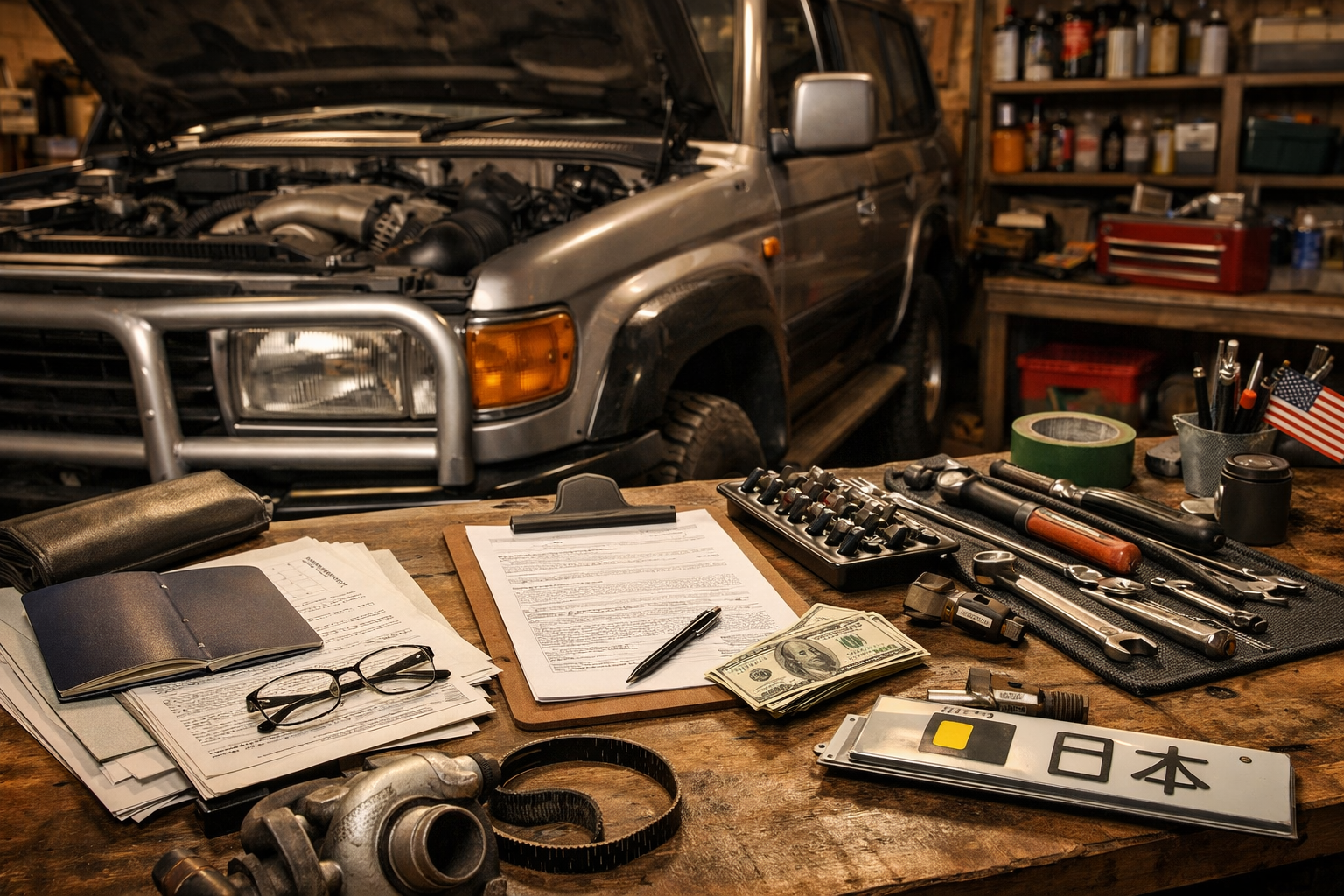
That dream of owning a right-hand-drive 80 Series diesel is strong… until you try to import JDM Land Cruiser models and drown in paperwork. I’ve watched guys spend $30,000 on the truck and then get blindsided by another $8,000 in fees, storage, and “oops” mistakes at the port. It’s doable — and totally worth it — but only if you understand the rules before the boat leaves Japan.
This guide walks you through the 25 year rule, the Japanese import process, real 2025–2026 costs, and the pitfalls that can turn your classic SUV importing dream into a financial headache. Think of me as your shop buddy who’s already seen what happens when this goes sideways.
What You’ll Need
- Tools: Scanner/printer, document folder, OBD2 scanner (for post-arrival checks), basic metric socket set (10mm–19mm), battery charger
- Parts/Materials: Shipping insurance ($150–$300), customs bond ($100–$200), potential maintenance parts ($300–$1,000)
- Time: 6–12 weeks shipping; 1–2 full days for DMV + inspections
- Difficulty: 🔧🔧🔧 (paperwork heavy, mechanically moderate)
- Dealer Cost: Import broker package $3,000–$5,000 vs DIY Cost: $800–$1,500 — You Save: $2,000+
Why This Matters
The biggest reason people import JDM Land Cruiser rigs? You get bulletproof diesel engines, solid axles, and trim levels we never saw in the States. A clean 1996–2000 70 or 80 Series diesel can run $18,000–$35,000 landed — still cheaper than many new SUVs pushing $50K.
But skip one form or misunderstand the 25 year rule, and U.S. Customs can seize the vehicle. I’m not being dramatic — I’ve seen it happen. Check the official NHTSA import guidelines before money changes hands.
The 25 year rule means the vehicle must be at least 25 years old from its build date to be exempt from U.S. DOT and EPA compliance. In 2026, that means 2001 models are just becoming eligible. Anything newer? Don’t even try unless you enjoy legal bills.
Before You Start
⚠️ WARNING: Never wire money directly to a private seller overseas without verified export documentation. Use a reputable exporter or escrow service.
Before bidding at auction, confirm:
- Exact production month (not just model year)
- No active recalls via NHTSA recall lookup once stateside
- Engine type (1HD-FT, 1HZ, etc.) — parts availability varies
Know that some states (California especially) have stricter emissions rules. Check EPA import exemptions at EPA.gov before committing.
If you’re not comfortable handling customs forms (HS-7, EPA 3520-1), a broker may be worth the $800–$1,200 fee. That’s still cheaper than storage fees at port — which can hit $200 per day if paperwork’s wrong.
Step-by-Step Guide
-
Verify Eligibility Under the 25 Year Rule
Confirm build date from chassis plate or export certificate. Count 25 years from month/year — not just model year. -
Choose a Reputable Exporter
Expect auction fee ($800–$1,200) and exporter fee ($1,000–$2,000). Shipping (RORO) runs $1,500–$2,500 to West Coast ports in 2025 pricing.
Pro Tip: Container shipping costs $3,000–$4,500 but reduces damage risk. -
Budget for Import Costs
U.S. import duty is 2.5% of vehicle value. A $25,000 Land Cruiser = $625 duty. Add customs bond ($150), port fees ($300–$600), and broker if used. -
File Required Paperwork
Submit:- Bill of Lading
- Japanese Export Certificate (translated)
- HS-7 Form (DOT)
- EPA Form 3520-1
-
Pick Up at Port
Bring ID and stamped clearance forms. Inspect for damage immediately.
Pro Tip: Bring a jump pack — I’ve seen batteries drained after 8 weeks on a boat. -
State Title & Registration
Some states require VIN inspection. Budget $300–$800 depending on taxes and fees. -
Baseline Maintenance
Change engine oil (7–10 quarts depending on engine), fuel filter, air filter, and check timing belt history. Parts run $300–$700. Consult factory manual for torque specs.
Once it’s road-ready, think about tires. These rigs deserve proper rubber — check our Off Road Tire Guide before you bolt on bargain mud tires that howl like a bad wheel bearing.
Common Mistakes to Avoid
- Buying too new: I’ve seen guys try to slide in a 23-year-old truck. Customs doesn’t “round up.”
- Ignoring rust: Coastal Japan equals corrosion. Frame rot can turn a $25K SUV into a $10K parts truck.
- Skipping insurance during shipping: $200 insurance beats losing $30K in a storm claim dispute.
- Forgetting parts availability: Some diesel components take weeks to source.
- Not budgeting repairs: Plan $1,000–$2,000 in catch-up maintenance. I’ve never seen an import that needed zero work.
When to Call a Professional
If customs paperwork feels overwhelming, hire a licensed customs broker. Fair rate: $800–$1,200. If someone quotes $4,000 “mandatory processing,” walk away.
Once the truck lands, have a trusted diesel mechanic inspect it if you’re not comfortable. Pre-purchase-style inspections run $150–$300. Ask:
- Is there timing belt documentation?
- Any blow-by from crankcase?
- Frame rust severity?
Red flags? Shops that won’t give written estimates or claim “parts are impossible.” These trucks are mechanical tanks. They’re not Ferraris — though if you want exotic headaches, check out the Ferrari Luce review.
Recommended Products
- NOCO Boost Plus GB40: Compact jump pack — perfect for port pickup ($120)
- BlueDriver OBD2 Scanner: Helpful for later OBD swaps or diagnostics ($100)
- Fluid Film Undercoating: $15 per can — protect against U.S. road salt
- Toyota OEM Filters: Don’t cheap out on diesel filtration ($20–$40 each)
After you import JDM Land Cruiser models, protect them from winter corrosion. Salt eats frames faster than termites in a barn — our road salt protection guide is worth the read.
Do This
- Verify build date twice
- Budget 10–15% extra for surprise costs
- Change all fluids immediately
- Insure during shipping
Don’t Do This
- Assume Customs will “let it slide”
- Skip rust inspection photos
- Cheap out on maintenance
- Forget state-specific registration rules
To import JDM Land Cruiser legends the right way, you need patience more than wrenches. Respect the 25 year rule, follow the Japanese import process step-by-step, and budget realistically. Do that, and you’ll own one of the toughest classic SUV importing icons ever built — without paying dealer-level middleman fees.
You can do this. It’s paperwork-heavy, not rocket science. Got questions about a specific engine or state rules? Drop them in the comments. Stay safe under there, and remember — a $20 repair manual saves a $2,000 repair bill.