
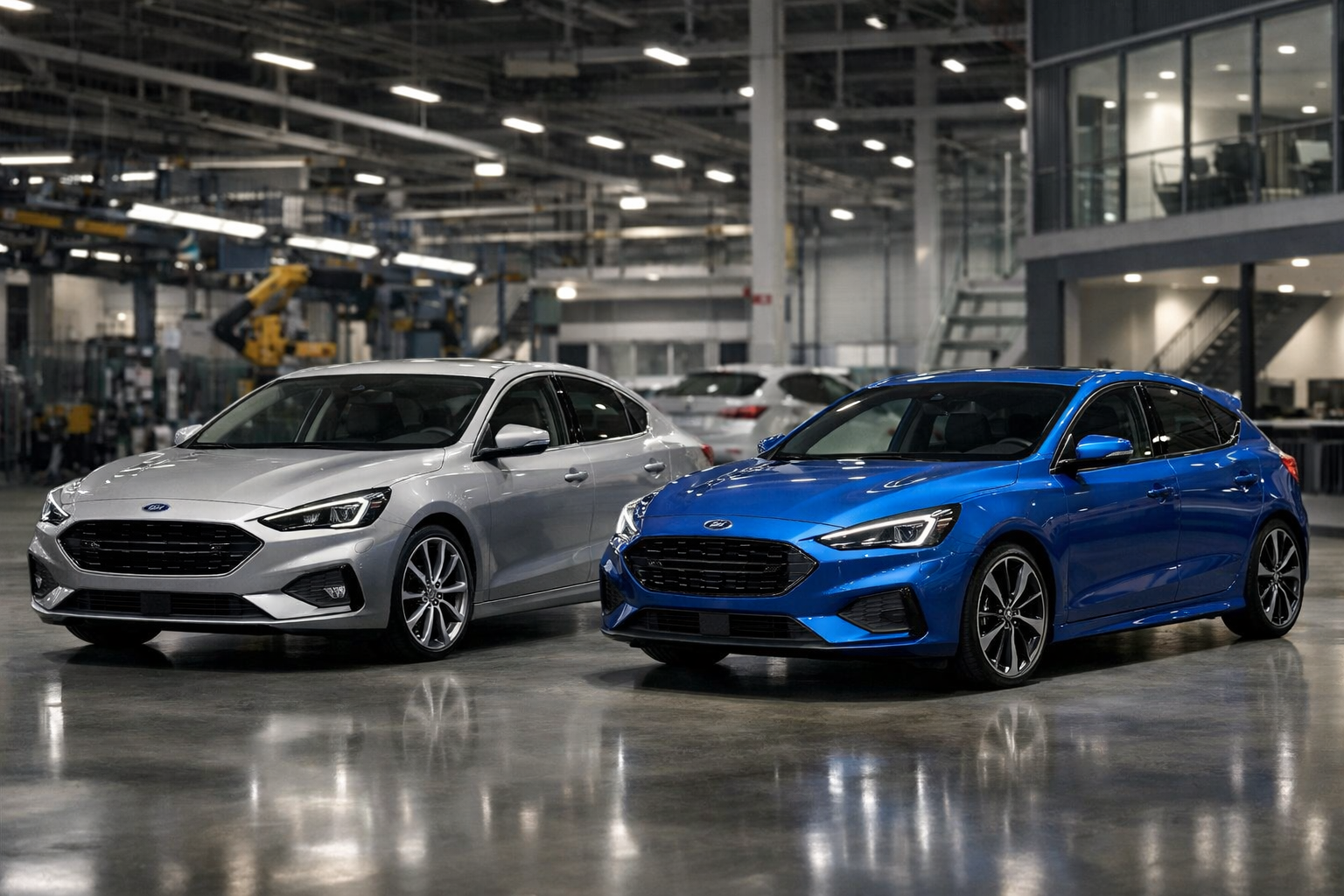
Ford signaled a potential return to traditional passenger cars this week, teasing new sedans and hatchbacks for the region under the banner of Ford Europe sedans during a March 6, 2026 media preview in Cologne. The announcement comes just two years after Ford ended production of the Fiesta and Mondeo, effectively exiting Europe’s mainstream car segments.
That makes this more than a routine product tease. According to company executives, the new models will slot below the Mustang and complement the Puma and Kuga crossovers, suggesting Ford may be reconsidering its SUV-heavy strategy in a European car market that is shifting faster than many expected.
The Headlines
- What: Ford teased new sedans and hatchbacks for Europe after discontinuing most passenger cars
- Who: Ford Motor Company, Ford of Europe
- When: Announcement on March 6, 2026; launches expected 2027–2028
- Impact: Signals potential strategic pivot amid rising EV and Chinese competition in Europe
- Key Number: Nearly 20% of European sales were EVs in January 2026
What Happened
Ford of Europe executives previewed two concept silhouettes—one compact hatchback and one midsize fastback sedan—during a product strategy briefing at its Cologne EV Center. While the company did not confirm names, executives indicated both vehicles would ride on an updated version of the Volkswagen-sourced MEB electric platform currently underpinning the Explorer EV.
According to Ford’s European leadership team, production is targeted for 2027, with final design reveals expected in late 2026. Reuters reported earlier this year that Ford was reassessing its European lineup amid weaker-than-expected EV margins and intensifying price competition from Chinese brands such as BYD and SAIC (Reuters).
Notably, Ford exited the Fiesta in 2023 and the Mondeo in 2022, leaving the Focus as its only traditional car in Europe before confirming its discontinuation for 2025. That move aligned with then-CEO Jim Farley’s profitability push, prioritizing commercial vehicles and higher-margin SUVs. This week’s teaser suggests the pendulum may be swinging back—at least partially.
Why It Matters
The European car market is evolving faster than many automakers anticipated. According to ACEA data and industry reports, battery-electric vehicles accounted for nearly 20% of new car registrations in January 2026, a trend we analyzed in our coverage of the Europe EV sales surge. Meanwhile, total passenger car demand remains soft, with growth concentrated in compact, affordable EVs.
However, SUVs now represent roughly 50% of European registrations, up from about 30% a decade ago, per JATO Dynamics estimates. Ford’s earlier decision to abandon sedans and hatchbacks mirrored that shift. The question now is whether the rise of lower-cost EV platforms—and competition from Chinese automakers—has reopened the business case for smaller passenger cars.
In fact, Chinese brands gained significant share in Europe in 2025 and early 2026, undercutting legacy players on price and equipment. As detailed in our report on Europe car sales 2026: Chinese brands surge, value-focused EV hatchbacks are driving that growth. Ford’s re-entry into this space looks less nostalgic and more defensive.
The Bigger Picture
Ford’s European reset began in 2019, when it announced billions in restructuring charges to stem years of losses. According to company filings, Ford Europe returned to modest profitability by 2023, largely thanks to commercial vehicles like the Transit and higher-margin crossovers.
Meanwhile, regulatory pressure remains intense. The European Union’s CO2 fleet targets tighten again in 2027, with significant fines for non-compliance. The European Commission’s official climate targets are outlined at European Commission climate policy. Smaller, lighter EV sedans and hatchbacks can help balance fleet averages more efficiently than larger SUVs.
However, profitability remains the sticking point. Volkswagen has struggled to generate strong margins on its ID.3 hatchback. Stellantis has leaned heavily on its STLA Small platform to spread costs across Peugeot, Opel, and Fiat. Ford’s ability to leverage VW’s MEB architecture reduces development expense, but it also limits differentiation.
What the Competition Is Doing
Volkswagen continues to double down on compact EV hatchbacks, with the ID.3 and upcoming ID.2 targeting sub-€25,000 price points. Meanwhile, Stellantis is rolling out refreshed Peugeot 308 and Opel Astra EV variants to defend its share in the C-segment.
In contrast, Renault has leaned into retro-inspired EV hatchbacks like the reborn Renault 5, aiming squarely at urban buyers. Chinese players—BYD, MG (owned by SAIC), and Nio—are aggressively pricing their sedans and hatchbacks, often bundling advanced driver-assistance features as standard.
Ford’s earlier withdrawal created space for those rivals. Re-entering now means fighting on price and technology. It also comes as Ford manages other global pressures, from recalls like the Ford Explorer recall affecting 412K SUVs to U.S. regulatory shifts highlighted in our coverage of the EPA emissions repeal. Capital allocation is tighter than it was five years ago.
What It Means for You
If you’re a European buyer who prefers lower ride heights and sharper handling over SUVs, this is encouraging news. Sedans and hatchbacks typically offer better efficiency and lower starting prices than crossovers built on the same platform.
However, don’t expect a budget miracle. Even with shared architecture, battery costs remain the largest expense in EV production. Analysts at BloombergNEF estimate pack prices around $100 per kWh in 2026—improved, but not transformative. Therefore, pricing will likely align with Volkswagen ID.3 levels rather than undercut them dramatically.
For now, buyers should treat this as a 2027–2028 development. If you’re shopping in 2026, your choices remain SUV-heavy in Ford showrooms. That said, increased competition in the European car market could gradually push prices and features in your favor.
What to Watch Next
First, watch for confirmation of production sites and battery sourcing. Localized battery supply will be critical to cost control and regulatory compliance. Additionally, monitor whether Ford positions these as affordable mass-market EVs or as tech-forward halo products.
Equally important is timing. If Ford misses the 2027 CO2 compliance window, the strategic rationale weakens. Finally, pay attention to whether Ford revives legacy nameplates—branding will signal whether this is a true return to Ford passenger cars or an entirely new chapter.
The Upside
- Broader choice beyond SUVs in Ford’s European lineup
- Potentially improved fleet CO2 compliance for Ford
- Competitive pressure on VW, Stellantis, and Renault pricing
- Shared platforms reduce development risk and cost
The Concerns
- Thin margins in compact EV segments
- Intense price competition from Chinese brands
- Platform sharing may limit differentiation
- Launch timing could miss regulatory or market windows
Having covered Ford’s European retrenchment over the past decade, this feels less like nostalgia and more like necessity. The economics of EVs, regulatory pressure, and Chinese competition have shifted the equation.
If Ford Europe sedans move from teaser to production on schedule, they won’t just fill a gap—they’ll test whether traditional passenger cars can thrive again in a market once declared the domain of SUVs. The next 18 months will reveal whether this is a true comeback or simply strategic hedging.
Disclosure: This article may contain affiliate links. If you make a purchase through these links, we may earn a small commission at no extra cost to you. This helps support RevvedUpCars.com. Learn more.