
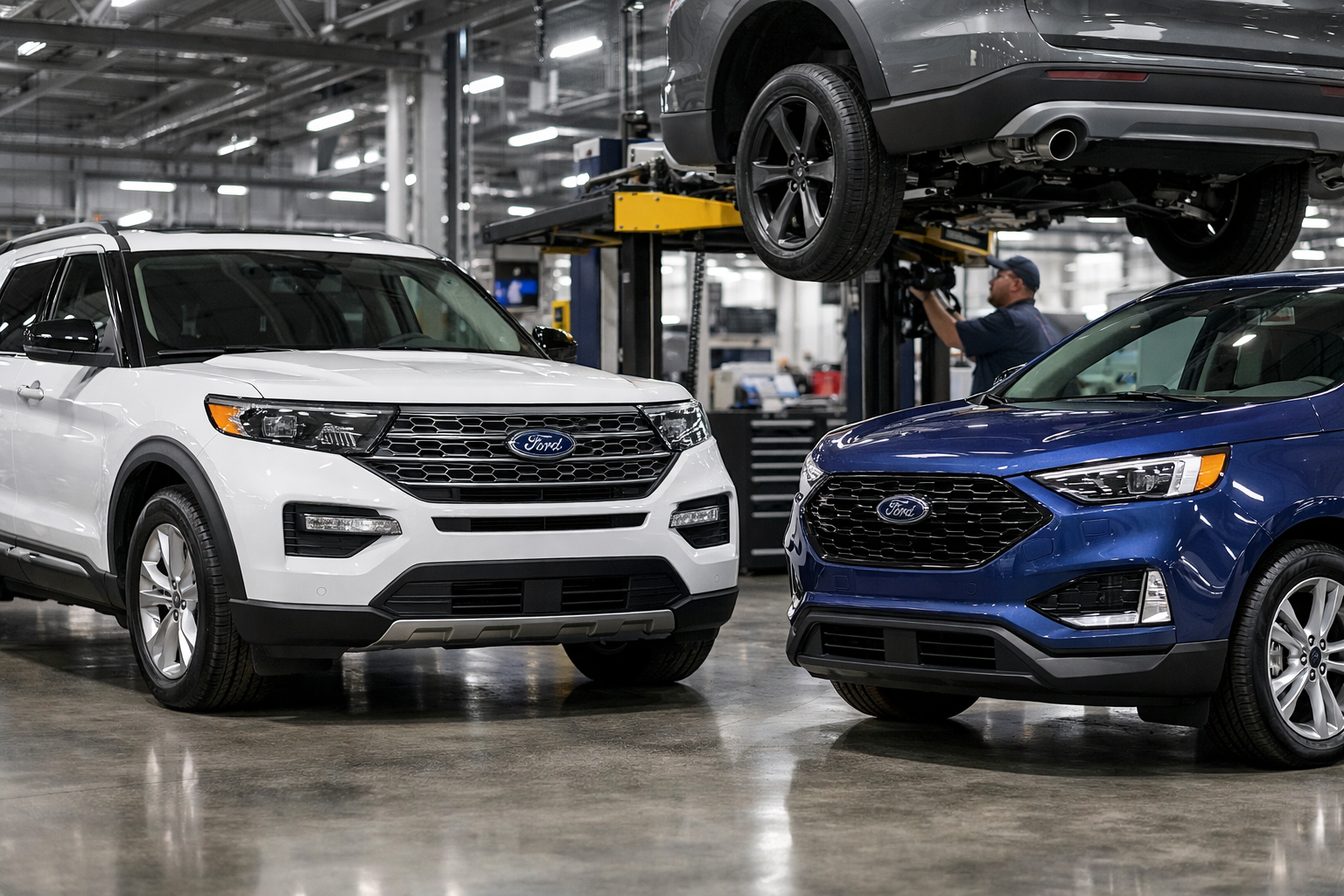
Ford is recalling 412,000 SUVs in the United States over a rear suspension defect that could increase crash risk, according to documents filed with the National Highway Traffic Safety Administration (NHTSA) on March 4, 2026. The Ford Explorer recall covers certain 2025 and 2026 model-year vehicles equipped with a rear toe link that may fracture, potentially causing a loss of steering control.
This is not a minor service campaign. The Explorer is Ford’s best-selling SUV nameplate, with more than 186,000 units sold in the U.S. in 2025, per company sales reports. A recall affecting over 400,000 units touches a significant share of the current fleet and raises fresh questions about supplier quality control as automakers push aggressive production targets.
The Headlines
- What: Recall of 412,000 Ford Explorer SUVs over potential rear toe link fracture
- Who: Ford Motor Company; NHTSA
- When: Announced March 4, 2026; owner notifications begin in April
- Impact: Drivers may experience reduced steering stability; dealers will inspect and replace parts free of charge
- Key Number: 412,000 vehicles affected
What Happened
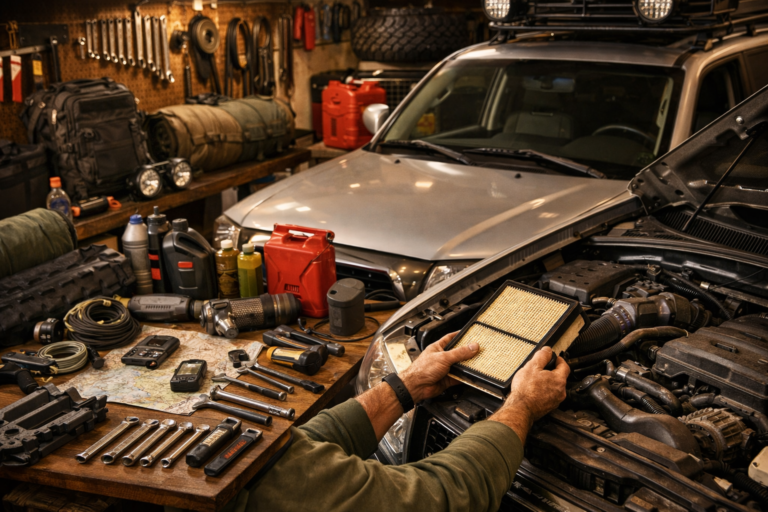
According to Ford’s NHTSA filing, the issue centers on the rear toe link, a suspension component that helps maintain wheel alignment during cornering and uneven road conditions. Reports indicate that certain parts may not meet durability specifications and could fracture under load. If that happens, drivers could hear unusual noises, notice misalignment, or in worst cases experience a sudden change in vehicle handling.
Ford told regulators it is aware of multiple warranty claims and field reports but said it has not confirmed any fatalities related to the defect. The company will instruct dealers to inspect the rear suspension and replace the toe link with an updated component at no cost. Owner notification letters are scheduled to mail beginning April 15, 2026, per the NHTSA recall notice.
In a statement, Ford said it is “committed to the highest levels of safety and quality” and is working with suppliers to address the issue. However, having covered several Ford product cycles, I can tell you suspension-related recalls tend to point to either supplier metallurgy inconsistencies or rushed validation testing during ramp-up.
Why It Matters
The Explorer is central to Ford’s profitability. SUVs and trucks account for roughly 80% of Ford’s U.S. sales mix, according to company filings, and the Explorer competes directly with the Toyota Highlander, Honda Pilot, and Chevrolet Traverse. A large-scale SUV suspension recall affects not just owners but dealer service capacity and brand perception.
Moreover, suspension failures carry higher perceived risk than software glitches or infotainment bugs. While modern buyers have grown accustomed to over-the-air updates, a rear toe link failure is mechanical and visible. That matters in a market where consumer confidence is already sensitive to pricing pressures from tariffs and supply chain volatility, as we outlined in our Auto Tariffs Buying Guide: Save on Car Prices 2026.
Additionally, NHTSA has increased scrutiny of chassis and steering components in recent years, especially after several high-profile investigations across the industry. A formal recall can also trigger civil penalties if regulators determine reporting delays, though there’s no indication of that here.
The Bigger Picture
This isn’t the first time a high-volume SUV has faced a chassis-related recall. Just months ago, Nissan recalled 642,000 Rogues for a separate issue, as we detailed in our coverage of the Nissan Rogue recall: 642,000 SUVs affected. The common thread is production scale: when you’re building hundreds of thousands of units annually, even a 1% defect rate becomes a national headline.
Furthermore, automakers are balancing cost pressures from raw materials and regulatory compliance. Although the EPA’s evolving emissions stance has grabbed headlines—see our breakdown of the EPA Emissions Repeal: What 2026 Buyers Need—quality control investments often compete internally with electrification and software budgets.
Globally, recalls are rising in frequency but not necessarily in severity, according to industry data compiled by Reuters and Bloomberg. The reality: vehicles are more complex, supply chains are more fragmented, and validation cycles are compressed. That combination increases the odds of issues surfacing post-sale.
What the Competition Is Doing
Toyota, which sold over 200,000 Highlanders in North America last year, continues to lean heavily on its reputation for durability. Notably, Toyota’s TNGA platform strategy centralizes component validation across multiple models, reducing part variation risk.
Meanwhile, General Motors has faced its own suspension and steering recalls in recent years but has invested heavily in supplier auditing following ignition switch-era scrutiny. Honda, for its part, has emphasized extended durability testing for the Pilot and CR-V, especially in North American plants.
In contrast, Ford is juggling a broad portfolio refresh—from hybrids to performance trims—while managing cost discipline. The risk is that high recall volume could undermine consumer trust just as rivals tout reliability and long-term ownership costs as selling points.
What It Means for You
If you own a 2025 or 2026 Explorer, check your VIN on NHTSA’s recall lookup tool or wait for Ford’s official notice. Dealers will perform the repair free of charge, and in most cases, the fix should take only a few hours.
However, if you’re shopping for a three-row SUV, this Ford Explorer recall shouldn’t automatically push you elsewhere. Recalls are common across the industry; what matters more is how quickly and transparently the manufacturer responds. Still, buyers prioritizing long-term mechanical reliability may compare warranty coverage and service track records carefully.
Additionally, expect potential short-term service delays as dealerships process affected vehicles. That could mean longer wait times for routine maintenance in high-volume markets.
What to Watch Next
First, monitor whether NHTSA escalates the investigation or expands the scope to additional model years. Second, watch Ford’s quarterly earnings call for any mention of recall-related costs; large campaigns can run into tens of millions of dollars depending on parts and labor.
Equally important is whether this Ford Explorer recall affects resale values. Historically, well-managed recalls have minimal long-term impact, but repeated mechanical issues can shift consumer perception over multiple product cycles.
The Upside
- Proactive recall reduces long-term safety risk
- Free repair for all affected owners
- No confirmed fatalities linked to the defect
- Opportunity for Ford to reinforce transparency and service quality
The Concerns
- Large volume—412,000 SUVs—signals supplier quality lapse
- Potential short-term hit to brand perception
- Dealer service backlogs in high-density markets
- Possible financial impact depending on repair complexity
Ultimately, the Ford Explorer recall is serious but not unprecedented. Ford’s response speed and transparency will determine whether this becomes a footnote or a pattern. Having watched the industry cycle through similar moments, I’d say the real story isn’t the broken part—it’s how well automakers manage complexity as vehicles become more advanced and margins grow tighter.
Over the next two years, quality control will quietly become as important to competitiveness as electrification or software. And for buyers, that means paying attention not just to features and incentives—but to how brands handle problems when they inevitably arise.
Disclosure: This article may contain affiliate links. If you make a purchase through these links, we may earn a small commission at no extra cost to you. This helps support RevvedUpCars.com. Learn more.