
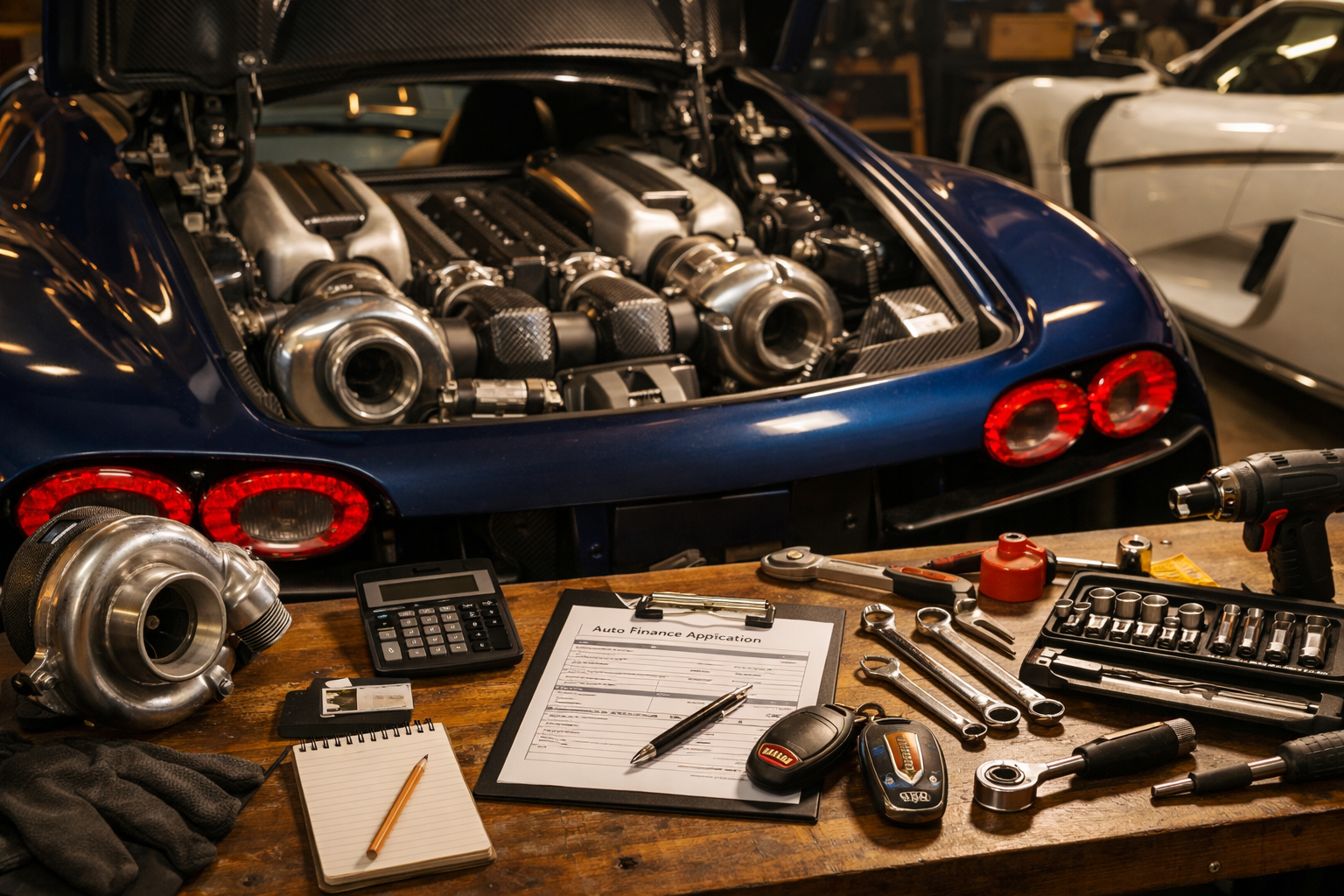
You’ve worked your tail off, built a business, maybe sold one, and now you’re staring at a seven-figure window sticker wondering how to finance a hypercar without doing something stupid. A Bugatti W16 Tribute. A Koenigsegg Gemera production slot. This isn’t your typical “what’s my monthly payment?” situation.
One wrong move here can cost you more than most folks’ houses. Insurance, maintenance, storage, taxes — exotic car ownership costs can chew through cash faster than a twin-turbo at full boost. In this guide, I’m breaking down what actually matters before you sign anything, so you don’t end up hyperventilating over your hypercar.
What You’ll Need
- Tools: CPA who understands exotic assets, specialty auto lender, insurance broker experienced with high-value vehicles
- Parts/Materials: 20–40% down payment ($500,000–$1.5M on most hypercars), strong liquidity reserves
- Time: 2–6 weeks for underwriting and approval
- Difficulty: 🔧🔧🔧🔧 (4/5 — financially complex)
- Dealer Cost: Markups of $250,000+ over MSRP vs Smart Financing Strategy: Potential six-figure savings over loan term
Why This Matters When You Finance a Hypercar
Miss a payment on a Camry? That’s annoying. Miss a payment on a $3 million Bugatti? That’s a headline. Lenders treat these cars like rolling art collections, not transportation.
Most hypercars depreciate 10–20% the moment they hit secondary market — unless they’re ultra-limited or historically significant. The Bugatti W16 Tribute models and limited Koenigsegg Gemera production runs may hold stronger, but there are zero guarantees.
And here’s the kicker: maintenance alone can run $25,000–$50,000 annually, even if you barely drive it. Skip scheduled service and you’re not just risking reliability — you’re torching resale value.
Before You Start
⚠️ WARNING: Never finance a hypercar using short-term, high-interest business credit unless your cash flow is bulletproof. I’ve seen guys leverage inventory lines for toys — it ends badly.
You’ll need:
- Excellent credit (720+ minimum, 780+ preferred)
- Documented liquidity — usually 12–24 months of payments in reserve
- Proof of secure storage (climate-controlled garage)
If you’re stretching to make the down payment, stop. Hypercars are like race engines — they punish weakness.
Also pay attention to broader market signals. With shifts in 2026 car pricing trends and global uncertainty affecting luxury segments, timing can impact resale more than you think.
Step-by-Step Guide
-
Get Pre-Approved Through a Specialty Lender
Forget your local credit union. You want lenders who deal in exotics — Woodside Credit, J.J. Best, Premier Financial. Rates in 2025–2026 typically range from 6.5% to 9.5%, depending on structure.
Pro Tip: Longer terms (up to 144 months) lower payments but increase total interest dramatically. Run the math with your CPA.
-
Understand the True Down Payment
Expect 20–40% down. On a $3 million Koenigsegg Gemera, that’s $600,000–$1.2 million upfront. Some limited allocations require full payment before production.
-
Factor Insurance Before You Sign
Insurance runs $15,000–$40,000 per year depending on driving history and location. Agreed-value policies are mandatory. Shop brokers who specialize in collector cars.
Need help understanding coverage strategies? Start with our guide on choosing the best car insurance in 2026.
-
Budget Annual Service and Consumables
Bugatti oil change? Around $25,000 at the dealer. Tires? $30,000–$40,000 per set on some models. Carbon-ceramic brake service can exceed $80,000.
Check manufacturer maintenance guidelines directly — for example, Bugatti and Koenigsegg publish service intervals on their official sites. Always verify schedules through the manufacturer.
-
Plan Your Exit Strategy
Are you flipping in 24 months? Holding 10 years? Auction houses charge 5–10% seller fees. Private brokers take similar cuts.
Follow industry shifts like the Koenigsegg IPO developments — public financial pressure can influence production volume and resale values.
Common Mistakes to Avoid
- Ignoring Total Cost of Ownership
I’ve seen buyers fixate on the monthly payment and forget $50,000 yearly upkeep. That’s how forced sales happen. - Overleveraging Investments
Pulling volatile assets to fund a depreciating toy? Risky move. Markets dip, car values dip — double hit. - Skipping Professional Inspection on Secondary Market Cars
Even hypercars need pre-purchase inspections. Independent exotic specialists can charge $2,000–$5,000 — cheap insurance. - Believing “It Will Only Appreciate”
In 20 years of wrenching and watching markets, hype fades. Only the rarest specs win long-term.
When to Call a Professional
If your income fluctuates heavily year to year, bring in a CPA who understands luxury asset structuring. Tax implications vary by state, especially with Montana LLC registration strategies.
Fair financing terms in 2026: under 9% APR for well-qualified buyers. If someone quotes you 12%+, walk away.
Ask lenders:
- Is there a prepayment penalty?
- Is this a simple or precomputed interest loan?
- What happens if market value drops below loan balance?
Red flags? Pressure to wire deposits immediately. Vague allocation promises. Refusal to provide VIN documentation.
For consumer protection basics, review resources from Consumer Reports and recall databases at NHTSA.gov.
Recommended Products
- Hagerty or Chubb Agreed-Value Insurance — What I’d use for a seven-figure car.
- Battery Tender Plus (12V) — $75. Hypercars hate weak batteries.
- Climate-Controlled Storage — $300–$1,000/month depending on region.
- Professional Car Cover (Indoor, Custom Fit) — $400–$800. Protect that paint.
Do This
- Put 20–40% down minimum
- Maintain 12+ months of payment reserves
- Insure for agreed value
- Research production limits carefully
Don’t Do This
- Stretch your liquidity thin
- Assume appreciation is guaranteed
- Ignore annual maintenance costs
- Sign without independent review
If you’re going to finance a hypercar, do it like a pro — with planning, reserves, and a clear exit strategy. These machines are engineering masterpieces, but they’re still assets on a balance sheet.
You’ve earned the right to dream big. Just don’t let ego outrun math. Got questions about structuring a deal? Drop them in the comments.
Stay sharp, spend smart — and remember, even a $3 million car can become a $300,000 mistake if you don’t run the numbers first.