
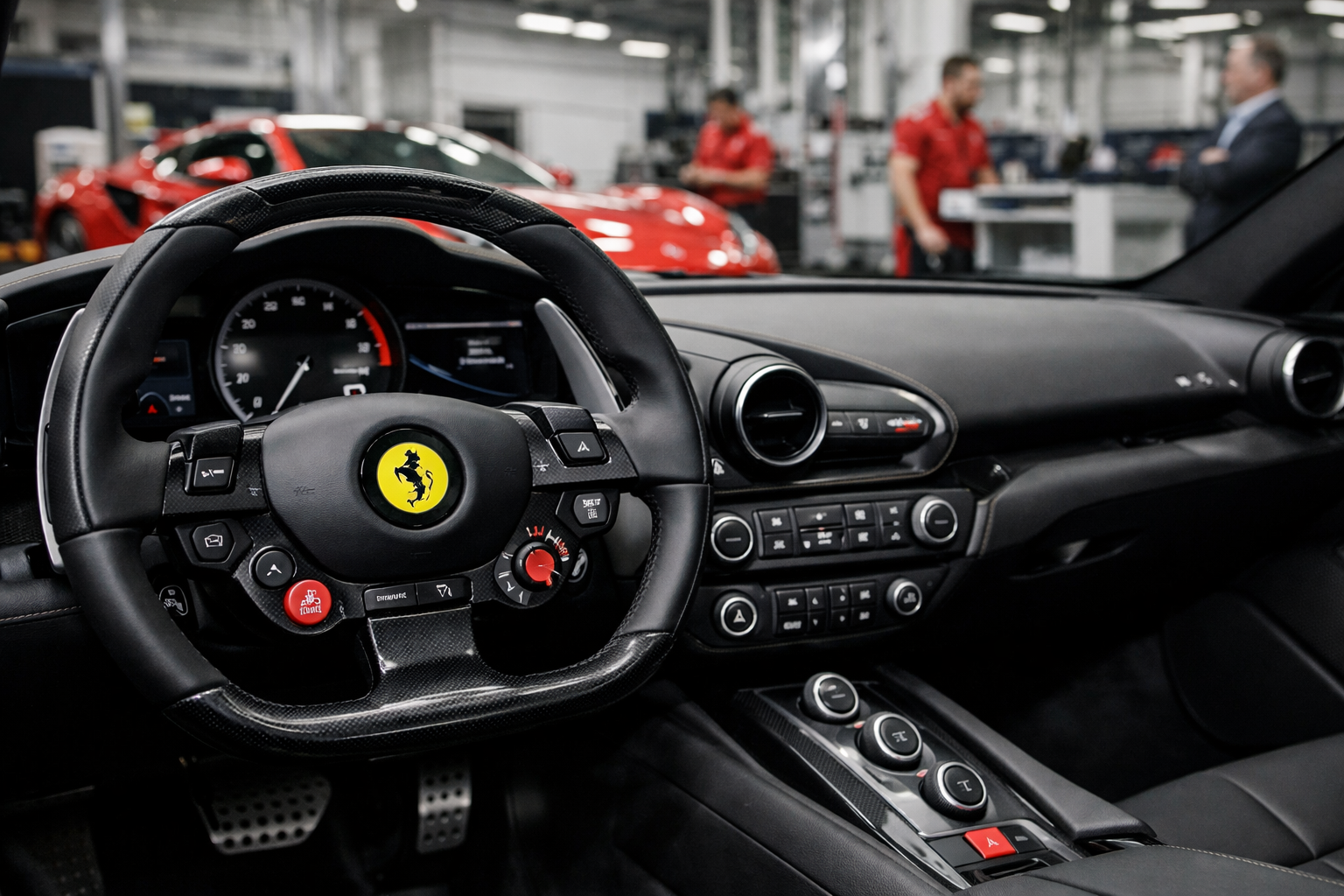
Ferrari is reversing course on touch-heavy interiors and bringing back Ferrari physical buttons to its latest models, acknowledging customer backlash and usability concerns that have simmered since 2019. The shift, confirmed by executives in March 2026 during media previews in Maranello, marks a notable retreat from the capacitive steering-wheel controls introduced on the SF90 Stradale and later rolled out across the Roma, 296, and Purosangue.
This is not a minor trim update. For a brand that prides itself on driver focus, admitting that its high-tech interface went too far signals a broader rethink of supercar ergonomics. Moreover, it reflects a growing industry-wide reassessment of all-touch interiors as safety regulators and customers push back.
The Headlines
- What: Ferrari will reintroduce physical buttons on steering wheels and key controls in upcoming models
- Who: Ferrari, under CEO Benedetto Vigna and Chief Design Officer Flavio Manzoni
- When: Announced March 2026; rolling into refreshed 2026–2027 models
- Impact: Signals wider industry retreat from touch-only controls amid safety and customer concerns
- Key Number: 13,663 vehicles sold by Ferrari in 2025 (company-reported), many featuring touch controls
What Happened
Ferrari confirmed that upcoming production runs will replace several capacitive touch surfaces—particularly on the steering wheel—with tactile, mechanical switches. The company will also offer retrofit kits for certain recent models, according to executives speaking to European media outlets and reported by Reuters.
Since 2019, Ferrari has used haptic touchpads and swipe controls to manage indicators, wipers, drive modes, and infotainment. Owners complained about accidental inputs during spirited driving and difficulty locating controls without looking down. As one executive acknowledged during the March preview event:
“We listened carefully to our clients. The steering wheel must allow total focus on driving, not menu navigation.”
Notably, Ferrari sold 13,663 cars in 2025, up 3% year-over-year per company filings. That means thousands of customers experienced the controversial interface firsthand. Additionally, Ferrari’s ultra-high margins—around 26% EBIT in recent earnings reports—give it flexibility to make costly mid-cycle adjustments without derailing profitability.
Why It Matters
The return of Ferrari physical buttons is about more than nostalgia. It reflects mounting evidence that touch controls can compromise usability and safety. Studies cited by the European New Car Assessment Programme (Euro NCAP) show drivers take their eyes off the road longer when using touchscreens compared to physical knobs.
Meanwhile, regulators are paying attention. The NHTSA has increased scrutiny of in-vehicle distraction, and software-related recalls are climbing. We’ve already seen how digital interfaces complicate ownership in cases like this Car Software Recall Guide: Navigate Recalls Easily, where over-the-air fixes are not always seamless.
For Ferrari, the stakes are higher. Buyers spending $250,000 to $400,000 expect intuitive controls at 200 mph. In contrast to mainstream brands chasing cost savings through shared touch modules, Ferrari’s value proposition centers on driver engagement. If the interface undermines that, it undercuts the brand itself.
The Bigger Picture
Over the past decade, automotive interior trends shifted sharply toward minimalism. Tesla led with its center-screen-only Model 3 in 2017. Volkswagen followed with capacitive sliders in the Mk8 Golf, later drawing criticism and quietly revising the design in newer models, as discussed in our analysis of Volkswagen’s 2026 EV strategy.
However, cost played a major role in this shift. Touch panels reduce part counts and wiring complexity. According to industry supplier estimates reported by Bloomberg, eliminating physical switchgear can save automakers tens of dollars per vehicle—significant at scale.
Ferrari never needed those savings. In fact, the move toward touch controls aligned more with a tech-forward image than financial necessity. Therefore, its reversal suggests that the industry may have overcorrected in pursuit of smartphone-like cabins.
Furthermore, as Ferrari prepares its first fully electric model—previewed in the Ferrari Luce EV: Teaser Reveals Strategy—ergonomics become even more critical. EVs already require drivers to adapt to new powertrain behaviors. Layering unintuitive controls on top of that compounds friction.
What the Competition Is Doing
Porsche has largely retained physical toggles and a prominent drive-mode dial in the 911 and Taycan, balancing digital screens with analog redundancy. Consequently, it has avoided the same level of backlash.
Meanwhile, Lamborghini’s Revuelto keeps fighter-jet-inspired physical switches for core functions, even as it expands digital displays. McLaren, after experimenting with screen-heavy layouts, reverted to more tactile interfaces in the 750S following customer clinics.
In contrast, Tesla remains committed to screen-centric design, even removing turn-signal stalks in the refreshed Model 3. BMW sits somewhere in the middle; while iDrive 8 leaned heavily into curved displays, recent feedback has prompted subtle hardware button returns in 2025 and 2026 models, echoing themes from our coverage of BMW’s EV transition strategy.
The competitive takeaway is clear: brands focused on performance driving are rediscovering the value of tactile feedback, while tech-centric brands continue betting on software-first cabins.
What It Means for You
If you’re a Ferrari buyer awaiting a 2026 or 2027 build slot, this change could materially improve daily usability. Additionally, retrofit options may protect resale values for recent models that critics labeled overly complex.
However, don’t expect a wholesale rejection of screens. Ferrari will still integrate digital clusters and advanced infotainment. The shift targets high-frequency controls—turn signals, wipers, drive modes—where muscle memory matters most.
For buyers outside the supercar sphere, this reinforces a broader lesson: test interior ergonomics before signing. As vehicle prices climb—see our analysis on why the $800 car payment is becoming normal—you’re paying for the interface as much as the engine.
What to Watch Next
First, watch how quickly Ferrari implements Ferrari physical buttons across the lineup. Mid-cycle refreshes typically take 12 to 24 months. If adoption accelerates, it suggests urgency rather than gradual evolution.
Second, monitor regulatory developments. Euro NCAP plans to weight physical controls more heavily in future safety scoring criteria starting in 2026. If similar standards reach the U.S., other automakers may follow Ferrari’s lead.
Finally, pay attention to Ferrari’s EV debut later this year. If the electric model launches with a thoughtfully balanced interface, it could set a template for supercar ergonomics in the software-defined era.
The Upside
- Improved driver focus and reduced distraction at high speeds
- Signals responsiveness to customer feedback
- Potential boost to brand loyalty and resale values
- May influence broader industry rethink of touch-heavy cabins
The Concerns
- Retrofit complexity and potential cost for existing owners
- Admits prior design misstep, which may affect short-term perception
- Does not eliminate reliance on software-driven systems
- Unclear global regulatory alignment on control standards
Having covered multiple product cycles, I’ve seen this pattern before: the industry embraces minimalism, customers push back, and tactile controls quietly return. Ferrari physical buttons may seem like a small hardware tweak, but they represent a philosophical pivot back to driver-first design.
Over the next five years, expect more automakers to blend digital flexibility with analog certainty. The brands that strike that balance will win—not because they look futuristic, but because they feel right at 150 mph.
Disclosure: This article may contain affiliate links. If you make a purchase through these links, we may earn a small commission at no extra cost to you. This helps support RevvedUpCars.com. Learn more.