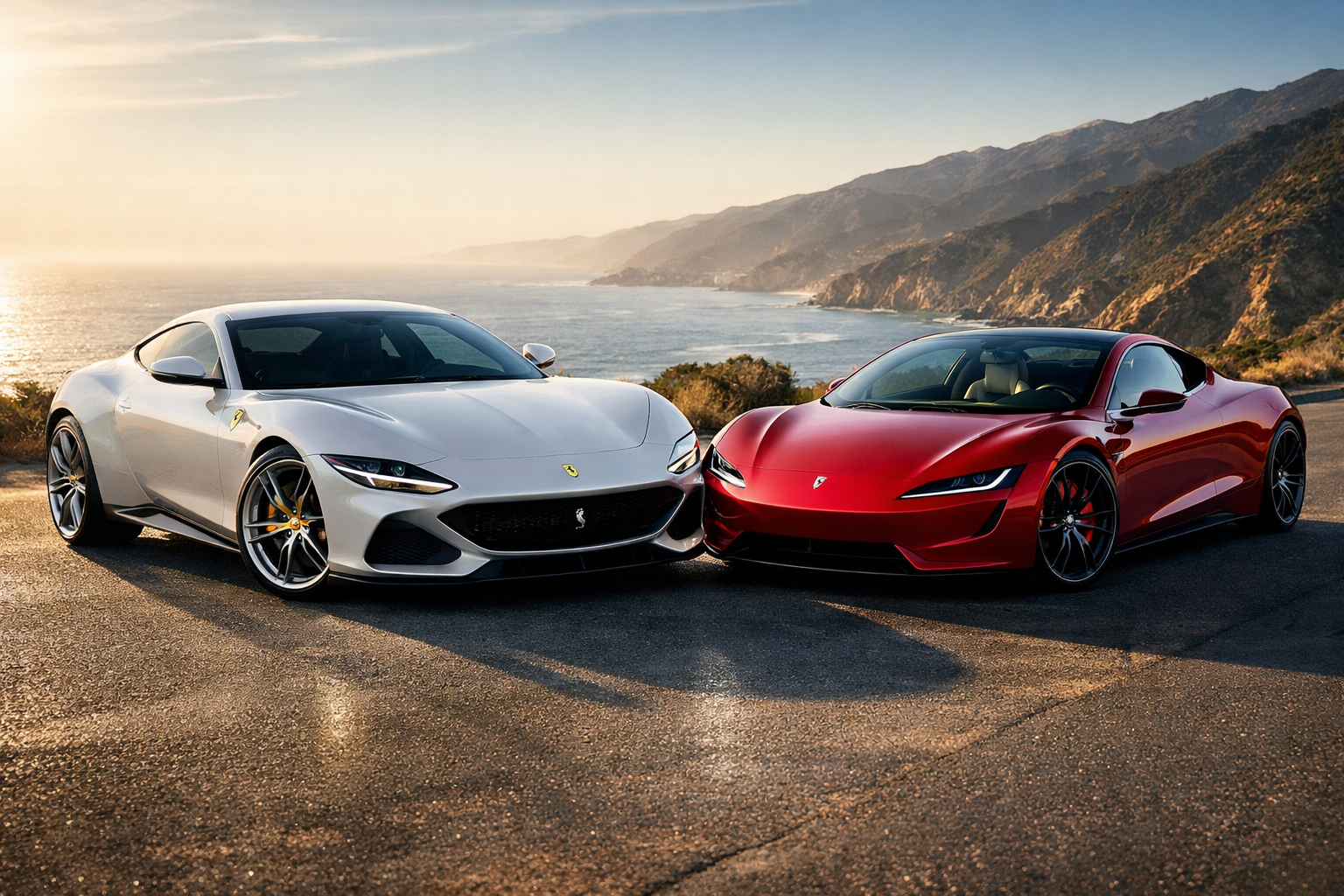

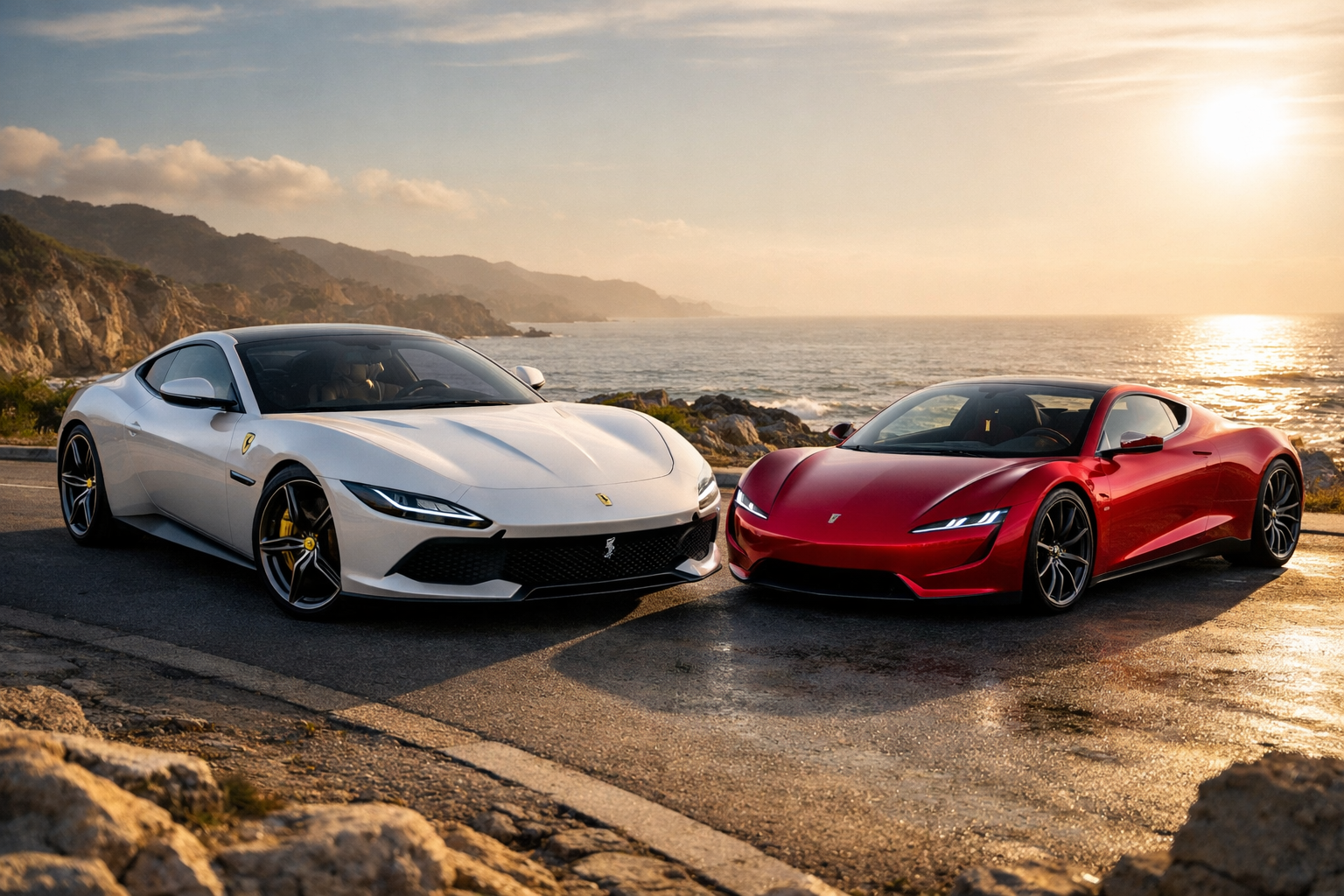
Here’s a sentence I never thought I’d write: Ferrari and Tesla now build cars chasing the same buyer. The Ferrari Luce vs Tesla Roadster battle isn’t just about who hits 60 mph first—it’s about two completely different ideas of what an electric supercar should be.
One comes from Maranello, where V12s still echo off the factory walls and engineers treat steering feel like a religion. The other comes from Silicon Valley, where software updates are more sacred than camshafts and “Plaid” is a performance metric. If you’re about to drop north of $200,000 on electrons and ego, this philosophy clash matters right now.
Quick Specs
- Starting Price: Luce approximately $275,000 / Roadster approximately $200,000 (check manufacturer website for latest pricing)
- Engine: Dual/Triple Electric Motors
- Power: Luce ~1,000 hp / Roadster up to 1,100+ hp (claimed)
- 0-60 mph: Luce ~2.3 seconds / Roadster claimed 1.9 seconds
- Fuel Economy: Luce ~350-mile range / Roadster claimed 600+ mile range
The Contenders
The 2026 Ferrari Luce is Maranello’s first full-bore electric supercar, and if you want the deep dive, read our full Ferrari Luce review. It rides on a dedicated EV platform, packs roughly 1,000 horsepower, and sprints to 60 mph in about 2.3 seconds. Ferrari says range hovers around 350 miles on a gentle day.
The 2025/2026 Tesla Roadster—yes, the long-awaited second-generation one—claims 1.9 seconds to 60 mph, 250+ mph top speed, and a frankly outrageous 600-plus-mile range. Starting around $200,000 for the base and $250,000 for the “Founder’s Series,” it’s Elon’s middle finger to every internal-combustion hypercar ever built. Official details live at Tesla’s website, though “claimed” is doing a lot of heavy lifting.
For context, both sit above the Porsche Taycan Turbo GT, Rimac Nevera, and even the 1,000+ hp electric SUVs like the AMG’s 1,000-hp electric monster. This isn’t Model S vs Taycan territory. This is poster-on-your-wall stuff.
Design Face-Off
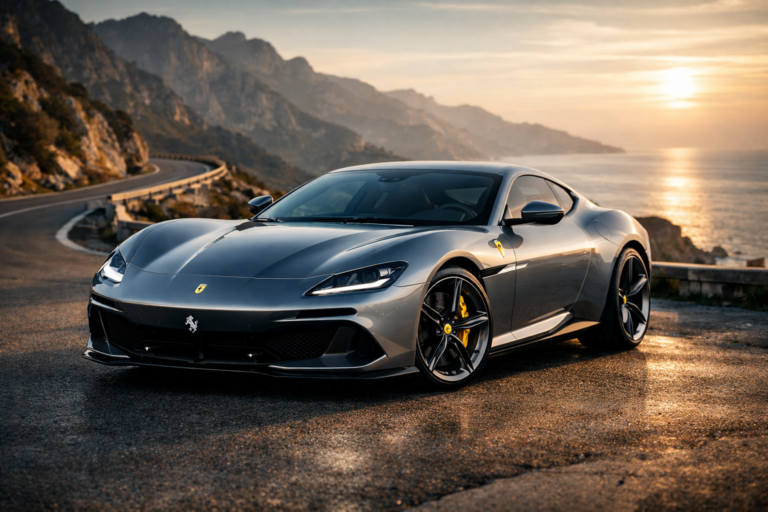
The Luce looks like a Ferrari that swallowed a lightning bolt. Long hood, sculpted hips, dramatic intakes that may or may not cool anything—because drama still matters in Italy. It’s theatrical without being cartoonish, like someone crossbred an SF90 with a concept car from the Geneva show floor.
The Roadster is minimalist to the point of arrogance. Low, wide, clean surfacing, and almost no visual noise. It’s less “look at me” and more “you already know.”
Hot take: the Ferrari will age better. Tesla design cycles move faster than iPhone refreshes, and yesterday’s cutting-edge Tesla can feel old when the next OTA update drops. Ferrari shapes, like a 458 or F40, become art—just ask anyone who’s read our take on how cars become art.
Interior & Tech
Inside, the Luce is Ferrari trying to prove it can do Silicon Valley without losing its accent. There’s a sweeping digital display, haptic controls, and a design language that feels almost Apple-inspired. It’s gorgeous, but as we’ve argued in why touchscreens went too far, Ferrari risks burying real driving controls under glossy glass.
The Roadster interior is peak Tesla minimalism: massive central screen, sparse buttons, yoke-style steering (depending on final spec), and software that updates faster than your Netflix queue. Over-the-air improvements are brilliant, and the UI is still industry-leading in responsiveness.
But here’s the controversial bit: at $200K+, I expect occasion. The Tesla feels like an extremely fast Model S inside. The Ferrari feels like an event every time you drop into the seat.
Performance: Numbers vs Feel
On paper, the Ferrari Luce vs Tesla Roadster comparison looks like a simple spreadsheet victory for Tesla. 1.9 seconds to 60 mph and 600 miles of range would be physics-bending if real. Even if real-world tests land at 2.1 seconds and 500 miles, that’s still absurd.
The Luce counters with about 1,000 hp, torque-vectoring wizardry, and Ferrari’s obsession with steering calibration. I’ve driven enough Ferraris to know this: they don’t just chase lap times, they chase sensation. Throttle response is razor-sharp, and the chassis communicates like it’s whispering secrets through the wheel.
The Tesla will likely dominate drag strips and YouTube thumbnails—hello, 1.9-second launch videos. The Ferrari will dominate a mountain road where brake feel, weight transfer, and mid-corner adjustability matter more than who hits 60 first.
And here’s another hot take: straight-line speed is becoming boring. When family SUVs are running 3.5-second 0-60 times, the supercar game has to be about feel. Ferrari understands that. Tesla sometimes feels like it’s chasing leaderboard bragging rights.
Range & Real-World Usability
If Tesla actually delivers 600+ miles of range, it changes the electric supercar conversation. That’s grand-touring territory, nearly double what many rivals offer. You could realistically road-trip this thing without planning your life around chargers.
The Luce’s roughly 350-mile range is more typical for high-performance EVs. Still usable, but you’ll be more intimate with charging networks. For official efficiency numbers, check FuelEconomy.gov once EPA data is finalized.
Both support ultra-fast DC charging, but Tesla’s Supercharger network remains the gold standard in North America. Ferrari owners may rely on third-party networks, which are improving—but still not as seamless.
Value Breakdown
Let’s talk money. The Tesla Roadster starting around $200,000 undercuts the Ferrari Luce by roughly $75,000 or more. That’s a Porsche 911 Carrera T sitting in your garage as change.
But value in this segment isn’t about price per horsepower. It’s about brand equity. Ferrari resale values historically crush most competitors, and exclusivity plays a role Tesla simply can’t replicate at scale.
Warranty-wise, Tesla typically offers 4 years/50,000 miles basic and 8 years on the battery. Ferrari’s coverage varies, often including 3-year unlimited-mile basic coverage with extended maintenance packages. Safety ratings for niche supercars are limited, but broader data lives at NHTSA.gov.
| Spec | Ferrari Luce | Tesla Roadster |
|---|---|---|
| Starting Price | ~$275,000 | ~$200,000 |
| Power | ~1,000 hp | 1,100+ hp (claimed) |
| 0-60 mph | ~2.3s | 1.9s (claimed) |
| MPG/Range | ~350 miles | 600+ miles (claimed) |
| Cargo Space | Limited (front trunk) | Limited (front + small rear) |
| Warranty | 3 yr/unlimited mi | 4 yr/50,000 mi |
Pros
- Ferrari-level driving dynamics and steering feel
- Tesla’s potentially class-leading acceleration and range
- Both deliver hypercar performance without tailpipe emissions
- Cutting-edge tech and fast-charging capability
Cons
- Six-figure pricing firmly in dream-car territory
- Tesla claims still need real-world validation
- Charging infrastructure still less convenient than gas in some regions
The Winner
The Ferrari Luce vs Tesla Roadster showdown comes down to what you worship: numbers or nuance. If Tesla delivers on its promises, the Roadster will be the quickest, longest-range electric supercar you can actually buy for around $200K. That’s seismic.
But if you care about steering feel, chassis balance, and the intangible tingle that makes you take the long way home, the Ferrari wins. It’s engineered like a Stradivarius with a battery pack.
My final word on Ferrari Luce vs Tesla Roadster? The Tesla might rewrite the spec sheet, but the Ferrari rewrites your pulse rate. And in a world where everyone’s quick, I’ll take the one that makes me feel something.
Frequently Asked Questions
Which is faster: Ferrari Luce vs Tesla Roadster?
The Tesla Roadster claims 0-60 mph in 1.9 seconds, while the Ferrari Luce is around 2.3 seconds. Real-world independent testing will ultimately confirm how close Tesla gets to its headline figure.
How much does the Ferrari Luce cost?
The 2026 Ferrari Luce starts at approximately $275,000. Pricing can vary with options, so check Ferrari’s official website or your local dealer for the latest figures.
What is the range of the Tesla Roadster?
Tesla claims a range of over 600 miles on a full charge. Final EPA-certified numbers will be published closer to full production and availability.
Are electric supercars practical for daily driving?
They’re more usable than traditional supercars thanks to instant torque and fewer mechanical parts, but limited cargo space and charging times still make them less practical than performance sedans or SUVs.