
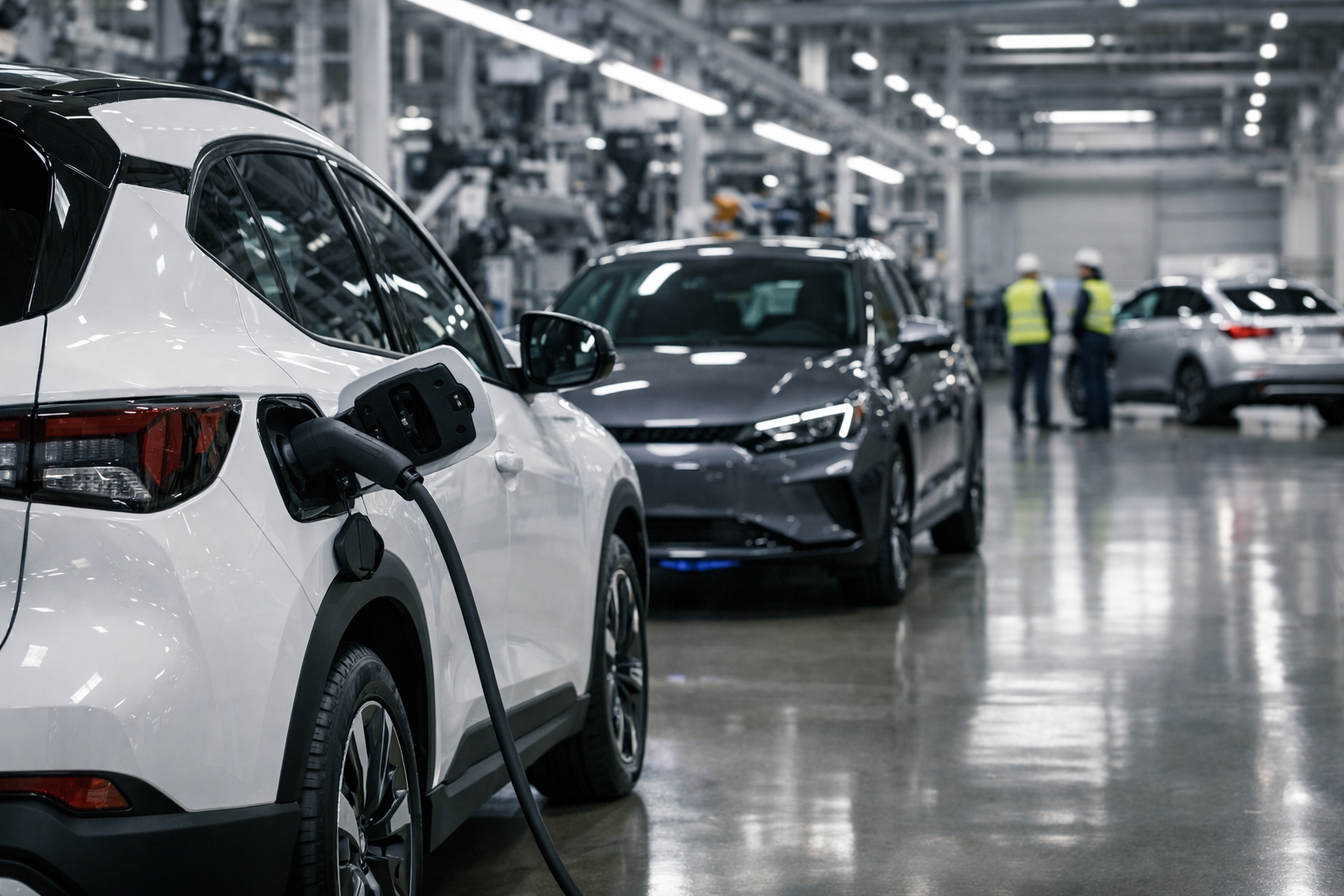
Europe EV sales hit a symbolic milestone in January 2026: nearly one in five new cars registered across the European Union had no internal combustion engine at all. According to the latest ACEA report released March 3, battery-electric vehicles (BEVs) accounted for 19.8% of January 2026 car sales, up from 14.6% a year earlier.
That’s not just a monthly blip. It’s a structural shift in the electric vehicle market share across Europe’s biggest markets—Germany, France, and the Netherlands all posted double-digit EV growth, even as total auto demand remained relatively flat. After two years of subsidy cuts and consumer hesitation, the market is accelerating again.
Importantly, this comes as Europe’s overall passenger car registrations rose just 2.1% year over year in January. In other words, EVs are gaining share faster than the market itself is growing.
The Headlines
- What: Battery-electric vehicles reached nearly 20% of January 2026 car sales in the EU
- Who: European automakers, Tesla, and fast-growing Chinese brands like BYD and MG
- When: January 2026 registrations, reported March 3, 2026
- Impact: EVs are approaching mainstream status, reshaping pricing and production strategies
- Key Number: 19.8% BEV market share
What Happened
ACEA’s January 2026 car sales data shows 176,000 battery-electric vehicles registered across the EU, up 34% year over year. By comparison, gasoline vehicle registrations fell 7.3%, while diesel dropped another 12%, continuing a decade-long decline.
Germany, Europe’s largest auto market, saw BEV registrations jump 29%, even after the government ended its environmental bonus program in late 2024. France posted a 31% increase, helped by new leasing incentives targeted at lower-income households. Meanwhile, Spain and Italy—historically EV laggards—both recorded growth above 40%, albeit from smaller bases.
Notably, plug-in hybrids (PHEVs) gained only 5%, suggesting buyers are increasingly opting for full battery-electric models. That’s a significant behavioral shift after years of PHEVs serving as a “bridge technology.”
Manufacturers responded quickly. Volkswagen Group reported that BEVs represented 22% of its European deliveries in January, according to its preliminary sales release. Tesla, despite increased competition, maintained strong Model Y volumes. Meanwhile, Chinese brands continued their surge, a trend we’ve covered in depth in Europe car sales 2026: Chinese brands surge.
Why It Matters
This jump in Europe EV sales reflects more than consumer enthusiasm—it’s policy-driven inevitability meeting industrial reality. The EU’s 2035 ban on new internal combustion engine sales is now less than a decade away. Automakers must raise electric vehicle market share every single year to avoid massive compliance penalties under fleet CO₂ rules.
Additionally, battery prices have resumed their downward trend after spiking in 2022–2023 due to lithium shortages. BloombergNEF estimates pack prices fell 14% in 2025, easing pressure on automakers’ margins. That cost relief is finally translating into more competitive pricing on entry-level EVs.
For consumers, the tipping point is psychological as much as financial. When one in five neighbors buys an EV, range anxiety becomes less abstract. Charging infrastructure has expanded as well; the European Alternative Fuels Observatory reports over 700,000 public charging points across the EU, up 25% year over year.
However, this growth masks regional disparities. Germany and the Nordics are pulling ahead, while parts of Eastern Europe remain under 10% EV penetration. The transition is uneven—and politically sensitive.
The Bigger Picture
Europe’s EV trajectory contrasts sharply with the United States, where regulatory uncertainty has clouded the outlook. As we’ve analyzed in US Tailpipe Rollback: What It Means Now, policy shifts can quickly alter automaker strategy. In Europe, by contrast, the regulatory direction remains firm despite industry lobbying.
Historically, Europe leaned heavily on diesel to meet emissions targets. Diesel once commanded over 50% market share in 2015; today it’s below 14%, according to ACEA. The collapse of diesel after Dieselgate created space for hybrids and EVs, accelerating structural change.
Furthermore, trade tensions are shaping the market. The European Commission’s provisional tariffs on Chinese EV imports—announced in 2025 and reported by Reuters—aim to counter alleged state subsidies. Yet Chinese brands are still gaining traction through aggressive pricing and localized assembly plans.
The non-obvious insight here: tariffs may slow Chinese imports, but they also pressure European automakers to cut costs faster. Protection buys time—but not competitiveness.
What the Competition Is Doing
Volkswagen Group remains Europe’s EV volume leader, leveraging its MEB platform across VW, Audi, and Skoda brands. However, its profitability per EV still trails internal combustion models, according to recent earnings calls.
Tesla, once the uncontested EV king, now faces margin compression in Europe as it adjusts prices to maintain share. Its Berlin Gigafactory gives it logistical advantages, but brand differentiation is narrowing as legacy automakers improve software and range.
Meanwhile, Stellantis is pushing a multi-energy strategy. It continues investing in BEVs while keeping hybrids and even diesel alive in certain segments—see our breakdown in Stellantis diesel comeback: 2026 explained. That hedge could pay off if EV demand softens, but it also risks spreading R&D too thin.
Chinese automakers like BYD and SAIC’s MG brand are the wildcard. They compete aggressively on price, often undercutting European rivals by €3,000–€5,000 per model. If they localize production within the EU, tariffs become less effective, intensifying competition further.
What It Means for You
If you’re shopping in 2026, the surge in January 2026 car sales for EVs translates into more choice and, gradually, better pricing. Entry-level models like the Renault 5 E-Tech and VW ID.2 (launching later this year) aim to hit the €25,000 price point before incentives.
However, incentives vary widely by country and can disappear quickly. Germany’s abrupt subsidy end in 2024 is a cautionary tale. Timing your purchase around national programs can save thousands.
Additionally, resale values are stabilizing after sharp depreciation in 2023–2024. As electric vehicle market share rises, the used market becomes less volatile. That reduces ownership risk for first-time EV buyers.
Still, if you live in a region with limited charging infrastructure or rely on long-distance rural driving, hybrids remain a pragmatic alternative. The transition is real—but not universal.
What to Watch Next
First, watch the March and April registration data. January can be distorted by fleet purchases and year-end order spillover. Sustained 20%+ share through mid-2026 would confirm this as a durable trend in Europe EV sales.
Second, monitor battery plant ramp-ups across Germany, France, and Hungary. Delays could constrain supply just as demand accelerates. Third, keep an eye on EU tariff decisions expected later this year; they will influence pricing strategies for both European and Chinese brands.
The Upside
- Rapid growth signals EVs nearing mainstream adoption
- Falling battery costs improving price competitiveness
- Expanding charging infrastructure reduces usability concerns
- Stronger used EV market stabilizing resale values
The Concerns
- Regional inequality in charging access persists
- Profitability challenges for legacy automakers
- Potential trade conflicts raising vehicle prices
- Subsidy dependence in some key markets
Having covered Europe’s market through diesel’s peak, Dieselgate’s fallout, and the first EV wave, this feels different. The growth is broader, less subsidy-dependent, and increasingly competitive.
If current trends hold, Europe EV sales could approach 25% market share by 2027. At that point, automakers that failed to scale battery supply and software capability will find themselves permanently behind. The transition isn’t theoretical anymore—it’s visible in the registration data.
Disclosure: This article may contain affiliate links. If you make a purchase through these links, we may earn a small commission at no extra cost to you. This helps support RevvedUpCars.com. Learn more.