
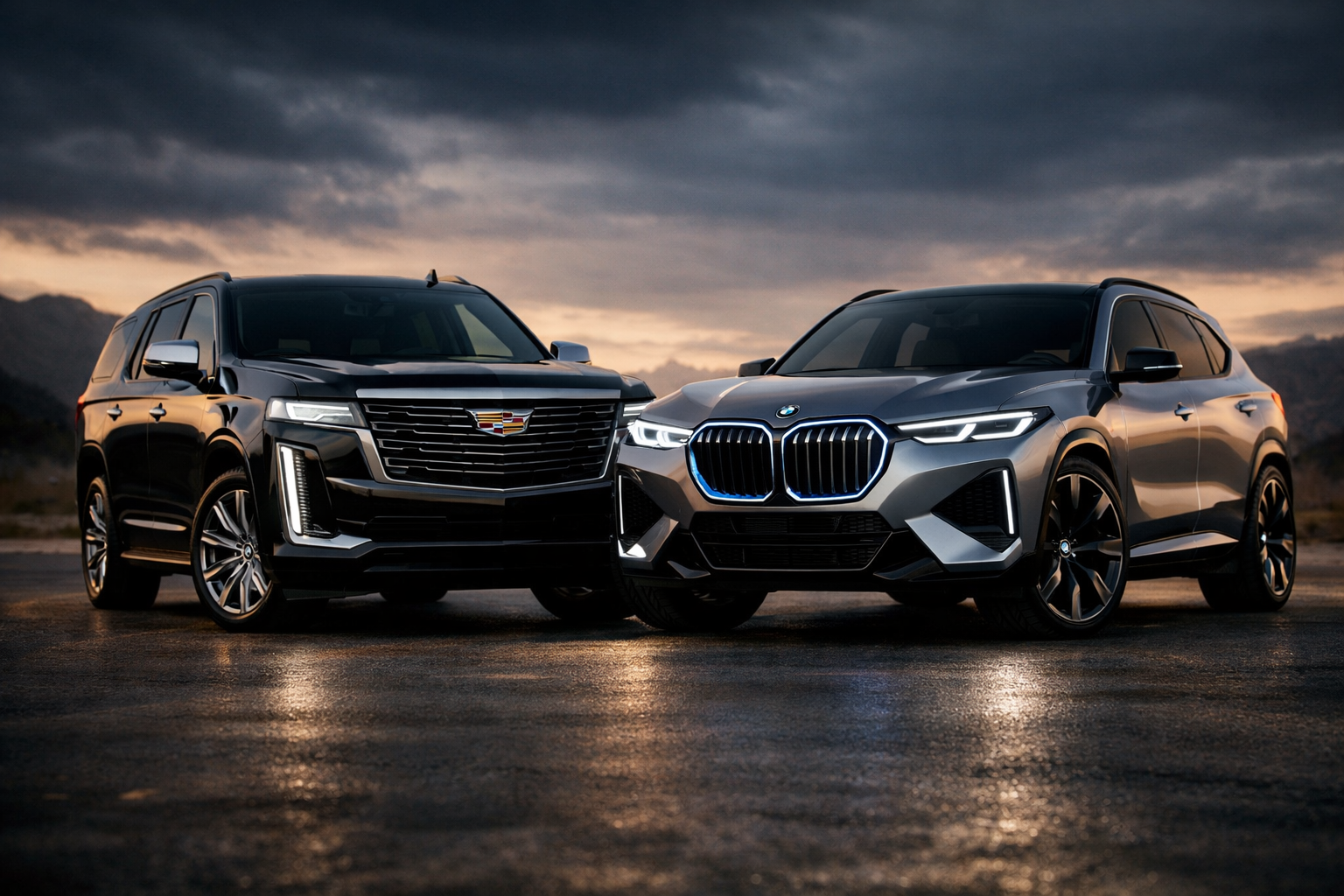
The Cadillac Escalade has spent two decades bullying driveways like a chrome-plated linebacker, but now BMW is sharpening a very German knife to bring to the fight. The Escalade vs BMW SUV showdown matters because Munich is finally ready to stop pretending the X7 is enough and unleash a true full-size flagship aimed squarely at America’s luxury obsession. If BMW gets this right, the Escalade’s reign won’t end quietly—it’ll go out kicking, V8 roaring, Super Cruise blinking.
I’ve driven dozens of full-size luxury SUVs, from Escalades to Range Rovers, and here’s the uncomfortable truth: buyers want size, tech, and presence more than Nürburgring lap times. BMW knows this, which is why its rumored flagship—think “X9” or “XM Grand”—is expected to be bigger, louder in design, and less apologetic about excess. This is no longer about handling purity; it’s about who does opulence with fewer buzzwords.
So let’s talk specs we expect to see, why they matter right now, and whether BMW can actually dethrone the Escalade without losing its soul. The Escalade vs BMW SUV conversation isn’t speculation fluff—it’s a preview of where full-size luxury SUVs are heading in 2026 and beyond.
Quick Specs
- Starting Price: Escalade starting around $82,000; BMW flagship approximately $95,000+
- Engine: Escalade 6.2L V8 / 3.0L diesel; BMW twin-turbo V8 + plug-in hybrid assist
- Power: Escalade 420 hp (682 hp Escalade-V); BMW expected 550–650 hp
- 0-60 mph: Escalade ~5.9s (Escalade-V 4.4s); BMW expected ~4.5s
- Fuel Economy: Escalade ~14 city / 19 highway mpg; BMW PHEV expected 20–25 mpg combined
The Contenders: American Excess vs German Ambition
The 2025–2026 Cadillac Escalade is still the default answer for celebrities, athletes, and anyone who wants their SUV to double as a status announcement. Starting around $82,000 (check manufacturer website for latest pricing), it brings magnetic ride control, a 38-inch curved OLED display, and optional Super Cruise that’s eerily good on highways. Rivals like the Lincoln Navigator, Range Rover, and Lexus LX600 have tried, but the Escalade’s cultural clout is half the battle.
BMW’s future flagship SUV—widely teased and discussed in industry circles—aims to go bigger than the X7 and more luxurious than the XM. Expect it to slot above both, with pricing nudging $100,000 and powertrains borrowing from BMW M’s hybrid V8 playbook. If you want context, our deep dive on BMW’s large SUV Escalade rival lays out why this isn’t just rumor mill noise.
Design Face-Off: Presence Beats Subtlety
The Escalade looks like it was designed with a ruler and a dare. It’s massive—224 inches long—and unapologetically boxy, which is exactly why buyers love it. The vertical LED lighting and slab sides scream authority, even if the aerodynamics are about as slippery as a brick in a tuxedo.
BMW, historically allergic to subtlety lately, will likely go full drama here. Expect a grille large enough to rent out, split headlights, and a stance closer to a Maybach GLS than an X5. Hot take: if BMW tries to “refine” this design too much, it’ll fail—full-size luxury buyers want intimidation, not Bauhaus restraint.
Interior & Tech: Screens, Screens, and More Screens
Cadillac currently owns this space. The Escalade’s 38-inch OLED setup is still one of the best in the business, with crisp graphics and intuitive controls that shame some German systems. Add in AKG audio with up to 36 speakers and seats that massage better than most airport lounges, and it’s easy to see why buyers don’t cross-shop much.
BMW’s answer will be iDrive 9 or newer, massive panoramic displays, and probably rear-seat cinema screens aimed at chauffeured buyers. The risk? Overcomplication. BMW interiors lately feel like Doug DeMuro’s quirks-and-features segment gone wild, and that’s not always a compliment.
Performance: Power Wars, Not Corner Carving
The Escalade’s standard 6.2-liter V8 makes 420 hp, which is fine, but the Escalade-V’s 682 hp is the real headline. A 6,200-pound SUV hitting 0–60 mph in about 4.4 seconds is gloriously unnecessary, and I adore it for that. Fuel economy? Let’s just say FuelEconomy.gov won’t be impressed.
BMW is expected to counter with a twin-turbo V8 paired to a plug-in hybrid system, targeting 550–650 hp and a sub-4.5-second sprint. Controversial take: BMW will make it faster on paper, but the Escalade will feel more dramatic every single time you floor it. Numbers don’t replace theater.
Value Breakdown: What Your Money Actually Buys
On paper, the Escalade looks expensive until you realize how much standard tech and space you get. GM’s parts sharing also keeps long-term servicing less terrifying than some German alternatives, and reliability has improved noticeably. For ownership cost myths, our guide on evaluating mythos vehicles is worth a read.
BMW’s flagship will be pricier and likely more complex, especially with hybrid systems. That complexity brings efficiency and performance, but also higher maintenance anxiety once warranties expire. Buyers cross-shopping a Mercedes-Maybach GLS or Range Rover SV will accept that trade-off; Escalade loyalists might not.
Safety & Driver Assistance: Silicon vs Simplicity
Super Cruise remains one of the best hands-free systems on the market, and Cadillac deserves credit for making it feel natural instead of gimmicky. The Escalade’s safety ratings can be checked via NHTSA, and they’re solid for a vehicle this size. It’s tech that actually reduces fatigue, not just adds menus.
BMW will bring its latest driver assistance suite, likely more configurable and more complex. It’ll appeal to tech-forward buyers, but there’s a fine line between advanced and annoying. Sometimes less Silicon Valley, more Detroit common sense works better.
Escalade vs BMW SUV: The Cultural Factor
This is where spreadsheets fail. The Escalade vs BMW SUV debate isn’t just about horsepower or screens; it’s about identity. The Escalade is woven into pop culture, from music videos to valet lines, in a way no BMW SUV has managed.
BMW’s challenge is to create a flagship that feels aspirational without feeling like an overgrown X7. If it succeeds, it’ll lure buyers from the Range Rover and GLS camps first. Converting Escalade diehards will take more than a faster 0–60.
| Spec | Cadillac Escalade (2025) | BMW Flagship SUV (Expected) |
|---|---|---|
| Starting Price | $82,000 approx | $95,000+ approx |
| Power | 420 hp (682 hp V) | 550–650 hp |
| 0-60 mph | 5.9s (4.4s V) | ~4.5s |
| MPG/Range | 14–19 mpg | 20–25 mpg est |
| Cargo Space | ~121 cu ft | ~110 cu ft est |
| Warranty | 4 yr/50,000 mi | 4 yr/50,000 mi |
Pros
- Escalade’s unmatched road presence
- BMW’s expected performance and efficiency edge
- Both offer cutting-edge tech and luxury
- Strong resale for Escalade historically
Cons
- Escalade’s fuel economy is brutal
- BMW’s complexity may hurt long-term ownership
- Both are expensive to buy and insure
Here’s the bottom line: the Escalade remains the king of charisma, while BMW’s upcoming flagship could be the engineer’s choice. The Escalade vs BMW SUV battle won’t produce a clear knockout, but it will finally give Escalade buyers a reason to pause before signing. And that alone makes this one of the most important luxury SUV showdowns of 2026.