
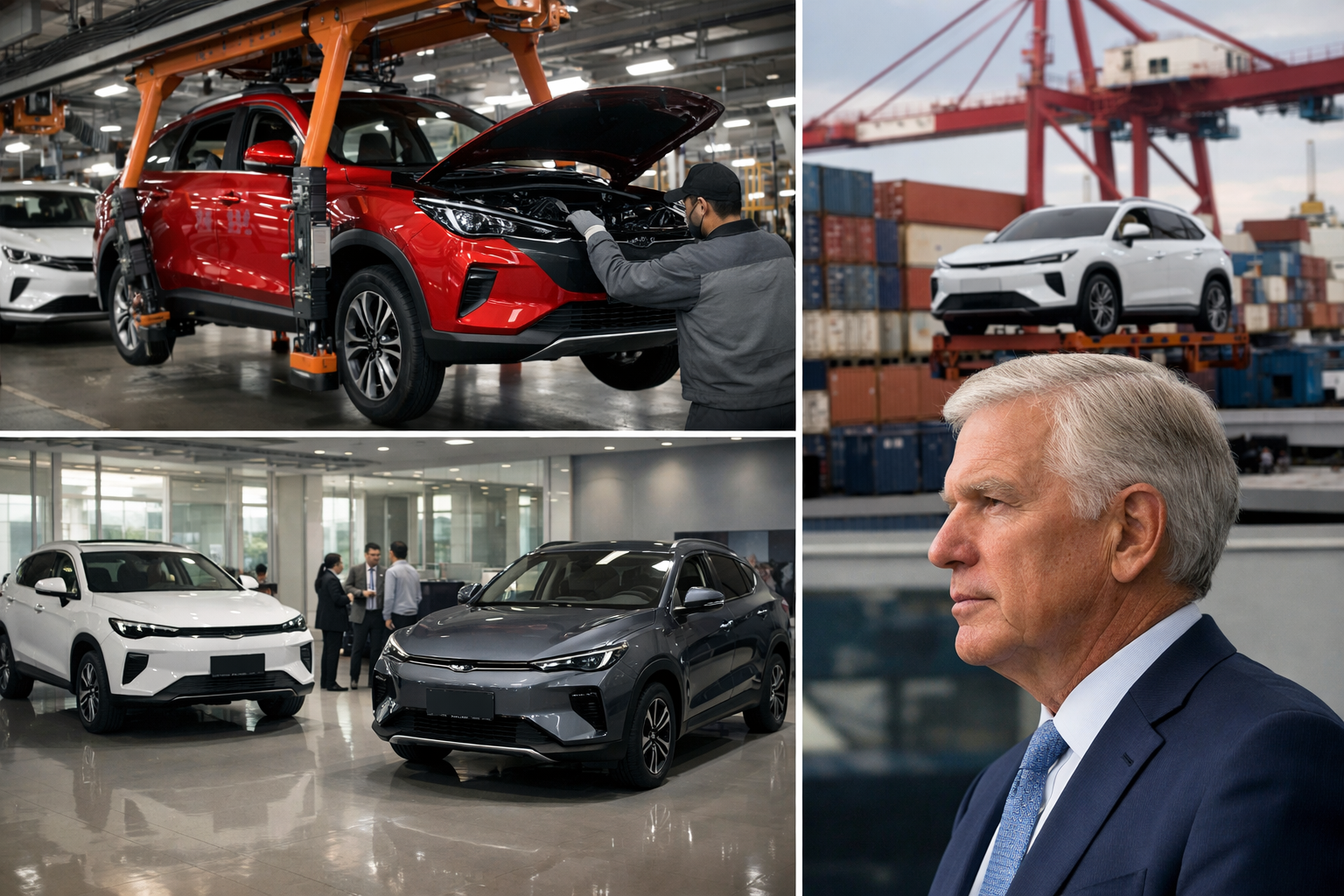
AutoNation, the largest dealership group in the U.S. with more than 300 stores nationwide, says it is not ready to bet on Chinese cars in US showrooms—at least not yet. Speaking during the company’s fourth-quarter earnings call on February 18, 2026, executives struck a cautious tone even as Chinese automakers aggressively expand in Europe, Latin America, and Southeast Asia.
The hesitation is notable. AutoNation sells roughly 1 in every 20 new vehicles retailed in America, according to company filings, giving it outsized influence over which brands gain traction. If the biggest dealer network in the country isn’t eager to sign up Chinese partners, that sends a signal about how complicated the U.S. market remains.
The Headlines
- What: AutoNation says it is cautious about adding Chinese brands to its U.S. dealership portfolio
- Who: AutoNation; potential Chinese automakers such as BYD, Chery, and Geely
- When: Comments made February 18, 2026, during Q4 earnings call
- Impact: Signals distribution and political hurdles for Chinese EV imports despite global growth
- Key Number: 27.5% — current U.S. tariff on Chinese vehicle imports, before additional proposed measures
What Happened
During its earnings call, AutoNation CEO Mike Manley addressed analyst questions about whether the group would partner with emerging Chinese brands seeking entry into the U.S. market. He acknowledged strong product momentum from companies like BYD and Geely overseas but emphasized “significant regulatory and political uncertainty” domestically.
“We evaluate every potential brand on its long-term viability in the U.S.,” Manley said. “Right now, the tariff structure and geopolitical environment make that assessment challenging.”
Currently, imported vehicles from China face a 27.5% tariff—25% under Section 301 trade actions plus the standard 2.5% passenger vehicle duty. Moreover, the Biden administration’s Inflation Reduction Act restricts federal EV tax credits for vehicles assembled outside North America and with battery materials sourced from “foreign entities of concern,” as outlined by the U.S. Department of Energy.
As a result, even competitively priced EVs from China would struggle to match the effective after-incentive pricing of U.S.-built models. According to Reuters, several Chinese automakers have paused or slowed formal U.S. entry plans amid ongoing trade tensions and the possibility of higher tariffs.
AutoNation’s stance does not rule out future partnerships. However, executives made clear they will prioritize brands with established U.S. manufacturing footprints or clear compliance strategies.
Why It Matters
The U.S. dealer model remains one of the biggest gatekeepers in the industry. Unlike Tesla and Rivian, which operate direct-to-consumer sales in many states, most new brands must secure franchise partners. Therefore, reluctance from a dealer group representing over $27 billion in annual revenue, per its latest SEC filing, creates a significant barrier to entry.
Meanwhile, Chinese automakers now account for more than 60% of global EV production, according to the International Energy Agency. Companies like BYD have surpassed Tesla in global EV deliveries in certain quarters. However, success in Europe—where BYD and MG have gained market share—does not automatically translate to the U.S.
Additionally, the political climate is shifting. Several lawmakers have proposed further restrictions on connected vehicle software and data sharing involving Chinese firms, citing cybersecurity concerns. The National Highway Traffic Safety Administration has also increased scrutiny of advanced driver-assistance systems and over-the-air updates, an area where Chinese brands often tout rapid innovation.
For consumers, this means the wave of ultra-low-cost EV imports some analysts predicted for 2025 and 2026 has not materialized. Instead, the U.S. market continues to be shaped by domestic production strategies from Ford, GM, Hyundai, and Tesla.
The Bigger Picture
To understand the caution around Chinese cars in US dealerships, you have to look at history. Japanese automakers faced similar skepticism in the 1970s, followed by voluntary export restraints in the 1980s. Korean brands encountered quality stigma in the 1990s before Hyundai and Kia rebuilt reputations through aggressive warranties and local production.
However, China’s situation is more geopolitically charged. Trade tensions, technology restrictions, and bipartisan skepticism in Washington create layers of risk beyond simple market competition. According to Bloomberg, some Chinese manufacturers are exploring Mexican assembly plants to circumvent U.S. tariffs under USMCA rules, though that approach could trigger political backlash.
In fact, distribution may prove as critical as product. As we’ve seen in our analysis of Chinese automakers vs legacy brands, competitive pricing alone does not guarantee service infrastructure, parts logistics, and resale value stability—factors American buyers prioritize.
Moreover, the industry is already recalibrating around regulatory uncertainty. Policy shifts like the proposed rollback of start-stop mandates, covered in our report on the start-stop feature ban, demonstrate how quickly federal priorities can change. Dealers are understandably wary of adding brands whose regulatory footing could shift overnight.
What the Competition Is Doing
Tesla, which controls roughly 50% of the U.S. EV market according to Cox Automotive estimates, continues to leverage domestic production in Texas and California. That local footprint insulates it from import tariffs and secures eligibility for federal tax credits.
Meanwhile, General Motors and Ford are doubling down on U.S.-built EVs and hybrids. GM’s Ultium-based models and Ford’s expanded hybrid lineup aim to protect market share without relying on imported vehicles. Hyundai and Kia, notably, accelerated U.S. battery and assembly investments in Georgia to ensure IRA compliance.
In contrast, brands like BYD and Chery have focused on Europe, Australia, and Latin America, where trade barriers are lower. Volvo, owned by China’s Geely, maintains U.S. operations but carefully separates branding from Chinese origin in marketing. Polestar, also Geely-backed, shifted some production to South Carolina to maintain incentive eligibility.
Therefore, the competitive landscape favors companies willing to localize manufacturing. Without that, even technologically advanced EV imports face structural disadvantages.
What It Means for You
If you were hoping for a $20,000 Chinese-built EV to disrupt the market in 2026, temper expectations. Tariffs and tax credit rules make that price point difficult unless production moves to North America.
However, competition pressure still benefits buyers. The mere threat of low-cost EV imports has pushed established brands to sharpen pricing and add features. For example, vehicles like the 2026 Kia K4 GT-Line Turbo show how aggressively mainstream brands are packaging performance and tech at sub-$30,000 price points.
Additionally, service infrastructure remains a key differentiator. Buying from an established dealer network often means easier warranty work, loaner vehicles, and resale value predictability. That stability matters more than headline range figures for many households.
My advice: focus less on badge origin and more on total cost of ownership. Incentives, insurance rates, software support, and dealer proximity will likely outweigh a marginal upfront price difference.
What to Watch Next
First, watch U.S. trade policy through the 2026 election cycle. Any increase in tariffs or tightening of IRA sourcing rules could further delay Chinese brand entry. Conversely, a détente could reopen the conversation quickly.
Second, monitor whether Chinese automakers commit to North American production. A factory announcement in Mexico or the U.S. would fundamentally change dealer calculations.
Finally, keep an eye on dealership consolidation. As large groups like AutoNation, Lithia, and Penske Automotive expand, their brand-selection decisions will increasingly shape which vehicles Americans can actually buy.
The Upside
- Protects dealers from geopolitical and tariff volatility
- Encourages localized U.S. manufacturing investment
- Maintains eligibility for federal EV tax credits
- Reduces consumer risk around service and resale uncertainty
The Concerns
- Limits low-cost EV competition in the short term
- May slow EV adoption if affordable imports are blocked
- Reduces consumer choice in a rapidly evolving segment
- Could trigger retaliatory trade measures affecting U.S. exports
Having covered multiple market entry cycles, I can tell you distribution often matters more than product headlines. Chinese automakers have scale, battery expertise, and cost advantages. However, without dealer confidence and regulatory clarity, those strengths may not translate into U.S. sales anytime soon.
For now, AutoNation’s caution underscores a broader truth: Chinese cars in US markets are not just a pricing story—they’re a political, logistical, and strategic puzzle. And until those pieces align, America’s largest dealer is content to wait.
Disclosure: This article may contain affiliate links. If you make a purchase through these links, we may earn a small commission at no extra cost to you. This helps support RevvedUpCars.com. Learn more.