
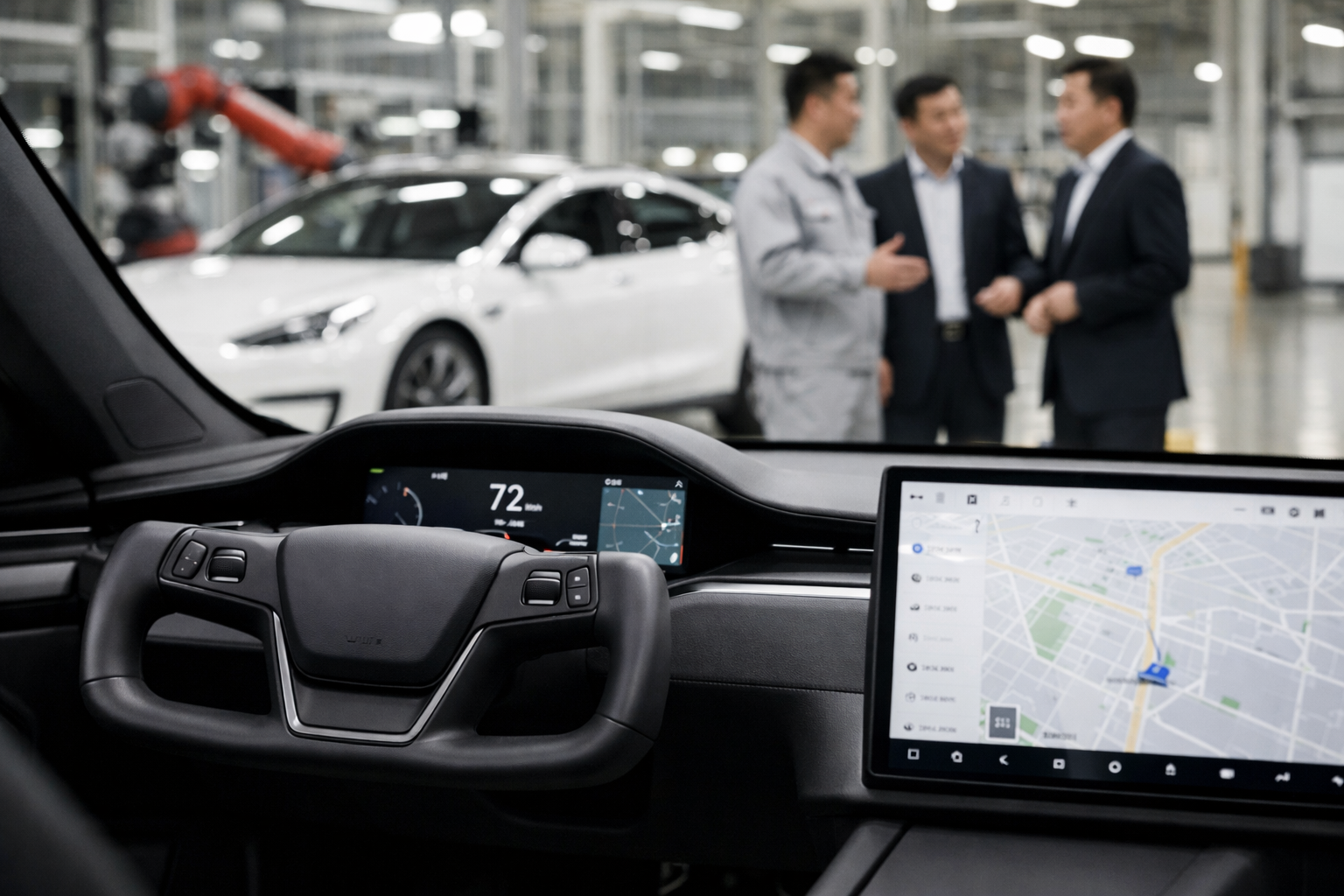
China’s top market regulator has formally enacted a yoke steering wheel ban, prohibiting the sale of new passenger vehicles equipped solely with aircraft-style yoke controls starting July 1, 2026. The rule, published February 17 by China’s Ministry of Industry and Information Technology (MIIT), requires all new vehicles to feature a “continuous circular steering interface” that meets updated emergency maneuver standards.
That may sound technical, but it’s a direct hit to Tesla’s controversial yoke-equipped Model S and Model X variants sold in China. More broadly, it signals that Beijing is drawing a harder line on experimental interior designs as advanced driver-assistance systems (ADAS) proliferate. For an industry that often tests bold ideas in China first, this is not business as usual.
The Headlines
- What: China bans non-circular yoke-style steering wheels in new passenger vehicles
- Who: China’s MIIT; affected automakers include Tesla and select domestic EV startups
- When: Effective July 1, 2026 for new vehicle certifications
- Impact: Forces design changes for certain EVs and limits experimental steering interfaces
- Key Number: 23.6 million passenger vehicles sold in China in 2025, per CAAM estimates
What Happened
According to the official MIIT notice, vehicles must now use a “closed-ring steering wheel” capable of full-hand repositioning during emergency avoidance maneuvers. Regulators cited test data showing reduced driver recovery performance during high-angle steering inputs with truncated yoke designs.
Additionally, the regulation requires that any steer-by-wire system be paired with mechanical redundancy and a traditional circular control interface. In effect, a pure yoke—without an optional round wheel—will no longer pass type approval in China.
Tesla introduced its yoke steering on the Model S and Model X in 2021, later offering a round wheel option in North America after customer backlash. In China, however, the yoke remained standard on certain trims through the 2025 model year. Reuters reports that Tesla sold roughly 1.8 million vehicles globally in 2025, with China accounting for more than 30% of deliveries (Reuters).
“The regulation enhances active safety in extreme steering conditions and ensures consistency with international best practices,” MIIT said in its February 17 statement.
Notably, the rule does not ban steer-by-wire technology outright. It targets steering interface geometry—an important distinction as automakers move toward fully electronic control systems.
Why It Matters
China is the world’s largest auto market, representing nearly one-third of global vehicle sales, according to the International Energy Agency. When Beijing tweaks safety standards, suppliers and global automakers pay attention.
However, the immediate volume impact is limited. Tesla’s Model S and Model X combined represent a small fraction of its China sales, which are dominated by the locally built Model 3 and Model Y. The real significance lies in regulatory signaling: China is prioritizing driver control clarity over minimalist experimentation.
Furthermore, this comes amid a broader reevaluation of in-car interfaces. European regulators have criticized excessive touchscreen reliance, and U.S. safety advocates have pushed NHTSA to examine driver distraction linked to novel controls (NHTSA). We’ve already seen pushback on digital minimalism in our coverage of why touchscreens went too far in cars.
The press release frames the rule as purely safety-driven. The reality is more nuanced. China has aggressively supported EV innovation, but it also wants standardization as domestic brands scale globally. Consistency in core controls reduces liability and export friction.
The Bigger Picture
This isn’t the first time regulators have stepped in on seemingly minor hardware features. In January, policymakers floated restrictions on automatic start-stop calibration thresholds, as we detailed in Start Stop Feature Ban Could Reshape 2026 Rules. Small interface tweaks can have outsized ripple effects across global platforms.
Historically, steering wheels have remained remarkably unchanged for a reason: they allow continuous hand repositioning during rapid countersteer events. Yokes, by contrast, require drivers to release and regrip more frequently in tight maneuvers—fine on a racetrack, less ideal in a sudden lane-change at 120 km/h.
Moreover, China’s move aligns with a subtle shift away from design-for-design’s-sake. Domestic automakers like BYD, SAIC, and Geely are focused on cost efficiency and mass adoption. Experimental cockpit elements may win headlines, but they complicate homologation and driver training.
There’s also a geopolitical layer. As we’ve explored in Chinese Automakers vs Legacy Brands: Should You Care?, China wants its brands to compete globally. Aligning steering standards with Europe and North America simplifies exports and strengthens regulatory credibility.
What the Competition Is Doing
Tesla remains the most visible proponent of the yoke concept, though it quietly reintroduced round wheels as an option in the U.S. after customer complaints. In contrast, Mercedes-Benz, BMW, and Audi have largely stuck to conventional wheels even as they deploy advanced Level 2+ systems.
Meanwhile, Toyota and Honda have prioritized incremental ADAS improvements over radical interior redesigns. The 2026 Honda Civic Sport Hybrid, for example, pairs updated driver assists with traditional controls—a conservative approach that reduces regulatory risk.
Chinese EV leaders BYD and NIO have experimented with rectangular wheels in concept vehicles, but production models overwhelmingly use circular designs. In fact, BYD surpassed Tesla in global EV deliveries in 2025, according to Bloomberg estimates, without resorting to radical steering changes (Bloomberg).
The contrarian insight: Tesla may actually benefit long-term. By standardizing steering globally, it simplifies manufacturing and reduces customer confusion. The yoke generated buzz, but it never drove meaningful sales volume.
What It Means for You
If you’re a Chinese buyer considering a 2026 Model S or Model X, expect a round steering wheel as standard equipment by mid-year. Additionally, resale values of existing yoke-equipped models could see short-term volatility, though limited production volumes cap the downside.
For global buyers, don’t expect an immediate domino effect. U.S. regulators have not announced similar rules, and Tesla continues to offer the yoke domestically. However, automakers designing next-generation EV platforms may think twice before betting on unconventional steering interfaces.
Therefore, if you prefer traditional ergonomics, the regulatory tide is on your side. If you loved the sci-fi aesthetic, the window for factory yokes may be narrowing—at least in the world’s biggest market.
What to Watch Next
First, watch Tesla’s response. Will it quietly standardize round wheels globally, or maintain a split strategy? Second, monitor whether the European Union updates UNECE steering regulations in 2026. Regulatory harmonization often follows China’s lead in technical standards.
Additionally, pay attention to how this affects steer-by-wire adoption. The technology itself isn’t banned, but pairing it with conventional wheels may slow more radical cockpit redesigns. Finally, look for supplier shifts—companies like ZF and Bosch could adjust R&D spending toward compliant steering modules.
The Upside
- Improved consistency in emergency steering performance
- Simplifies global vehicle certification for exports
- Reduces consumer confusion over unconventional controls
- Encourages focus on core ADAS safety improvements
The Concerns
- Limits interior design experimentation
- Potential short-term reengineering costs for affected models
- Could slow steer-by-wire innovation timelines
- Signals tighter regulatory scrutiny of future cockpit tech
The yoke steering wheel ban isn’t about nostalgia for round wheels—it’s about regulatory maturity in the EV era. China is signaling that innovation must clear a higher safety bar as vehicles become more software-defined and autonomous features expand.
Having covered three product cycles of cockpit “revolutions,” I’ve learned that flashy hardware rarely survives regulatory scrutiny unless it delivers measurable safety gains. For now, the circle wins. The bigger question is whether the next interface breakthrough will prove compelling enough—and safe enough—to change that geometry again.
Disclosure: This article may contain affiliate links. If you make a purchase through these links, we may earn a small commission at no extra cost to you. This helps support RevvedUpCars.com. Learn more.