
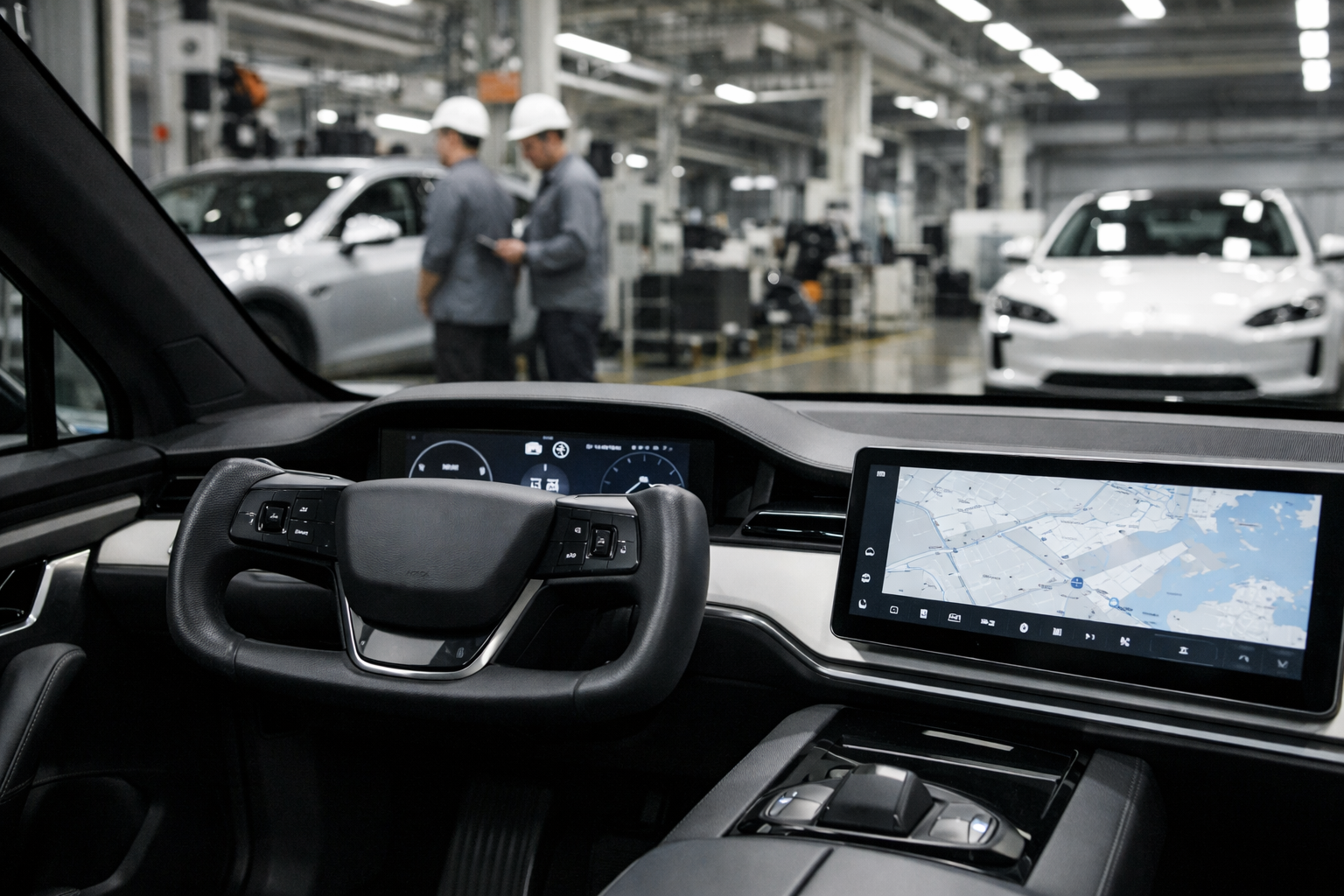
China’s top market regulator has effectively enacted a yoke steering wheel ban, prohibiting the sale of new passenger vehicles equipped solely with aircraft-style yoke controls starting January 1, 2027, according to a February 14 notice from the Ministry of Industry and Information Technology (MIIT). The updated China auto safety rules require a “full circular steering control interface” for all new type approvals, citing emergency maneuvering and driver familiarity concerns.
For automakers like Tesla, which introduced a yoke on the Model S and Model X in 2021 and briefly expanded it to other trims, this is more than a design tweak. China accounted for roughly 23 million passenger vehicle sales in 2025, per the China Association of Automobile Manufacturers (CAAM), making it the world’s largest auto market. A regulatory shift here often ripples globally.
The Headlines
- What: China will require conventional circular steering wheels on new passenger vehicles
- Who: MIIT; automakers including Tesla, BYD, Nio, and others
- When: New approvals from January 1, 2027; existing models get a 12-month compliance window
- Impact: Forces design revisions for models using yoke-only steering in China
- Key Number: 23 million — China’s 2025 passenger vehicle sales (CAAM)
What Happened
MIIT’s revised national standard, published February 14, 2026, states that passenger vehicles must include a “continuous 360-degree steering control surface” accessible at all times. Regulators cited accident investigations and simulator testing that showed longer steering correction times during low-speed emergency maneuvers with non-circular controls, according to reporting by Reuters.
Additionally, the rule applies to new model homologations starting in 2027, with a one-year grace period for vehicles already approved. However, any mid-cycle refresh that requires re-certification will need to comply immediately. That detail matters because many 2026 and 2027 model-year updates are already in development.
Tesla reintroduced a conventional wheel option in North America in 2023 after customer complaints during the Tesla yoke controversy, but it continued offering yoke-only configurations on certain trims in China. Meanwhile, Chinese EV makers such as Nio and Xpeng experimented with concept-level yokes yet largely kept traditional wheels in production models.
In a brief statement, MIIT said the update aligns with its broader push to “standardize human-machine interfaces for safety and accessibility.” The ministry did not single out any brand.
Why It Matters
This is not just about one steering shape. It signals that China auto safety rules are becoming more prescriptive about driver interfaces, not just crash performance or emissions. In fact, as vehicles add advanced driver-assistance systems (ADAS), regulators are scrutinizing how humans interact with automation during handoff scenarios.
Furthermore, steering controls sit at the center of that debate. Unlike touchscreens, which primarily affect convenience, the steering interface is a primary safety control. According to the U.S. National Highway Traffic Safety Administration (NHTSA), steering input remains critical in collision avoidance even with Level 2 driver-assist systems.
For Tesla, which delivered approximately 603,000 vehicles in China in 2025 according to company filings and local reports, design uniformity reduces manufacturing complexity. However, regulatory divergence increases it. If China requires a round wheel while the U.S. permits a yoke, Tesla and others must regionalize interiors—adding cost in a price-sensitive EV market.
Notably, this move undercuts the argument that radical interior design equals innovation. As we explored in Physical Controls in EVs: Why They’re Back, consumers and regulators are rediscovering the value of intuitive, tactile controls.
The Bigger Picture
China has steadily tightened automotive standards over the past decade, from China 6 emissions rules—often stricter than Euro 6—to aggressive EV battery safety mandates. The country also leads in EV adoption, with battery-electric vehicles representing roughly 35% of new car sales in 2025, per CAAM estimates.
Therefore, when Beijing draws a line on design, global suppliers listen. Many components are engineered for China first due to scale. If suppliers standardize around circular steering modules, the business case for niche yoke systems weakens worldwide.
There’s also a philosophical shift underway. After a period when concept-car aesthetics bled into production—see our analysis in Concept Cars Are Getting Wilder Again—regulators appear to be reasserting guardrails. Innovation is welcome, but not at the expense of driver familiarity.
Moreover, this echoes Europe’s recent General Safety Regulation updates, which mandate specific ADAS features and warning systems. Global car regulations are converging around the idea that human factors engineering is as important as horsepower or range.
What the Competition Is Doing
Tesla is the obvious focal point of the yoke steering wheel ban discussion. The company initially made the yoke standard on the refreshed Model S and Model X in 2021, prompting significant customer backlash. By 2023, Tesla offered a round wheel option in the U.S. at no extra cost, a tacit acknowledgment that the market was split.
In contrast, BYD—the world’s largest EV maker by volume, with over 3 million electrified vehicles sold in 2025 according to company releases—has largely avoided extreme interior experimentation in mass-market models. Its strategy emphasizes cost, range, and rapid model turnover rather than radical controls.
Meanwhile, Nio and Xpeng have showcased yoke-style concepts but stopped short of making them standard in high-volume trims. European brands such as Mercedes-Benz and BMW have experimented with flattened wheels but retained full circular rims in production vehicles, including the 2026 AMG electric SUV.
The pattern is familiar. Automakers push a boundary, gauge consumer tolerance, then retreat if regulators or buyers resist. Having covered three product cycles, I can tell you that when three major markets align against a feature, it rarely survives in its purest form.
What It Means for You
If you’re shopping in China, the change likely means greater consistency and potentially fewer “quirky” interior options starting in 2027. Additionally, resale values for niche yoke-equipped vehicles could face pressure if buyers perceive them as non-compliant or outdated.
For U.S. and European buyers, the impact is indirect but real. If suppliers standardize around round wheels, niche configurations may become special-order items or disappear entirely. As we’ve seen in debates over Why Touchscreens Went Too Far in Cars, usability often wins over minimalism in the long run.
However, if you like the yoke for visibility or style, this isn’t an immediate extinction event. Tesla and others can still offer it in markets where regulations permit. The key question is whether the incremental engineering and certification cost justifies the limited demand.
What to Watch Next
First, watch how Tesla responds in its next China-specific filings and product updates. A swift global shift back to round wheels would signal that the compliance burden outweighs branding value. Additionally, monitor whether the European Union or the U.S. considers similar human-machine interface guidelines.
Second, pay attention to 2027 model-year homologation filings in China. If brands quietly drop yoke options before the deadline, that will tell you where the industry consensus is heading.
The Upside
- Improved emergency maneuver familiarity for average drivers
- Reduced manufacturing complexity if global designs standardize
- Clearer regulatory guidance for future interior innovation
- Potential boost to resale values of compliant vehicles
The Concerns
- Limits experimentation in vehicle interface design
- Increases regional design divergence for global automakers
- May slow adoption of steer-by-wire systems with new form factors
- Signals tighter oversight that could extend to other interior features
The yoke steering wheel ban may look cosmetic, but it reflects a deeper recalibration between innovation and regulation. China auto safety rules are evolving from reactive enforcement to proactive design governance, and that shift will shape cabins as much as batteries over the next five years.
Ultimately, this isn’t the end of bold interiors. It’s a reminder that the world’s largest car market still believes a steering wheel should look like a steering wheel—and in a business driven by scale, that belief carries weight.
Disclosure: This article may contain affiliate links. If you make a purchase through these links, we may earn a small commission at no extra cost to you. This helps support RevvedUpCars.com. Learn more.