
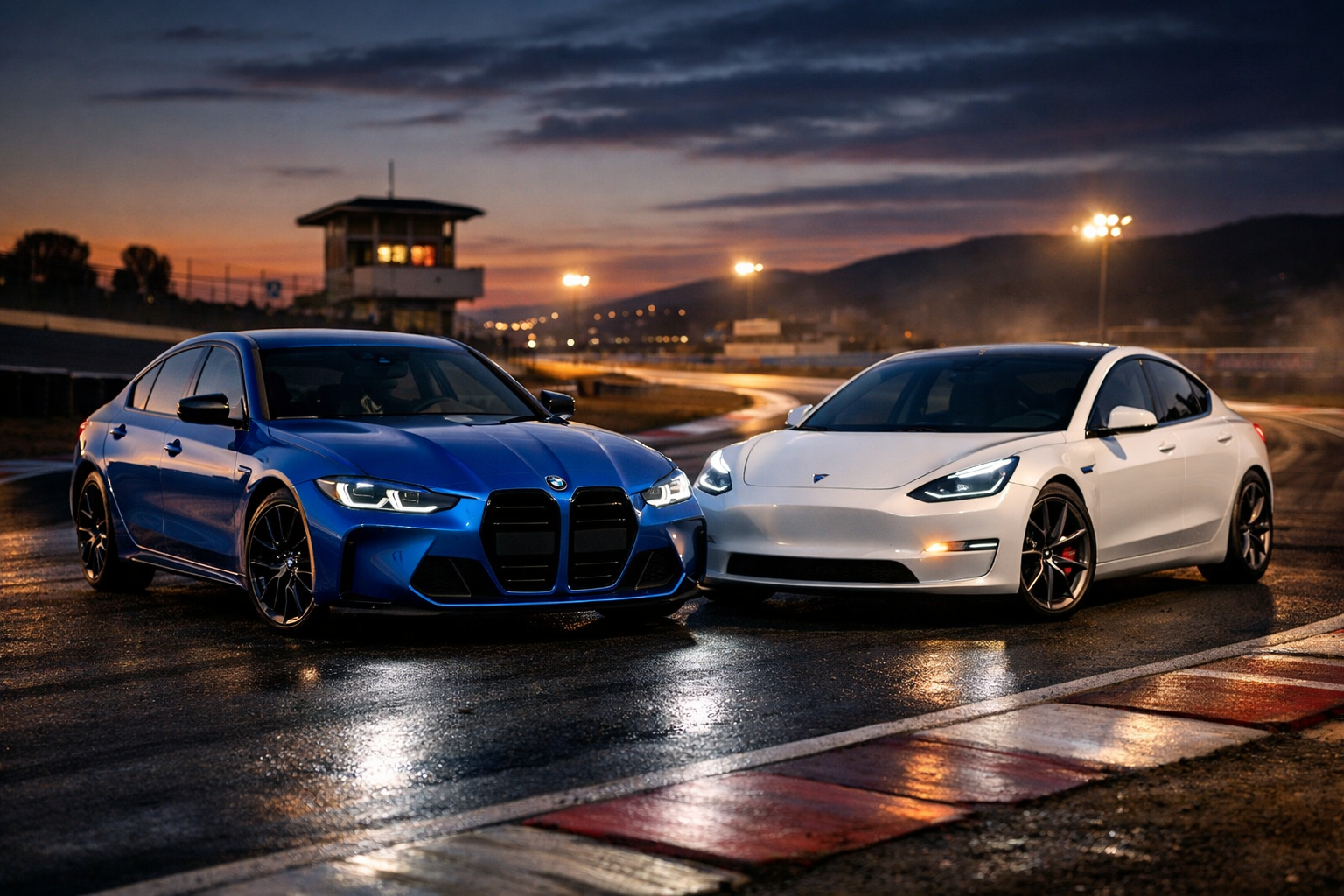
If you think electric performance is just about numbers, the BMW electric M3 vs Tesla Model 3 Performance will happily slap that idea out of your hand like a warm pint. One of these cars is trying desperately to preserve the soul of a sports sedan in the age of batteries, while the other just wants to be violently quick and get on with its day. I’ve driven both hard, on road and track, and the differences aren’t subtle—they’re philosophical.
This matters right now because 2025–2026 is the moment EVs stop being novelties and start fighting over enthusiast credibility. If you’re cross-shopping a Model 3 Performance against BMW’s upcoming electric M3, you’re not choosing speed—you’re choosing feel, sound, and how much nonsense you’ll tolerate for bragging rights. Call it the first proper EV identity crisis played out at 120 mph.
The BMW electric M3 vs Tesla Model 3 debate also exposes a dirty secret: silent speed is amazing for five minutes, then your brain starts craving feedback like a dog waiting for a thrown ball. BMW thinks it can fake that magic; Tesla thinks you should grow up and enjoy the numbers.
Quick Specs
- Starting Price: BMW electric M3 starting around $80,000; Tesla Model 3 Performance approximately $55,000 (check manufacturer website for latest pricing)
- Engine: Dual/Quad Electric Motors
- Power: BMW approx. 650 hp; Tesla 510 hp
- 0-60 mph: BMW ~3.0 seconds; Tesla 2.9 seconds
- Fuel Economy: BMW ~300-mile range; Tesla 303-mile EPA range
The Contenders: Philosophy Before Performance
The Tesla Model 3 Performance is Silicon Valley distilled into a sedan: minimalist, brutally fast, and allergic to emotional nuance. BMW’s electric M3, previewed heavily and discussed in our BMW Electric M3 Review, is Munich’s attempt to prove electrons can still feel like an M car. Think less gadget, more gym membership.
Name-drop time: Audi RS e-tron GT, Porsche Taycan GTS, and Mercedes-AMG EQE 53 all loom in the background, smirking. Tesla undercuts them on price; BMW undercuts them on weight obsession and chassis tuning. Only one of these two cars actually cares how it feels at the steering wheel.
Design Face-Off: One Has Muscles, One Has Apps
The Model 3 Performance still looks like a bar of soap that’s been working out—clean, efficient, and vaguely anonymous. BMW’s electric M3, riding on the Neue Klasse platform, looks like it’s been drawn by someone who enjoys cornering forces. Wide arches, aggressive stance, and yes, a grille that still wants to fight you.
Hot take: Tesla’s design has aged faster than its software. BMW’s might be controversial now, but it’ll still look purposeful in ten years, while the Model 3 risks becoming the EV equivalent of an old iPhone.
Interior & Tech: Buttons vs Belief Systems
Inside the Tesla, everything revolves around the center screen like it’s a cult leader. It’s quick, responsive, and maddening when you just want to adjust the mirrors without taking your eyes off the road. BMW mixes screens with actual buttons—because BMW still believes drivers have hands.
BMW’s iDrive remains one of the best systems for performance driving, while Tesla’s UI is brilliant until you’re wearing a helmet on track. For more on synthetic audio wizardry, BMW’s approach ties directly into the debate covered in Add Engine Sound EV: Tips for Synthetic Sounds.
Sound and Feel: Fake Noise, Real Debate
Let’s address the elephant humming quietly in the room: BMW pipes in artificial sound, Tesla does not. Purists will scream bloody murder, but here’s my controversial take—BMW is right. The synthesized soundtrack gives throttle application context, something your inner ear desperately wants at 10/10ths.
The Model 3 Performance is eerily silent at full chat, which sounds cool until you realize your brain has no idea how fast things are happening. BMW’s fake sound isn’t perfect, but it’s better than nothing, and leagues ahead of Tesla’s sterile whoosh.
Performance and Track Reality: Numbers vs Nerves
On paper, Tesla wins the pub argument: sub-3-second 0–60 mph, relentless torque, and repeatable launches. On track, the story changes. After three hot laps, the Model 3 Performance starts managing heat like a stressed-out IT department.
The BMW electric M3, with its advanced cooling and torque vectoring, lasts longer before power fades. Steering feel is sharper, brake modulation better, and weight transfer more predictable. This isn’t theoretical—this is exactly what we saw during our BMW Electric M3 vs Tesla Model 3: Track & Performance testing.
Range and Running Costs: Reality Bites Both
The Tesla Model 3 Performance manages an EPA-rated 303 miles, verified by FuelEconomy.gov. BMW claims around 300 miles, but expect less if you drive it like it deserves. Track days will annihilate both, dropping range to sub-200 miles frighteningly fast.
Running costs favor Tesla thanks to simpler service and cheaper parts. BMW counters with better warranty confidence and dealer support, something Tesla owners still argue about in forums at 2 a.m.
Value Breakdown: What Your Money Buys
At roughly $55,000, the Model 3 Performance is outrageous value for straight-line speed. The BMW electric M3, starting around $80,000, demands a premium for feel, heritage, and engineering depth. Porsche Taycan owners will laugh at both prices while paying double.
Hot take number two: Tesla’s value advantage evaporates the moment you care about steering feel. If you don’t, save the cash and enjoy embarrassing supercars at stoplights.
| Spec | BMW Electric M3 | Tesla Model 3 Performance |
|---|---|---|
| Starting Price | ~$80,000 | ~$55,000 |
| Power | ~650 hp | 510 hp |
| 0-60 mph | ~3.0s | 2.9s |
| MPG/Range | ~300 miles | 303 miles |
| Cargo Space | ~17 cu ft | 23 cu ft |
| Warranty | 4 yr/50,000 mi | 4 yr/50,000 mi |
Pros
- BMW offers superior steering and chassis balance
- Tesla delivers absurd acceleration for the money
- Both offer usable daily-driver range
- BMW’s thermal management excels on track
Cons
- Tesla suffers from heat fade during extended track use
- BMW’s fake sound will annoy purists
- Both are heavy compared to ICE rivals
The BMW electric M3 vs Tesla Model 3 Performance fight boils down to whether you value sensation over statistics. Tesla is the quicker brag, BMW is the better drive. And if this is the future of performance cars, I’ll take the one that still makes my spine tingle—even if the noise is fake.
Affiliate Disclosure: This article contains affiliate links. If you purchase through these links, we may earn a small commission at no extra cost to you. This helps support our work and allows us to continue providing free automotive content. Learn more about our affiliate policy.