
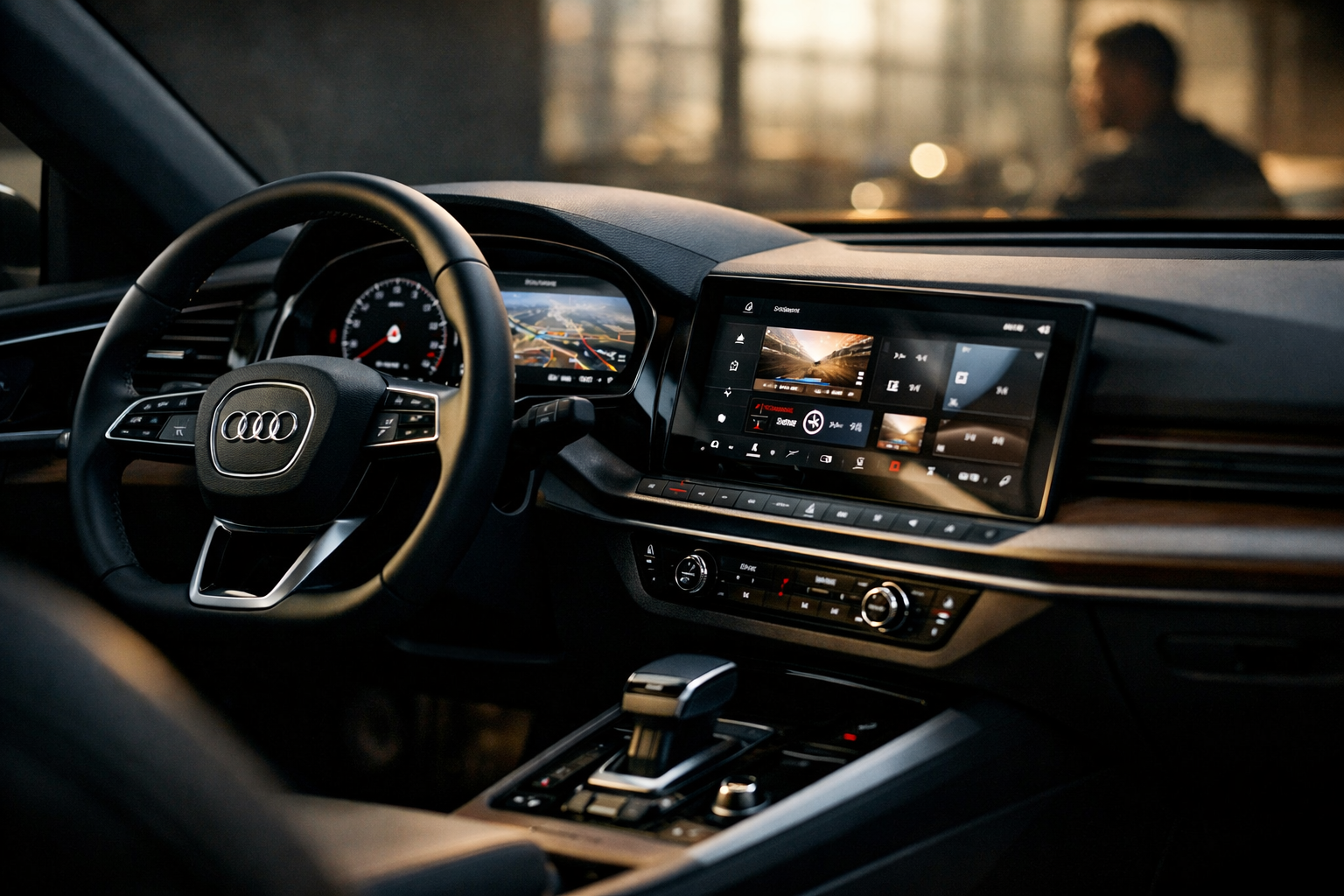
Here’s a heresy that would’ve gotten you laughed out of an Audi design studio five years ago: too many screens make cars worse. That’s not me shouting into the pub after my third pint; that’s coming straight from the Audi design chief, and it’s kicked the in-car screens debate back into the spotlight like a badly judged launch-control start. When the Audi design chief starts questioning whether a dashboard needs more glass than an Apple Store, you know something fundamental is shifting.
This matters right now because 2025 and 2026 cars are arriving with tablet-heavy interiors that feel obsolete before the first oil change. I’ve driven dozens of new SUVs where changing the fan speed requires more concentration than clipping Eau Rouge, and buyers are quietly fed up. The Audi design chief is effectively admitting that automotive UX has drifted away from humans and toward PowerPoint.
And yes, there’s a delicious irony here: Audi helped start this touchscreen arms race. Now, as the Audi design chief publicly questions screen overload, rivals like BMW, Mercedes, and Volvo are suddenly glancing nervously at their own glowing dashboards.
Quick Specs
- Starting Price: approximately $59,000 (check manufacturer website for latest pricing)
- Engine: 2.0L Turbocharged Inline-4
- Power: 261 hp / 273 lb-ft
- 0-60 mph: 5.4 seconds
- Fuel Economy: 24 city / 32 highway mpg
Why the Audi Design Chief Is Rethinking Screens
The Audi design chief didn’t say “screens are bad” outright, but the subtext was louder than a cold-start RS6. He talked about cognitive load, muscle memory, and the simple fact that humans evolved with knobs, not nested menus. Translation: drivers shouldn’t need a software update to turn on their heated seats.
This is a big deal because Audi interiors have long been poster children for clean, tech-forward minimalism. But minimalism becomes masochism when every function lives behind a glossy panel that reflects sunlight like a shaving mirror. The Audi design chief is effectively conceding that automotive UX went too far chasing Tesla vibes.
The Screen Arms Race Nobody Actually Won
Mercedes is the obvious counterpoint here, especially with the Hyperscreen in the EQS stretching nearly 56 inches across the dash. It looks spectacular, like Vegas at night, but try adjusting climate controls at 80 mph and tell me that’s progress. BMW’s iDrive 8 and Volvo’s Google-based systems aren’t innocent either, burying basic functions under layers of “intuitive” menus.
Hot take: Tesla didn’t ruin interiors; everyone copying Tesla without Tesla’s software competence did. The Audi design chief knows this, which is why his comments feel less like marketing spin and more like a quiet apology.
Automotive UX: When Touchscreens Attack
Automotive UX should reduce workload, not add to it, yet modern systems often demand eyes-on-screen time that borders on reckless. The NHTSA has already flagged distracted driving concerns linked to complex infotainment, and you can browse the data yourself at NHTSA.gov. Physical controls aren’t retro; they’re efficient.
I’ll go further: a volume knob is a safety feature. The Audi design chief hinting at a return to tactile controls feels like sanity reasserting itself after a tech bender.
Mercedes Interior Counterpoint: Style Over Sense?
Let’s talk about the Mercedes interior counterpoint because Stuttgart is doubling down where Ingolstadt is hesitating. The Hyperscreen is standard on some trims starting around $104,000, and it screams luxury showroom appeal. But live with it for a week, and you’ll miss the days when a button did one thing, every time.
Mercedes will tell you it’s about personalization and digital luxury. I’ll tell you it’s about selling screens because screens photograph well on Instagram.
Why This Shift Matters to Real Buyers
If you’re cross-shopping a 2025 Audi A6, BMW 5 Series, Lexus ES, or Mercedes E-Class, interior usability is no longer a side note. Prices starting around $55,000 to $65,000 mean buyers expect luxury without frustration. The Audi design chief pushing back on screen overload could make Audi cabins the thinking enthusiast’s choice again.
This philosophy echoes what we discussed in our deep dive on Audi’s tech-first interior debate, where restraint suddenly looks rebellious.
Engineering Honesty vs Corporate Buzzwords
What I respect is the honesty. Instead of parroting “seamless digital ecosystems,” the Audi design chief is talking about human factors like reaction time and muscle memory. That’s engineering-led design, not marketing-led design.
Compare that to some of the nonsense we’ve covered elsewhere, like artificial engine sounds in EVs, explored in our BMW Electric M3 sound debate. Not all tech makes cars better, and Audi seems ready to admit that publicly.
The Middle Ground: Screens Where They Belong
This isn’t a call to smash every touchscreen with a torque wrench. Navigation, camera systems, and deep vehicle settings belong on screens. The Audi design chief is advocating balance, not a return to 1998.
The sweet spot is a hybrid approach: physical controls for frequent tasks, screens for the rest. Mazda has quietly nailed this for years, and Lexus is finally catching on.
What Happens Next for Audi Interiors
Don’t expect Audi to rip out screens overnight. Product cycles mean changes we see in 2026 models were signed off years ago. But the Audi design chief’s comments suggest the next generation of cabins will feel calmer, more deliberate.
That aligns with Audi’s broader brand momentum, which we touched on in our analysis of Audi’s 2026 F1 branding push. Confidence brands simplify; insecure ones overdecorate.
Pros
- Clear acknowledgment that screen overload hurts usability
- Focus on human-centered automotive UX
- Potential competitive edge over Mercedes interior counterpoint
- Signals smarter, safer design philosophy
Cons
- Changes won’t arrive overnight
- Risk of confusing buyers who expect “more tech”
- Audi still helped create the problem
The Audi design chief questioning the gospel of giant screens feels like the industry sobering up after a long night of digital excess. If Audi follows through, it could shame rivals into rethinking their own glass-heavy cabins. And if not, well, at least someone in a tailored jacket finally said what drivers have been muttering all along: just give us a damn knob.