
Google confirmed on April 6, 2026, that its latest Android Automotive update 2026 will require significantly more processing power and memory, effectively pushing automakers toward higher automotive RAM requirements and deeper integration with Google’s cloud services. According to Google’s developer blog and statements shared with Reuters, the new release expands native AI assistants, over-the-air update layers, and third-party app support.
This is not a minor software patch. It signals Google’s intent to become the default operating system for connected cars—much like Android did for smartphones. Having covered three product cycles of in-car infotainment, I can tell you this pattern is familiar: software expands, hardware requirements rise, and automakers either adapt quickly or fall behind.
The Headlines
- What: Google rolled out a major Android Automotive software update with higher hardware requirements and expanded AI features
- Who: Google, Volvo, GM, Polestar, Ford, and other Android Automotive partners
- When: Announced April 6, 2026; rolling out across 2026 model-year vehicles
- Impact: Carmakers must upgrade in-car processors and memory, increasing costs but enabling richer connected features
- Key Number: 16GB+ RAM recommended for next-gen infotainment systems, up from 8GB typical in 2023 models
What Happened
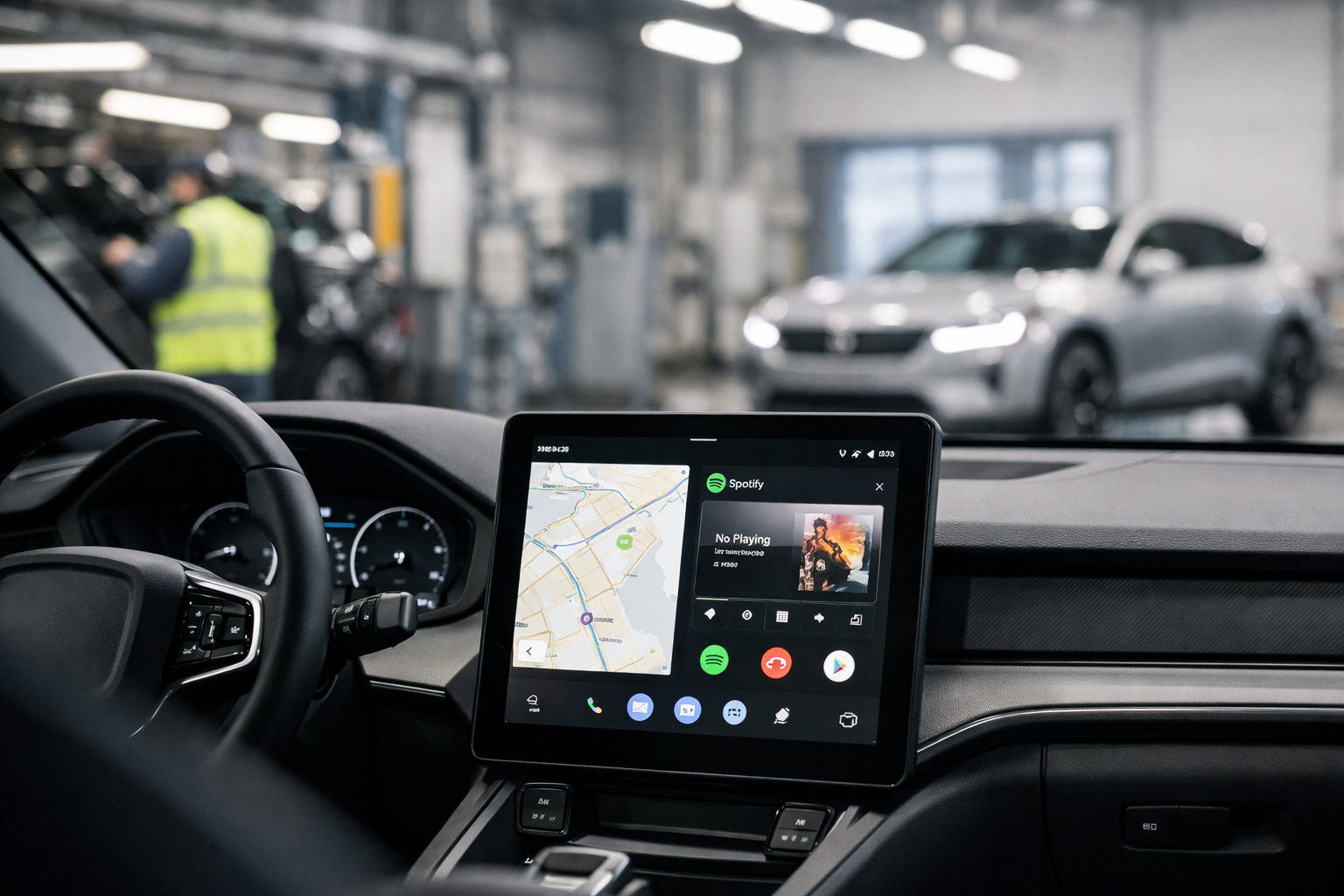
Google’s April 2026 release expands Android Automotive’s embedded AI capabilities, including an always-on voice assistant powered by Google’s Gemini models, deeper Google Maps integration, and support for more third-party streaming and productivity apps. Additionally, the company updated its developer guidelines to recommend a minimum of 16GB of RAM and more powerful multi-core processors for 2026-and-newer vehicles.
That may not sound dramatic—until you realize many 2023 and 2024 vehicles shipped with 8GB of memory and mobile-grade chips. In fact, several automakers told suppliers they are redesigning electronic control units (ECUs) to consolidate infotainment, digital cluster, and vehicle controls onto a single high-performance compute platform.
“Cars are becoming long-life computing platforms,” a Google automotive executive said during a virtual press briefing. “We’re building for a decade of updates, not a two-year phone cycle.”
Volvo, Polestar, GM, and Ford have all committed to expanding Android Automotive across more nameplates. GM, which phased out Apple CarPlay in many EVs in favor of Google built-in, said in a statement that the update will enable “richer personalization and AI-powered route optimization.”
However, higher automotive RAM requirements mean higher bill-of-material costs. Semiconductor suppliers such as Qualcomm and NVIDIA are already marketing automotive-grade chips with up to 32GB of memory support. As we explored in 300GB RAM Cars: The Next Software-Defined Leap, the industry is steadily moving toward data-center-level compute inside vehicles.
Why It Matters
Software is rapidly becoming the primary differentiator in new vehicles. According to Bloomberg Intelligence estimates, software-defined features could account for 20% of vehicle revenue by 2030. Therefore, whoever controls the operating system controls a growing slice of automotive profit.
For consumers, the appeal is seamless integration. Google Maps, voice commands, app downloads, and over-the-air fixes come natively embedded. We’ve already seen how powerful Google’s ecosystem can be through tools like AI-enhanced road trip planning, now migrating directly into dashboards.
However, there’s a tradeoff. Greater integration means greater dependence on Google’s ecosystem—and potentially less control for automakers. Apple is pursuing a parallel strategy with next-generation CarPlay, while Amazon and NVIDIA are pitching AI-driven cockpit platforms, as detailed in Amazon NVIDIA Car AI Sparks Automaker Rush.
Additionally, higher hardware specs raise vehicle costs. Memory prices have declined compared to the 2022 chip shortage, but adding 8GB more automotive-grade RAM plus a stronger processor can increase component costs by several hundred dollars per vehicle. Automakers must either absorb that or pass it on.
The Bigger Picture
The shift toward Google car software reflects a broader transformation: vehicles are evolving from mechanical products into rolling computers. The International Energy Agency has repeatedly noted that EVs contain significantly more semiconductor content than internal combustion vehicles. Meanwhile, U.S. policy incentives under the Inflation Reduction Act encourage domestic battery and chip investment, according to Energy.gov.
Notably, regulatory scrutiny is also increasing. The National Highway Traffic Safety Administration (NHTSA) has expanded its software defect investigations in recent years, as documented on NHTSA.gov. As software complexity rises, so does the risk of bugs affecting safety-critical systems.
Historically, automakers controlled proprietary infotainment stacks. However, development cycles were slow and costly. Android Automotive offers shared development costs and faster iteration—but at the price of platform dependency.
In contrast, Tesla built its own vertically integrated system, giving it unmatched control over updates and features. Traditional automakers now face a strategic fork: invest billions internally, or align with tech giants.
What the Competition Is Doing
Volvo and Polestar were early adopters and remain closely aligned with Google. GM has leaned heavily into Google integration, especially in its Ultium-based EV lineup. Ford uses Android Automotive in select models but continues supporting Apple CarPlay and Android Auto projection systems.
Meanwhile, BMW and Mercedes-Benz are doubling down on in-house operating systems. BMW’s iDrive 9 runs on Android underpinnings but retains heavy customization. Mercedes’ MB.OS aims for greater vertical control, a strategy we’ve seen echo in powertrain decisions like those discussed in Mercedes V12 Future: Flagship Engine at Risk.
Tesla, of course, remains fully proprietary. In fact, its approach eliminates third-party OS dependency entirely. However, that independence requires enormous R&D spending and talent acquisition—resources not every automaker can match.
Chinese automakers such as BYD and NIO are developing their own connected ecosystems domestically. Given China’s scale and rapid EV innovation, as we examined in China EV Innovation: Is the U.S. Missing Out?, the global software race is increasingly multipolar.
What It Means for You
If you’re buying a 2026 model-year vehicle with Android Automotive built in, expect faster response times, richer voice controls, and more integrated apps. Additionally, expect more frequent over-the-air updates that add features after purchase.
However, check hardware specs. Vehicles launching in early 2025 with older chipsets may not fully support future AI-heavy features tied to the Android Automotive update 2026 roadmap. Ask dealers about memory capacity and update guarantees—details rarely advertised prominently.
Furthermore, privacy considerations matter. Deeper integration means more driving data potentially flowing through Google services. Review data-sharing settings carefully before enabling cloud-based personalization.
What to Watch Next
Over the next 12 to 24 months, monitor which automakers upgrade hardware mid-cycle. Additionally, watch whether subscription-based features expand as compute capacity increases. Software-defined revenue models thrive on capable hardware foundations.
Equally important, pay attention to pricing. If hardware upgrades push MSRP higher in an already affordability-challenged market, buyers may push back. The success of the Android Automotive update 2026 strategy depends on delivering visible consumer value—not just backend sophistication.
The Upside
- More powerful infotainment with AI-enhanced voice and navigation
- Longer software support lifecycle through over-the-air updates
- Shared development costs across multiple automakers
- Faster feature rollout compared to proprietary systems
The Concerns
- Higher hardware costs may increase vehicle prices
- Greater dependence on Google’s ecosystem
- Potential privacy and data governance issues
- Risk of rapid hardware obsolescence in early 2025 models
Google is not just adding apps to dashboards; it is embedding itself into the core computing architecture of modern vehicles. The Android Automotive update 2026 marks a decisive step toward cars functioning like managed devices in a broader tech ecosystem.
Over the next five years, the winners will be automakers that balance powerful connected features with transparent pricing and data practices. As someone who’s watched infotainment evolve from clunky CD interfaces to AI copilots, I can say this: the operating system battle is no longer secondary. It is the automotive industry’s next frontline.
Disclosure: This article may contain affiliate links. If you make a purchase through these links, we may earn a small commission at no extra cost to you. This helps support RevvedUpCars.com. Learn more.