
China’s electric vehicle makers are rewriting the rules of the global auto industry — and American buyers may be watching from the sidelines. The surge in China EV innovation over the past three years has pushed battery costs down, software capabilities up, and sticker prices into territory Western automakers still struggle to match.
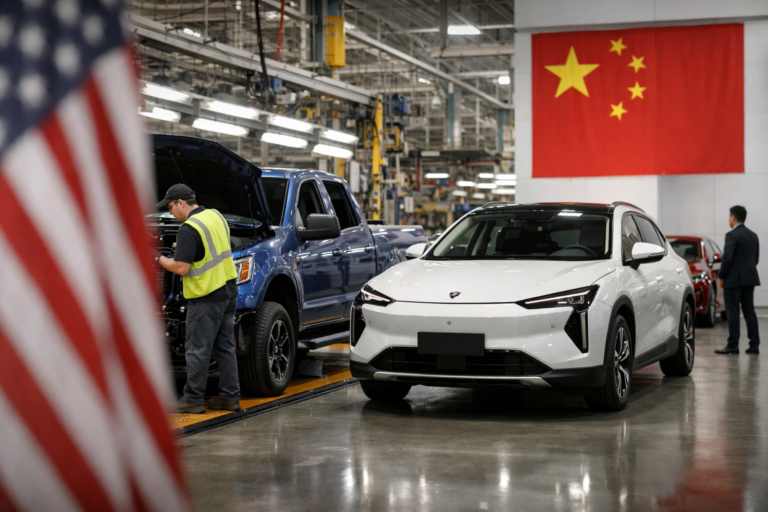
As of April 2026, Chinese brands account for more than 60% of global EV sales, according to the International Energy Agency. Yet in the United States, tariffs and trade restrictions effectively block most of those vehicles from entering the market. The result is a widening gap between what’s available in Shanghai or Shenzhen and what’s on dealer lots in Chicago or Dallas.
This isn’t just about geopolitics. It’s about whether the world’s second-largest auto market can compete on affordability and speed of innovation in the decade that will define electrification.
The Headlines
- What: Chinese automakers are accelerating EV tech and slashing prices, reshaping global competition.
- Who: BYD, SAIC, Geely, Tesla, and major U.S./European automakers
- When: Acceleration since 2023; impact intensifying through 2026
- Impact: U.S. consumers face higher EV prices and fewer choices amid trade barriers.
- Key Number: 60%+ of global EV sales now come from Chinese brands, per IEA estimates.
What Happened
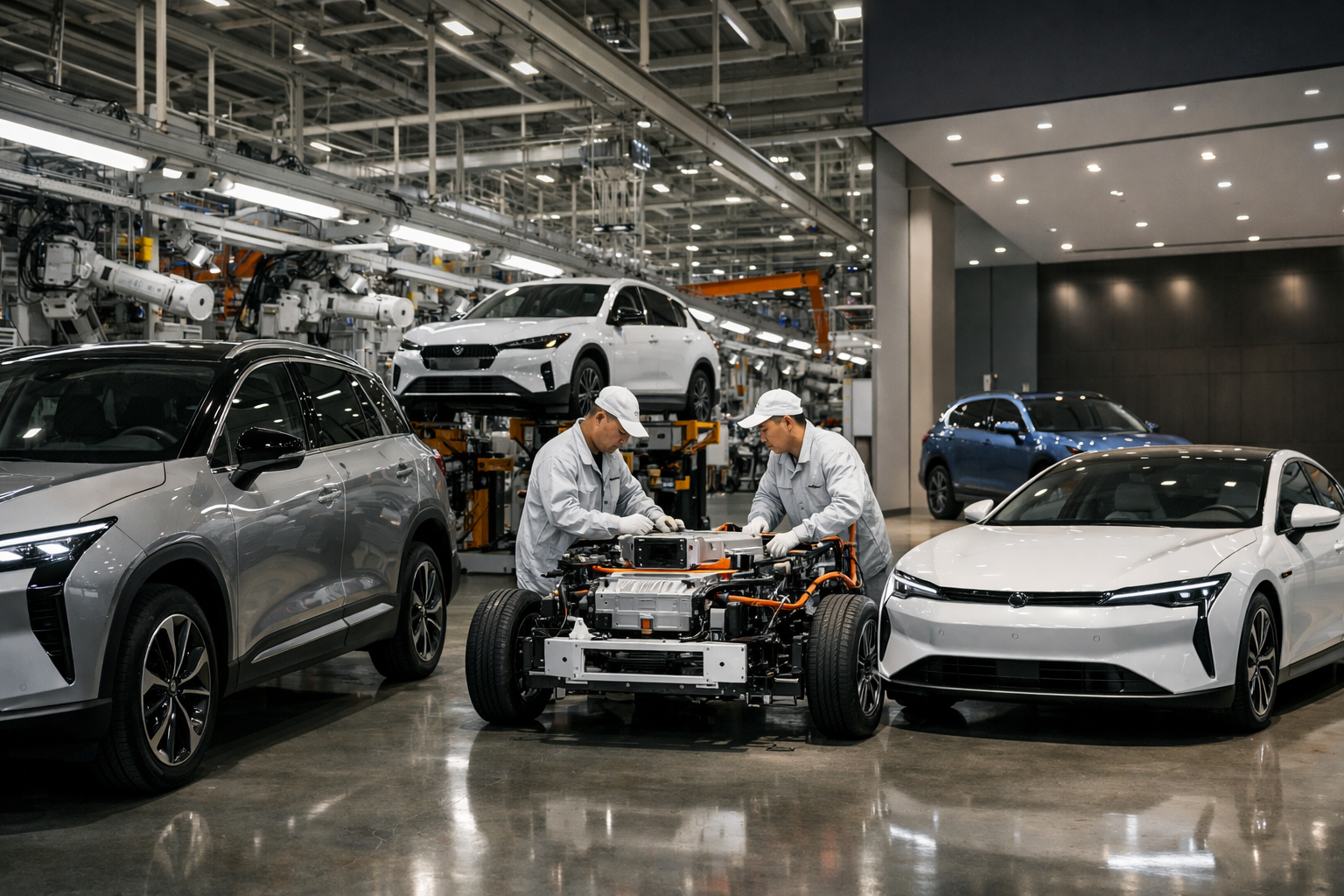
Chinese automakers didn’t just grow — they scaled at unprecedented speed. BYD sold more than 3 million new energy vehicles in 2025, according to company filings, surpassing Tesla’s global deliveries of roughly 1.9 million, as reported by Reuters. Meanwhile, SAIC and Geely expanded aggressively into Europe, Southeast Asia, and Latin America.
However, the real story is cost. BYD’s Seagull hatchback starts under $12,000 in China. Even after shipping and compliance costs, analysts at BloombergNEF estimate similar models could land in the U.S. under $20,000 — if not for the 100% tariffs imposed on Chinese EVs in 2024.
Additionally, battery innovation is accelerating. CATL and BYD introduced new lithium iron phosphate (LFP) chemistries and fast-charging architectures capable of adding 250 miles in 10–15 minutes under ideal conditions. The press releases call it “revolutionary.” The reality is more nuanced: charging infrastructure and grid capacity still limit real-world performance, especially outside China’s dense urban corridors.
Meanwhile, software integration has become a differentiator. Chinese brands now routinely offer advanced driver assistance systems, AI-powered infotainment, and over-the-air updates in sub-$25,000 vehicles — features that often require stepping into a $40,000-plus Tesla Model Y or Ford Mustang Mach-E in the U.S.
Why It Matters
The rise of China EV innovation directly reshapes global EV competition. When one market achieves massive economies of scale, everyone else feels the pricing pressure. According to the IEA’s 2025 Global EV Outlook, average battery pack prices fell below $100 per kWh in China last year — a psychological and economic milestone.
In contrast, U.S. battery costs remain higher due to smaller production volumes and supply chain localization efforts tied to Inflation Reduction Act incentives. The U.S. is building capacity — Ford, GM, and Hyundai have announced more than $60 billion combined in North American EV investments since 2022, per SEC filings — but those factories take years to reach full scale.
For consumers, the difference shows up on monthly payments. As we’ve reported in Why $800 Car Payment Is the New Normal, the average new car payment in the U.S. now hovers near $800. A $20,000 EV would materially change that math.
Therefore, the key issue isn’t whether Chinese EVs are “better.” It’s whether American buyers are missing out on a wave of affordable EV market options that could accelerate adoption and reduce emissions faster.
The Bigger Picture
This moment didn’t happen overnight. China spent more than a decade subsidizing EV production and battery manufacturing, investing billions in charging infrastructure and domestic supply chains. According to China’s Ministry of Industry and Information Technology, cumulative EV incentives since 2009 exceed $100 billion.
Meanwhile, U.S. policy has oscillated. The Inflation Reduction Act of 2022 introduced up to $7,500 in tax credits tied to North American assembly and sourcing, according to Energy.gov. However, stricter sourcing rules effectively exclude most Chinese-made batteries and vehicles.
Additionally, geopolitical tensions intensified trade barriers. We’ve already seen how tariffs ripple through pricing and supply chains in Auto Tariffs 2026: U.S. Trade Shifts Hit Industry. The same dynamics now shape the EV transition.
Globally, the competitive center of gravity has shifted east. Europe feels it acutely: the European Commission launched anti-subsidy investigations into Chinese EV imports in 2024, according to Bloomberg. In Southeast Asia and South America, however, Chinese brands are gaining market share rapidly because they undercut established players by thousands of dollars per vehicle.
What the Competition Is Doing
Tesla remains the benchmark in software integration and charging infrastructure. However, its price cuts in 2023 and 2024 signaled vulnerability to lower-cost rivals. In China, Tesla has repeatedly adjusted Model 3 and Model Y pricing to stay competitive with BYD.
Meanwhile, Volkswagen is betting on scale through its MEB platform and upcoming low-cost models, as outlined in Volkswagen 2026 Models: EV Push or Overload?. Yet VW’s ID lineup still struggles to match Chinese pricing without eroding margins.
Additionally, Ford and GM are recalibrating. Ford’s 2026 Ford Electric Truck aims to hit a more accessible price point, while GM is expanding Ultium-based models across segments. However, both companies face profitability challenges in their EV divisions, according to recent earnings calls.
In contrast, Hyundai and Kia have quietly gained U.S. EV market share with competitive pricing and strong range figures. Still, none of these brands currently offer a sub-$25,000 EV in the American market without heavy incentives.
The non-obvious insight? Chinese firms aren’t just competing on price. They’re vertically integrated — controlling batteries, semiconductors, and software stacks — which insulates them from some supply chain shocks that rattled Western automakers during 2020–2023.
What It Means for You
If you’re shopping for an EV in 2026, your choices depend heavily on geography. In China, buyers can choose from dozens of models under $25,000 with advanced features. In the U.S., realistic options under $30,000 are limited and often require stacking federal and state incentives.
However, tariffs don’t just limit imports — they shape domestic pricing strategy. Without low-cost Chinese competition, U.S. automakers face less immediate pressure to push entry-level EV prices downward. That dynamic could keep prices elevated longer than many policymakers anticipated.
Additionally, resale values and service networks matter. Chinese brands expanding into Europe are still building dealership and parts infrastructure. American buyers considering gray-market imports should think twice about warranty and compliance issues.
Therefore, if affordability is your top priority, waiting 12–24 months could make sense. Several U.S.-built lower-cost EVs are slated for 2027 production, and battery plants in Kentucky, Michigan, and Georgia are expected to ramp up capacity by then.
What to Watch Next
First, watch battery cost curves. If global pack prices fall another 10–15% by 2027, as BloombergNEF forecasts, even tariff-protected markets will feel downward pressure.
Second, monitor trade policy. A shift in U.S.-China relations — or new European tariffs — could redraw supply chains again. The affordable EV market hinges as much on diplomacy as engineering.
Finally, track profitability. If Chinese automakers begin struggling with overcapacity — a concern flagged in late 2025 earnings reports — consolidation could reshape the competitive landscape.
The Upside
- Faster global battery innovation and cost reductions
- Increased pressure on legacy automakers to improve value
- Rapid expansion of EV adoption in emerging markets
- Technological leapfrogging in software and charging speed
The Concerns
- U.S. consumers face higher prices due to tariffs
- Geopolitical tensions disrupt supply chains
- Overcapacity risks financial instability among Chinese firms
- Domestic automakers may delay aggressive price competition
Having covered three product cycles, I can tell you this pattern is familiar: innovation clusters geographically, scales rapidly, and forces everyone else to respond. The difference now is speed. What took Japan and Korea decades in combustion vehicles is happening in under ten years with EVs.
Whether American buyers ultimately gain access to the full benefits of China EV innovation depends less on engineering and more on policy. Over the next five years, the balance between protectionism and competition will determine not just prices — but who leads the automotive industry trends 2026 will be remembered for.
Disclosure: This article may contain affiliate links. If you make a purchase through these links, we may earn a small commission at no extra cost to you. This helps support RevvedUpCars.com. Learn more.