
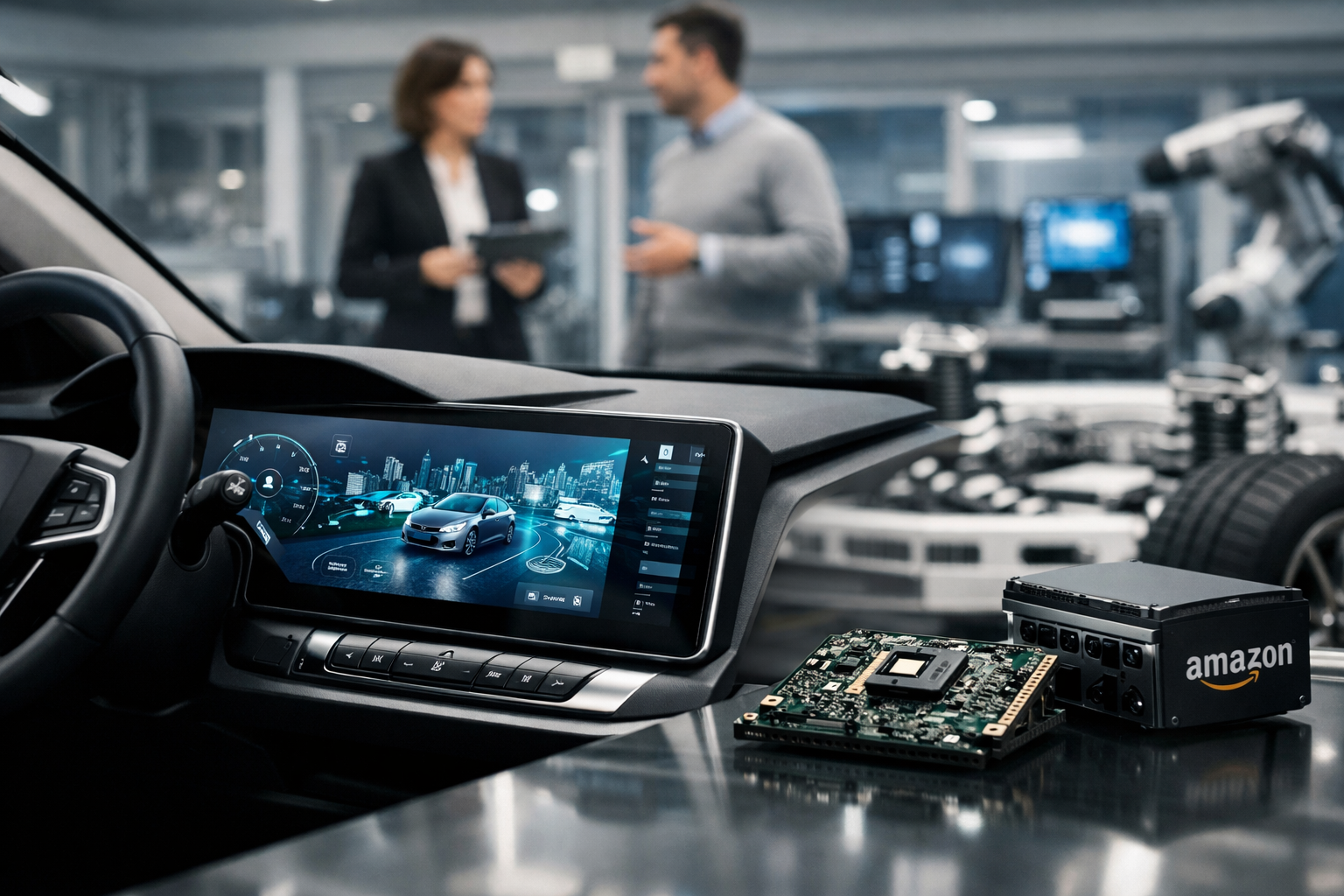
Amazon and NVIDIA want to turn your car into the next AI platform. On March 30, 2026, the companies announced an expanded partnership to embed generative AI and high-performance computing directly into dashboards, a move they say will redefine the Amazon NVIDIA car AI experience across multiple automakers starting with 2026 and 2027 model years.
This isn’t just another voice assistant update. It’s a coordinated push to merge Amazon Web Services’ (AWS) cloud and Alexa capabilities with NVIDIA’s DRIVE in-vehicle computing platform, which already powers advanced driver-assistance systems (ADAS) for brands including Mercedes-Benz, Volvo, and Hyundai. According to the companies’ joint release, the goal is to create a more conversational, context-aware in-car assistant that can manage navigation, entertainment, vehicle diagnostics, and even predictive maintenance.
Having covered three infotainment “revolutions” over the past decade, I can tell you this one has bigger stakes. The software-defined vehicle era is accelerating, and whoever controls the dashboard AI layer could control billions in recurring services revenue over the next five years.
The Headlines
- What: Amazon and NVIDIA expand partnership to deploy generative AI-powered in-car systems
- Who: Amazon (AWS, Alexa) and NVIDIA (DRIVE platform) with multiple automaker partners
- When: Announced March 30, 2026; rollout begins with select 2026–2027 models
- Impact: Smarter in car assistant features and deeper cloud integration for connected vehicles
- Key Number: NVIDIA’s automotive pipeline exceeds $14 billion, per latest company filings
What Happened
Amazon and NVIDIA formalized a deeper technical integration between AWS’s generative AI services and NVIDIA’s DRIVE AGX hardware platform. According to NVIDIA’s newsroom announcement, the updated stack will allow automakers to run large language models (LLMs) locally in the vehicle while tapping AWS for cloud-based updates and personalization.
In practical terms, that means your in car assistant could interpret natural language commands like “Find a fast charger near my next meeting and precondition the battery,” then execute them across navigation, climate control, and energy management systems. Additionally, the system can analyze vehicle data in real time for predictive service alerts—an extension of the telematics many brands already offer.
“Generative AI will transform the in-vehicle experience from command-based to conversational,” an NVIDIA executive said during the March 30 briefing.
Meanwhile, AWS confirmed that its Bedrock generative AI service will underpin many of these features, according to Reuters. The companies did not disclose specific contract values, but NVIDIA’s latest earnings report shows its automotive design-win pipeline has grown to more than $14 billion through 2030, underscoring how central automotive AI technology has become to its long-term growth.
Why It Matters
The modern car is already a rolling data center. However, most infotainment systems still rely on rigid menus and cloud-dependent voice commands that fail in low-signal areas. By combining local AI processing with cloud updates, Amazon and NVIDIA aim to reduce latency and improve reliability—two pain points consumers frequently cite in J.D. Power tech satisfaction studies.
Moreover, this shift dovetails with the broader move toward connected cars 2026, where software updates, subscriptions, and feature unlocks generate recurring revenue. According to McKinsey estimates, software-defined vehicle services could represent $400 billion annually by 2030. Automakers want a slice of that—and they need tech partners to get there.
There’s also a competitive dimension. Google’s Android Automotive OS already powers infotainment in Volvo, GM, and Honda vehicles. Apple continues to expand next-gen CarPlay integration. Therefore, Amazon and NVIDIA aren’t just improving voice control; they’re fighting for control of the dashboard ecosystem.
For consumers, this could mean fewer clunky interfaces and more seamless personalization. But it also raises data privacy questions, which we’ve covered in depth in our guide to vehicle connectivity and data protection. The smarter your car gets, the more data it generates—and shares.
The Bigger Picture
Automotive AI technology has been building toward this moment for years. Tesla proved that over-the-air updates could fundamentally change vehicle capability. Subsequently, legacy automakers invested billions in centralized computing architectures to catch up.
NVIDIA positioned itself early as the hardware backbone for ADAS and autonomous driving systems. In contrast, Amazon focused on cloud infrastructure and voice services. Now, their interests converge: edge computing in the car, with cloud augmentation in the background.
Regulators are watching closely. The NHTSA has increased scrutiny of driver-assistance systems and software updates, especially as AI systems gain more decision-making authority. Additionally, the U.S. Department of Energy has emphasized the role of intelligent energy management in EV efficiency—an area where AI-driven routing and battery optimization could deliver measurable gains.
However, history suggests caution. Automakers have overpromised on “revolutionary” infotainment before. Recall the early 2010s when touchscreens replaced buttons almost overnight—only for brands like Ferrari to backtrack, as we analyzed in our look at Ferrari’s return to physical buttons. Consumers value innovation, but not at the expense of usability.
What the Competition Is Doing
Google remains the most entrenched player in automotive software. Android Automotive OS runs natively in vehicles from Volvo, Polestar, GM, and Renault, giving Google a direct line to mapping, app ecosystems, and data services. In fact, Volvo reported strong EV growth in Q1 2026, driven partly by tech-forward models, as detailed in our coverage of Volvo’s EV sales surge.
Meanwhile, Apple is expanding its next-generation CarPlay, which integrates deeper into instrument clusters and HVAC controls. However, Apple still depends on automakers to approve that level of access, and several brands—including GM—have publicly resisted full CarPlay integration.
Tesla, notably, continues to operate a closed ecosystem. It builds its own AI chips and software stack, avoiding reliance on Amazon, NVIDIA, or Google. That vertical integration gives Tesla tighter control—but limits third-party app integration.
Therefore, Amazon and NVIDIA’s strategy sits between Tesla’s closed model and Google’s OS dominance. They’re offering modular AI layers that automakers can customize, rather than a full operating system takeover. Whether that flexibility wins contracts remains to be seen.
What It Means for You
If you’re shopping for a 2026 or 2027 vehicle, expect more marketing around AI-powered dashboards. However, don’t assume all systems are equal. Some will run more advanced local processing; others will rely heavily on cloud connectivity.
Additionally, smarter assistants could simplify road trips, charging stops, and maintenance scheduling. We’ve already seen how AI enhances navigation tools in our guide to Google Maps AI road trip planning. Extending that capability deeper into vehicle systems could make EV ownership smoother.
On the flip side, subscription fatigue is real. Many brands already charge monthly fees for connected services. If advanced Amazon NVIDIA car AI features sit behind paywalls, total ownership costs could climb—especially at a time when the average new car payment hovers near $800 per month, according to industry data.
What to Watch Next
First, watch which automakers publicly commit to this expanded platform in 2026. Mercedes-Benz and Hyundai already use NVIDIA hardware, but deeper AWS integration will signal how far they’re willing to go.
Second, monitor regulatory guidance around AI transparency and driver monitoring. As AI takes on more vehicle functions, federal agencies may require clearer disclosures and fail-safes.
Finally, pay attention to pricing models. Will AI features come standard, or will they be bundled into subscription tiers? That decision could determine consumer acceptance.
The Upside
- More natural, conversational in car assistant experiences
- Improved EV routing and energy management efficiency
- Faster local processing with reduced cloud latency
- Potential for predictive maintenance and fewer surprise repairs
The Concerns
- Increased data collection and privacy risks
- Subscription-based feature creep raising ownership costs
- Regulatory scrutiny over AI decision-making in vehicles
- Risk of overpromised capabilities versus real-world performance
Amazon NVIDIA car AI isn’t just about smarter voice commands—it’s about who owns the digital relationship between you and your car. Over the next two to five years, expect dashboards to feel less like static screens and more like adaptive digital copilots.
However, the winners won’t be the companies with the flashiest demos. They’ll be the ones who deliver reliable, intuitive systems that enhance driving rather than distract from it. The AI race is officially in your dashboard—and this time, the stakes are measured in billions.
Disclosure: This article may contain affiliate links. If you make a purchase through these links, we may earn a small commission at no extra cost to you. This helps support RevvedUpCars.com. Learn more.