
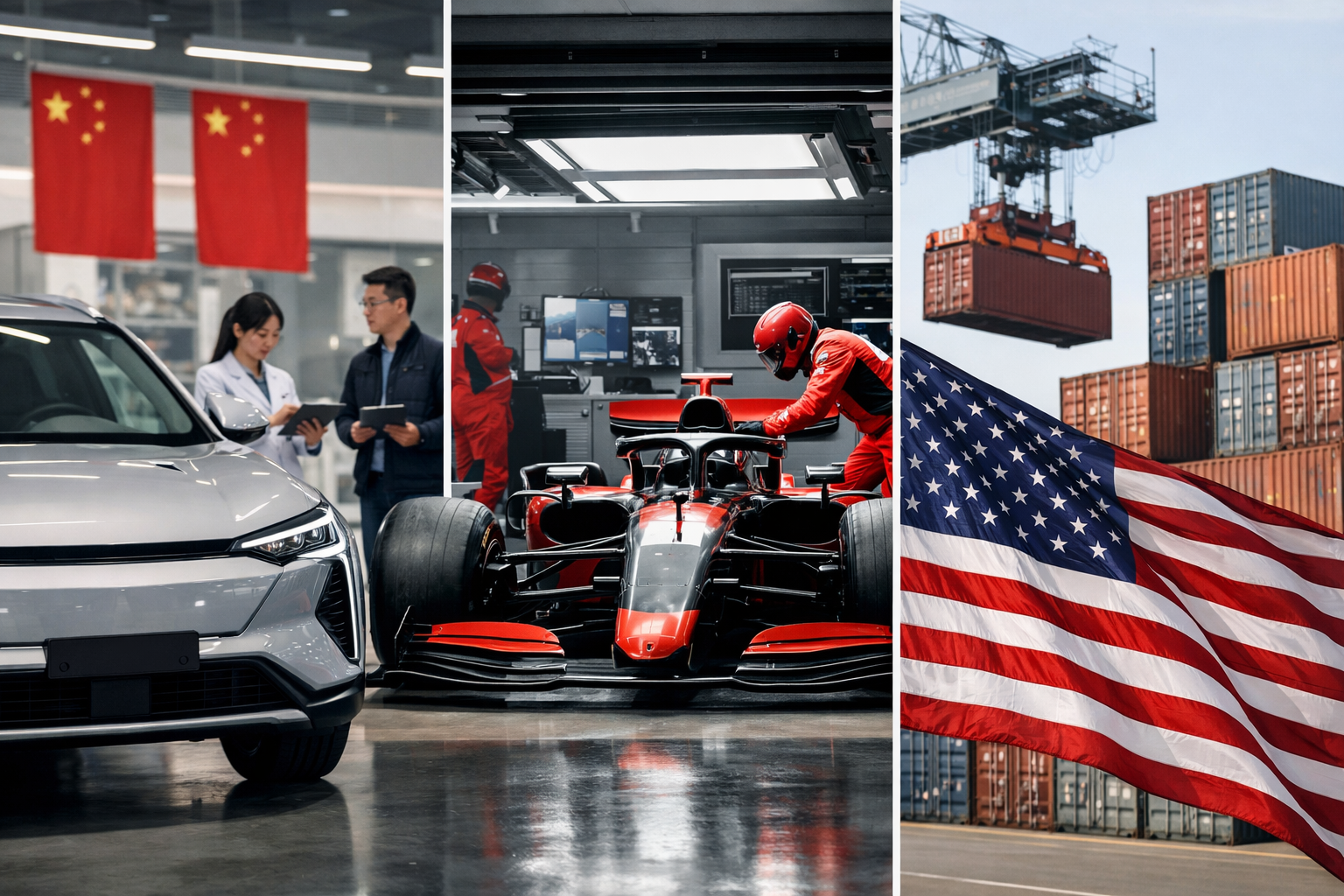
BYD is exploring a potential Formula 1 powertrain program just as Washington moves closer to tightening restrictions on Chinese vehicle imports—a pairing that underscores the collision between global ambition and BYD Formula 1 geopolitics. Multiple European outlets reported in mid-March 2026 that the Chinese EV giant has held preliminary talks with F1 stakeholders about a post-2028 engine entry, though no formal application has been filed.
However, the timing is what makes this significant. As U.S. policymakers debate expanded tariffs and even de facto barriers aimed at Chinese-connected vehicles under the banner of auto trade policy 2026, China’s largest automaker by sales is signaling it wants a seat at motorsport’s most exclusive table. That contrast—global brand-building abroad, political resistance in the U.S.—defines the current moment in the global car market.
The Headlines
- What: Reports indicate BYD is evaluating a Formula 1 power unit entry for the 2028+ engine cycle.
- Who: BYD, Formula 1, FIA; U.S. policymakers debating Chinese vehicle restrictions.
- When: Talks reported March 2026; next F1 engine regulations begin 2026, with new entrants eyed for 2028.
- Impact: Signals Chinese automakers’ global branding push amid rising U.S. trade barriers.
- Key Number: 3.02 million — BYD’s 2025 global vehicle sales, according to company filings.
What Happened
European motorsport media first reported in March 2026 that BYD executives had initiated exploratory conversations with Formula 1’s commercial rights holder and the FIA about joining as a power unit supplier in the next regulatory window. Reuters noted that F1’s 2026 engine rules—featuring 50% electrification and fully sustainable fuels—were designed specifically to attract new manufacturers.
While BYD has not confirmed a formal application, a company spokesperson told Chinese media that it is “studying global motorsport opportunities consistent with our technology roadmap.” That language is careful but deliberate. Having covered three product cycles, I can tell you this is how automakers float serious intent without locking themselves in.
Meanwhile, U.S. trade tensions continue to escalate. The Biden administration’s 100% tariff on Chinese EVs remains in place, and Congress is debating additional restrictions tied to vehicle connectivity and data security, according to reporting by Reuters. Lawmakers have cited national security concerns, particularly around connected-car data flows.
As a result, the same Chinese automakers facing what many describe as a “Chinese automakers US ban” scenario are doubling down on Europe, Southeast Asia, and Latin America. BYD sold 3.02 million vehicles globally in 2025, surpassing Tesla in pure EV volume for the second consecutive year, per company disclosures. However, it sells effectively zero passenger cars in the United States.
Why It Matters
Formula 1 is not just racing; it’s a global marketing machine reaching over 1.5 billion cumulative TV viewers annually, according to F1 data. For a company like BYD, which is aggressively expanding in Europe, an F1 presence would accelerate brand credibility in markets where Chinese badges still face skepticism.
However, there’s a strategic layer here. The 2026 F1 power unit formula emphasizes hybrid efficiency and advanced battery integration—areas where BYD has deep expertise. The company produces its own Blade batteries and semiconductors, and vertical integration has been its competitive edge. In theory, F1 becomes a technology showcase aligned with its road-car strengths.
In contrast, U.S. policy is moving the opposite direction. Under evolving auto trade policy 2026 proposals, vehicles with substantial Chinese software or hardware content could face additional scrutiny or exclusion from federal incentives. The U.S. Treasury and Department of Energy have already tightened sourcing requirements for EV tax credits, per Treasury guidance.
Therefore, BYD’s global strategy is bifurcated: brand elevation in Europe through initiatives like BYD Formula 1 discussions, and defensive positioning against American regulatory barriers. That split reflects the broader fragmentation of the global car market into regional blocs.
The Bigger Picture
Chinese automakers now account for roughly 60% of global EV production, according to the International Energy Agency. Domestically, competition has intensified to the point that price wars have eroded margins—a dynamic we explored in China Auto Sales Drop: Global Impact Now. As growth slows at home, exporting becomes a necessity, not an option.
Historically, Japanese and Korean automakers used motorsport to accelerate global acceptance. Honda and Toyota leveraged F1 and endurance racing to reshape brand perception in the 1980s and 1990s. Hyundai and Kia invested heavily in rally and performance sub-brands before achieving mainstream U.S. credibility.
However, the geopolitical overlay is new. In prior decades, trade friction meant tariffs and quotas. Today, it also means cybersecurity reviews and software supply chain audits. The U.S. National Highway Traffic Safety Administration has increased scrutiny of connected vehicle data practices, aligning with broader concerns outlined by the Commerce Department.
Additionally, Europe remains more open—for now. The EU has launched anti-subsidy investigations into Chinese EVs, according to Bloomberg, but has stopped short of U.S.-style blanket tariffs. That makes Europe the logical battleground for Chinese brands—and a logical stage for BYD Formula 1 ambitions.
What the Competition Is Doing
Tesla, which still holds roughly 18% global EV market share, has avoided traditional motorsport entirely. Instead, it leans on software leadership and direct-to-consumer sales. However, Tesla faces intensifying competition in Europe from BYD, SAIC’s MG brand, and Geely-owned Volvo.
Meanwhile, European incumbents are recalibrating. Volkswagen is pushing hard into electrification, as we analyzed in Volkswagen 2026 Models: EV Push or Overload?, but profitability remains under pressure. BMW, which we examined in BMW EV Sales: Can It Match Gas by 2030?, is betting on flexible architectures that build EVs and ICE vehicles on shared platforms.
Furthermore, Audi is already committed to entering F1 in 2026 as a power unit supplier, and Honda is returning through a works partnership with Aston Martin. If BYD joins, it won’t be alone; it will enter an increasingly crowded and expensive field.
The non-obvious insight: F1 participation doesn’t guarantee U.S. market access. Toyota raced in F1 from 2002 to 2009 and still struggled with brand perception in some segments. Therefore, BYD’s potential F1 move is more about Europe and emerging markets than cracking America.
What It Means for You
If you’re a U.S. buyer, the short-term impact is minimal. Chinese-branded passenger vehicles remain effectively absent from American showrooms due to tariffs and regulatory uncertainty. However, trade tensions influence pricing across the board. As we’ve seen with broader geopolitical shocks in pieces like Iran conflict auto industry: Prices May Rise, supply chain disruptions ripple globally.
In Europe, the story is different. A stronger Chinese presence—potentially amplified by BYD Formula 1 branding—could intensify price competition. That’s good for consumers in the near term, especially in the compact and midsize EV segments where BYD undercuts many European rivals by 10–20%.
However, U.S. buyers should pay attention to policy shifts. If Washington formalizes stricter rules under the evolving auto trade policy 2026 framework, it could reshape which EVs qualify for federal incentives. That directly affects total cost of ownership, particularly for shoppers comparing EV vs hybrid options.
Additionally, even if Chinese brands remain out, American and European automakers source components globally. Any escalation in trade restrictions could raise costs indirectly—fueling the trend we’ve documented around rising monthly payments.
What to Watch Next
First, watch whether BYD files a formal expression of interest with the FIA before the 2028 engine entry deadline. That would move this from exploratory to concrete. Additionally, monitor EU trade rulings expected later in 2026, which could impose countervailing duties on Chinese EV imports.
Meanwhile, in Washington, lawmakers are debating expanded authority to review connected vehicles under national security frameworks. If those measures pass, they could formalize what many already call a Chinese automakers US ban in practice, even if not in name.
Finally, keep an eye on sales data. If BYD’s European market share climbs above its current mid-single-digit level into the 8–10% range, motorsport branding could accelerate that trajectory.
The Upside
- Elevates Chinese engineering credibility on a global stage
- Accelerates hybrid and battery tech innovation aligned with F1 rules
- Increases price competition in Europe’s EV market
- Signals confidence from the world’s largest EV producer
The Concerns
- Geopolitical tensions could limit commercial benefits
- F1 programs cost hundreds of millions annually with uncertain ROI
- U.S. trade barriers may harden regardless of brand-building efforts
- EU anti-subsidy actions could blunt expansion momentum
Ultimately, BYD Formula 1 ambitions are less about racing trophies and more about strategic positioning in a fractured global car market. The company is signaling that it intends to compete at the highest technological and branding levels—just not necessarily in the United States.
Over the next two to five years, expect this split-screen reality to deepen: Chinese brands gaining ground in Europe and emerging markets, while America builds higher walls around its auto sector. For consumers, that means more choice and lower prices in some regions—and tighter, more politicized options in others.
Disclosure: This article may contain affiliate links. If you make a purchase through these links, we may earn a small commission at no extra cost to you. This helps support RevvedUpCars.com. Learn more.