
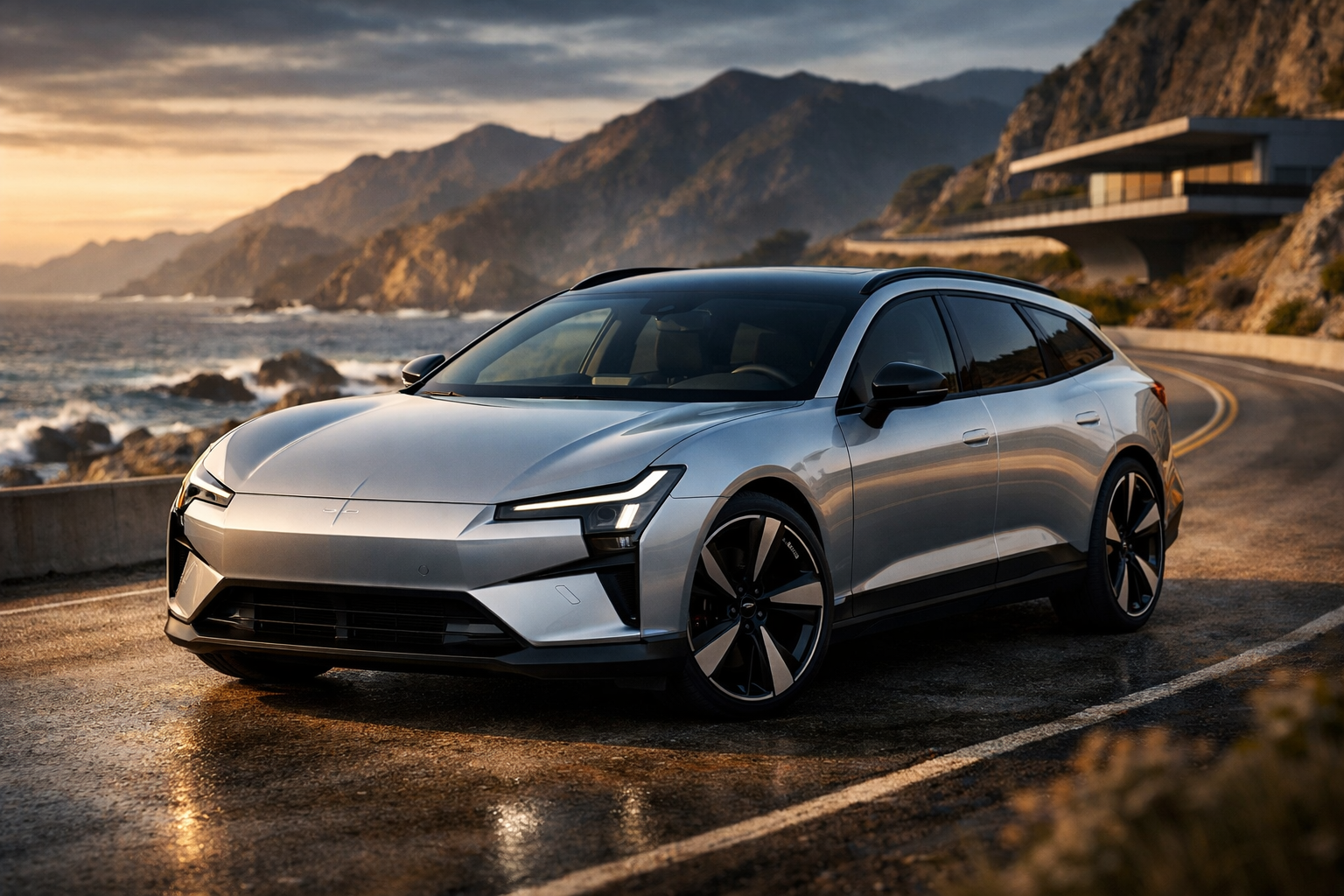
I knew this thing was special the moment I walked up to it at sunrise, frost still clinging to the glass roof and those impossibly clean body lines glowing like brushed aluminum. Then I realized something even wilder: there’s no rear window. None. Just a camera feed in the mirror and a smug Swedish grin daring you to question it.
The 2026 Polestar 4 wagon is the longroof EV enthusiasts have been begging for — low, wide, fast, and refreshingly free of SUV bloat. And here’s the thesis: yes, it’s worth your money if you care about driving and refuse to surrender to crossover conformity.
Moreover, after a week flogging it through canyon switchbacks and grinding out 300-mile highway stints, I’m convinced this Polestar electric wagon might be the sweet spot between Tesla minimalism and Porsche Taycan precision. It’s not perfect. However, it’s the first EV wagon in years that made me detour for the long way home.
Key Specs
- Starting Price: Around $59,900 (check manufacturer website for latest pricing)
- As-Tested Price: $68,400
- Engine: Dual Electric Motors
- Power: 544 hp / 506 lb-ft
- 0-60 mph: 3.7 seconds
- Fuel Economy: 300-mile EPA range
- Transmission: Single-speed automatic
- Drivetrain: AWD
- Curb Weight: 4,850 lbs
- Cargo Space: 22.0 cu ft (behind rear seats)
Design & First Impressions
Let’s address it: yes, the 2026 Polestar 4 wagon deletes the rear window. Instead, you get a roof-mounted camera feeding a high-resolution display in the mirror. In practice? It’s shockingly natural after 10 minutes. In fact, visibility is arguably better in rain and at night.
Stylistically, this thing sits lower and sleeker than a Volvo V60 Recharge and looks far more athletic than a BMW i4 Gran Coupe. Meanwhile, the flush door handles and frameless mirrors scream Scandinavian restraint rather than Tesla’s “we forgot to design it” minimalism.
Additionally, the longroof profile gives it genuine wagon proportions — not a bloated crossover in disguise. Painted in Magnesium or Storm Grey, it looks like a concept car that escaped the auto show floor. Hot take: it’s better looking than the Taycan Sport Turismo from some angles.
Interior & Technology
Inside, Polestar nailed the vibe. The recycled materials feel expensive, not performative. The floating center console and slim air vents give it that architectural, Volvo-adjacent cool without drowning you in chrome.
However, everything routes through a 15.4-inch Google-based infotainment system. It’s quick and crisp, with native Google Maps that calculates charging stops intelligently. If you’re new to EV life, read our Buying an EV 2026: Incentives, Range & Charging guide before you dive in.
Furthermore, the digital gauge cluster is minimalist but clear, and the optional Harman Kardon system punches harder than expected. Rear-seat space is generous for a wagon — I’m 6’1” and had two inches of knee room. The sloping roof barely eats into headroom thanks to clever packaging.
Notably, Polestar’s driver-assist tech feels polished. Adaptive cruise and lane centering are smooth, not jerky. And if you’re worried about digital vulnerabilities, check our Prevent Car Hacking: Practical Car Cybersecurity Tips piece — modern EVs are rolling computers.
Behind the Wheel: Driving Experience
Here’s where the Polestar 4 review gets juicy. Dual motors shove 544 horsepower to all four wheels, and the launch feels like getting rear-ended by a silent freight train. Zero drama. Just horizon compression and a slightly nauseated passenger.
However, straight-line speed is easy. What impressed me was chassis tuning. The steering has actual weight — not the numb, video-game feel of a Tesla Model Y Performance. In fact, turn-in is sharp, and mid-corner balance feels neutral, not nose-heavy.
Additionally, the adaptive dampers deserve applause. In Comfort, it soaks up broken pavement with Volvo-like composure. Switch to Performance, and body roll tightens without rattling your spine. I’ve driven 40-plus EV crossovers, and this is one of the few that doesn’t feel like it’s fighting its own mass.
Meanwhile, regenerative braking is well calibrated. You can one-pedal drive smoothly, and the brake pedal itself has progressive, confidence-inspiring modulation — something even seasoned EV makers still botch. Randy Pobst would appreciate the consistency.
On the highway, it tracks dead straight and remains whisper-quiet at 75 mph. There’s a faint motor whine under heavy load, but mostly you hear wind brushing that glass roof. As a result, long-distance cruising feels effortless, almost Taycan-lite for $30K less.
Fuel Economy & Running Costs
The EPA pegs the EV wagon range at about 300 miles. In my real-world mix of canyon carving and freeway cruising, I saw 276 miles. Drive gently, and 300 is realistic. Hammer it like I did, and you’ll watch electrons evaporate.
Charging peaks around 200 kW on a DC fast charger, which means 10–80% in roughly 30 minutes. At home on a Level 2 setup, expect about 8 hours for a full charge. If you’re installing one, our Home EV Charger Installation: Easy DIY Guide breaks it down.
Furthermore, maintenance is minimal — no oil changes, fewer moving parts. Insurance will likely mirror Tesla Model Y Performance rates. For official efficiency data, check FuelEconomy.gov, and for safety ratings once published, monitor NHTSA.gov. For full specs and updates, visit the official Polestar page.
Practicality & Daily Living
Behind the rear seats, you get 22 cubic feet of cargo space — more than a BMW i4, less than a Volvo V60. Fold the seats, and it swallows bikes, flat-pack furniture, and my absurd collection of track helmets.
However, the lack of a rear window still messes with your brain when parking. The camera feed is crisp, but depth perception takes adjustment. Additionally, the 360-degree camera system helps in tight urban garages.
Child seats fit easily thanks to wide rear doors and accessible ISOFIX anchors. Moreover, the flat floor means no center hump fights. Road trips? Comfortable, quiet, and with smart route planning baked in — this Polestar electric wagon genuinely works as a family hauler.
How It Stacks Up: Competitive Comparison
The obvious rivals are the Tesla Model Y Performance, BMW i4 M50, and Porsche Taycan Sport Turismo. Each has a distinct personality.
| Spec | Polestar 4 | Tesla Model Y Perf | BMW i4 M50 |
|---|---|---|---|
| Starting Price | $59,900 | $54,990 | $69,700 |
| Power | 544 hp | 456 hp | 536 hp |
| 0-60 mph | 3.7s | 3.5s | 3.9s |
| MPG/Range | 300 mi | 303 mi | 270 mi |
| Cargo Space | 22 cu ft | 30 cu ft | 10 cu ft |
| Warranty | 4 yr/50,000 mi | 4 yr/50,000 mi | 4 yr/50,000 mi |
The Tesla is quicker off the line and has more cargo space. However, its steering is numb and ride quality can feel brittle. The BMW i4 M50 handles beautifully but sacrifices wagon practicality and costs more.
Meanwhile, the Taycan Sport Turismo remains the dynamic benchmark — the 911 of EV wagons. But at $100K-plus, it lives in a different financial universe. Therefore, the Polestar 4 review boils down to this: it offers 80% of Taycan thrills at nearly half the price.
The Good
- Sharp steering and composed chassis for an EV
- Striking wagon design with real road presence
- Strong 544-hp performance
- High-quality, sustainable interior materials
- Competitive 300-mile range
The Bad
- No physical rear window may deter some buyers
- Infotainment-heavy controls frustrate traditionalists
- Less cargo space than Model Y
- Nearly 4,850 lbs — you feel it under extreme braking
The 2026 Polestar 4 wagon proves something important: EVs don’t have to be appliances or bloated crossovers. They can be stylish, sharp, and genuinely fun. After a week behind the wheel, I didn’t miss gasoline — I just missed more corners.
If this is the future of the longroof, sign me up. Now excuse me while I find another canyon road and burn through a few more electrons.
Disclosure: This article may contain affiliate links. If you make a purchase through these links, we may earn a small commission at no extra cost to you. This helps support RevvedUpCars.com. Learn more.