
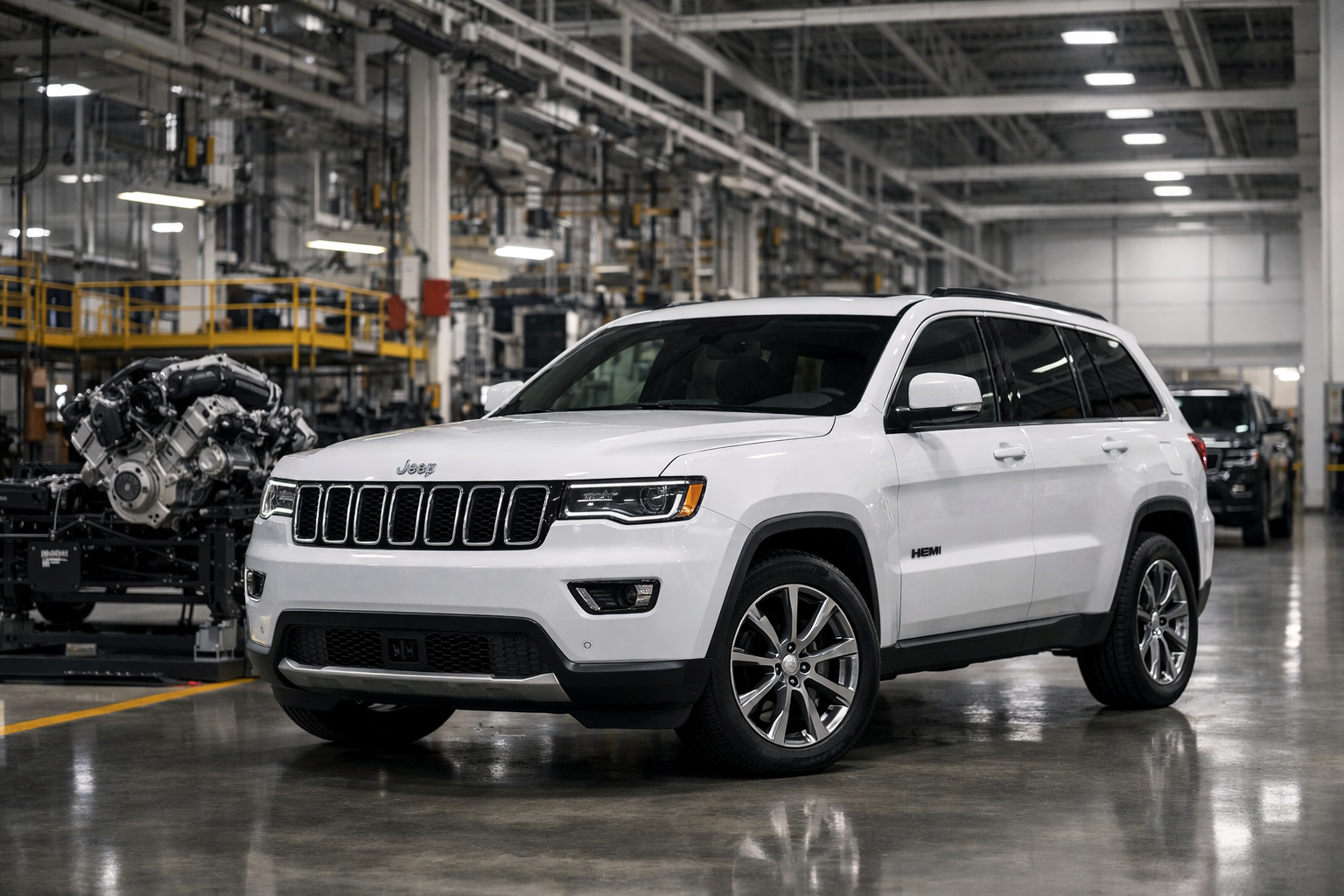
Jeep is actively evaluating a comeback for the Jeep Grand Cherokee Hemi, signaling that the V8 SUV return many enthusiasts have been asking for might not be off the table after all. According to multiple reports and dealer communications reviewed by Reuters in mid-February 2026, Stellantis is studying whether renewed consumer demand and shifting U.S. emissions policy could justify bringing the 5.7-liter Hemi V8 back to the Grand Cherokee lineup.
That matters because Jeep killed the Hemi option for the two-row Grand Cherokee after the 2022 model year, pivoting toward turbocharged six-cylinders and plug-in hybrids like the 4xe. However, slowing EV growth, strong sales of V8-powered rivals, and a political shift around federal efficiency rules are changing the calculus. The question isn’t nostalgia—it’s whether muscle SUVs still make financial sense in 2026 and beyond.
The Headlines
- What: Stellantis is evaluating a return of the Hemi V8 to the Jeep Grand Cherokee lineup
- Who: Jeep and parent company Stellantis
- When: Discussions surfaced February 2026; potential model-year timing unconfirmed
- Impact: A V8 comeback could reshape Jeep’s performance SUV strategy and pricing
- Key Number: 5.7 liters — the displacement of the potential returning Hemi V8
What Happened
Reports indicate Stellantis executives have discussed reintroducing the 5.7-liter Hemi V8 in select U.S. models, including the Grand Cherokee, following internal strategy meetings earlier this year. According to Reuters, the automaker is reassessing powertrain allocations amid regulatory uncertainty and sustained demand for higher-margin combustion vehicles.
Jeep currently offers the 3.6-liter Pentastar V6 and the 2.0-liter turbocharged 4xe plug-in hybrid in the 2025 and 2026 Grand Cherokee. The Grand Cherokee L still offers a V6 exclusively. Meanwhile, the high-performance Grand Cherokee Trackhawk—once powered by a 707-hp supercharged 6.2-liter V8—was discontinued after 2021.
While Jeep hasn’t confirmed a production timeline, insiders suggest a Hemi-equipped Grand Cherokee could slot above the V6 trims, likely starting north of $55,000 if launched. For context, the 2026 Grand Cherokee 4xe begins around $61,000 before incentives. The old 5.7-liter Hemi produced 357 horsepower and 390 lb-ft of torque, positioning it squarely between today’s V6 and any future SRT variant.
“We continue to evaluate customer demand and regulatory developments in the U.S. market,” a Stellantis spokesperson told reporters, declining to confirm specific product plans.
Why It Matters
The potential V8 SUV return isn’t happening in a vacuum. U.S. EV sales growth slowed to low double digits in 2025 after several years of 50%+ expansion, according to BloombergNEF estimates. Meanwhile, full-size and midsize SUVs with traditional engines remain profit centers for Detroit automakers.
Jeep sold approximately 244,000 Grand Cherokees in the U.S. in 2025, per company filings. However, the 4xe’s share of that volume has fluctuated with federal tax credit eligibility and gasoline prices. Additionally, uncertainty around emissions enforcement—following ongoing debates over federal rules discussed in EPA Emissions Repeal: What 2026 Buyers Need—has complicated long-term planning.
Here’s the non-obvious angle: V8s aren’t just about enthusiasts. They deliver higher transaction prices and thicker margins. In fact, performance and premium trims often account for a disproportionate share of profit despite lower volume. For Stellantis, which has faced profitability pressure in North America, a carefully limited Hemi offering could be a financial lever more than a branding exercise.
The Bigger Picture
Stellantis has already signaled a willingness to reconsider combustion strategies. Its renewed focus on diesel for certain U.S. products—outlined in our coverage of the Stellantis Diesel Return: What It Means for EVs—shows a broader recalibration. Rather than abandoning electrification, the company appears to be hedging.
Historically, Jeep’s identity has balanced off-road credibility with muscle-era swagger. The Hemi badge carried emotional weight, particularly in markets like Texas and the Midwest. However, federal Corporate Average Fuel Economy (CAFE) standards and EPA greenhouse gas rules, detailed at EPA.gov, pushed automakers to prioritize smaller engines and electrification.
Now, with policy potentially softening and competitors continuing to offer V8s, Stellantis sees an opening. The company’s SEC filings show North America remains its most profitable region. Therefore, tailoring powertrains to U.S. tastes—even if they diverge from Europe’s EV-heavy direction—could stabilize earnings over the next two to five years.
What the Competition Is Doing
Ford never abandoned the V8 formula in its larger SUVs. The 2026 Ford Explorer ST uses a twin-turbo V6, but the Expedition continues with a V6 tuned for V8-like output. More importantly, the Ford Mustang’s continued V8 production shows there’s still a business case for eight cylinders.
Meanwhile, Dodge—also under Stellantis—recently pivoted toward electrified muscle with the Charger Daytona EV while keeping a turbocharged Hurricane inline-six in the mix. That dual-path strategy mirrors what Jeep may attempt: electrified options alongside traditional performance.
Toyota offers a different model. The Land Cruiser returned to the U.S. in 2024 exclusively as a hybrid, prioritizing efficiency and torque over displacement. Chevrolet, on the other hand, still fields V8-powered Tahoes and Suburbans, maintaining a strong foothold in the body-on-frame segment.
In contrast to BMW’s cautious approach with enthusiast hardware—explored in our analysis of the BMW M Manual Transmission: Is It Doomed?—Jeep appears more willing to resurrect legacy powertrains if the numbers work. The risk, of course, is investing in an engine architecture that regulators could target again within a single product cycle.
What It Means for You
If Jeep greenlights the Hemi, expect a higher starting price and likely lower fuel economy than the V6 or 4xe. The previous Hemi Grand Cherokee averaged around 17 mpg combined, according to EPA data. Gas prices and insurance premiums will factor into ownership costs.
However, buyers who tow or simply prefer the sound and feel of a naturally aspirated V8 may find the trade-off worthwhile. Additionally, resale values for discontinued V8 models have historically remained strong, particularly limited-production trims.
If you’re shopping in 2026, the safe assumption is that any V8 return would appear no earlier than the 2027 model year. Therefore, waiting makes sense only if performance is your top priority. Otherwise, the current 4xe remains the most technologically advanced—and potentially incentive-eligible—option.
What to Watch Next
First, watch for official confirmation in Jeep’s mid-year product updates or at major auto shows. Additionally, monitor EPA rulemaking and CAFE targets through 2027, as those will directly affect viability. Finally, pay attention to Dodge and Ram product announcements—Stellantis often shares powertrain strategies across brands.
Equally important is dealer allocation strategy. If Jeep limits Hemi production, it could create scarcity pricing. Conversely, overestimating demand would hurt residual values and brand credibility.
The Upside
- Higher towing capacity and traditional V8 performance feel
- Stronger margins could stabilize Jeep’s U.S. profitability
- Broader powertrain choice for buyers hesitant about electrification
- Potential halo effect boosting overall Grand Cherokee sales
The Concerns
- Lower fuel economy and higher operating costs
- Regulatory risk if emissions standards tighten again
- Possible internal competition with 4xe models
- Uncertain long-term resale if policy shifts abruptly
The potential return of the Jeep Grand Cherokee Hemi is less about looking backward and more about hedging bets in an uncertain policy and demand environment. Having covered multiple product pivots over the past decade, I’ve seen this pattern before: automakers rarely abandon profitable formulas permanently.
Whether the V8 SUV return becomes reality will depend on regulatory clarity and consumer wallets. But one thing is clear—muscle SUVs aren’t dead yet. They’re evolving into niche, high-margin offerings, and Jeep appears ready to see if the roar of eight cylinders still translates into sales.
Disclosure: This article may contain affiliate links. If you make a purchase through these links, we may earn a small commission at no extra cost to you. This helps support RevvedUpCars.com. Learn more.