
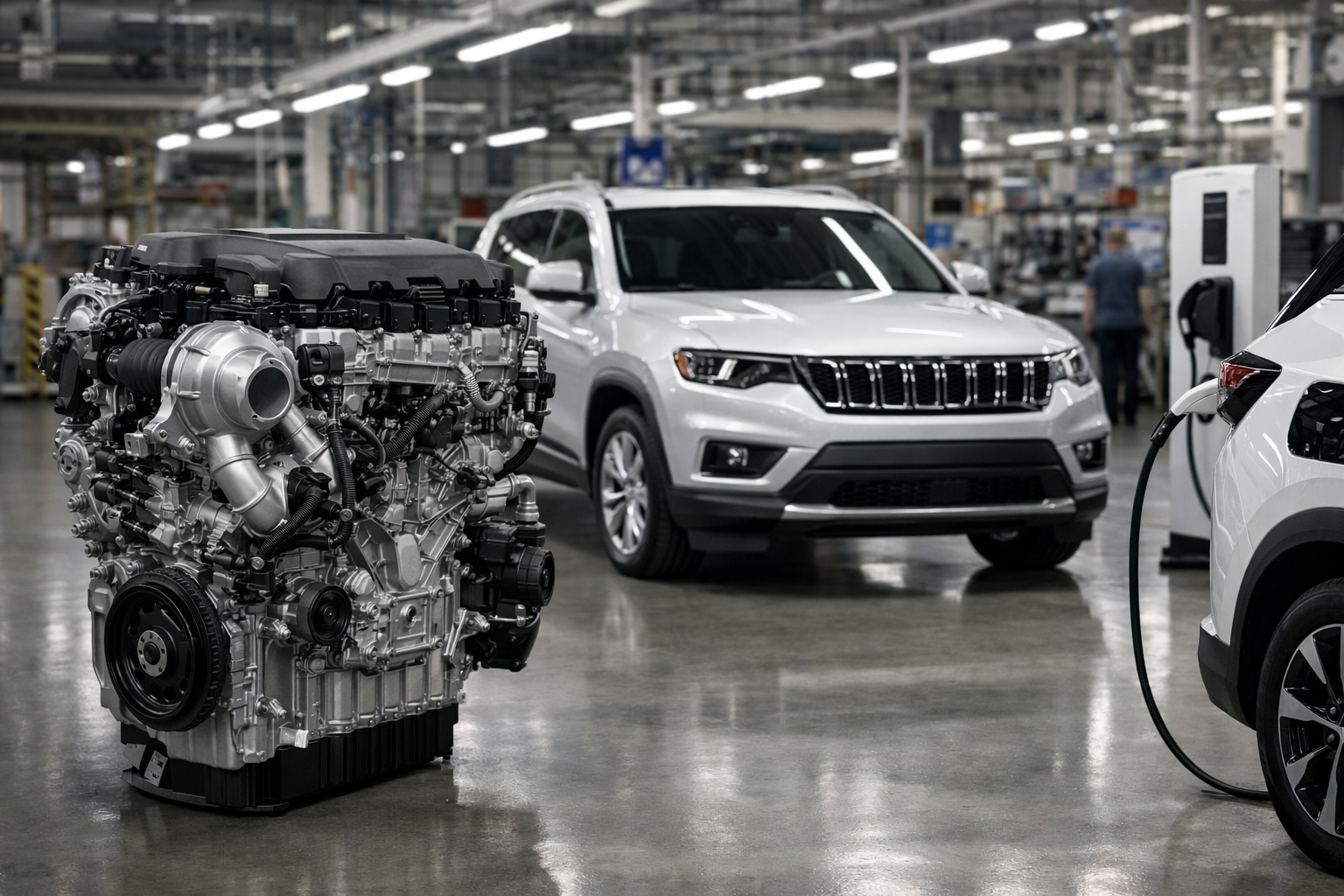
Stellantis confirmed on February 18, 2026 that it will expand diesel engine production for select Jeep, Ram, and Peugeot models, a decision executives framed as “meeting real-world demand” amid what many analysts describe as an EV slowdown. The announcement, made during the company’s full-year earnings call and detailed in its investor presentation, effectively marks a Stellantis diesel comeback at a time when most legacy automakers are still publicly committed to electrification targets.
This isn’t a wholesale retreat from electric vehicles. Stellantis says it remains committed to investing more than €50 billion in electrification through 2030. However, the pivot toward updated, cleaner-burning diesel options for 2026 and 2027 model years signals that the transition will be slower — and more complicated — than many policymakers and CEOs predicted in 2021 and 2022.
The Headlines
- What: Stellantis is expanding diesel engine offerings in 2026 despite ongoing EV investments
- Who: Stellantis (Jeep, Ram, Peugeot, Citroën) and global suppliers
- When: Announced February 18, 2026; rollout begins late 2026
- Impact: More diesel options for trucks and SUVs as EV demand growth moderates
- Key Number: €50 billion pledged for electrification through 2030
What Happened
During its earnings briefing, Stellantis executives said they will increase production capacity for next-generation Euro 7-compliant diesel engines in Europe and maintain diesel availability for Ram heavy-duty trucks in North America. According to company filings, the automaker plans to extend the lifecycle of its 2.2-liter and 3.0-liter diesel families through at least 2032.
“We are responding to customer demand in segments where electrification is progressing more gradually,” CEO Carlos Tavares said, according to the company’s official transcript.
Notably, Stellantis cited slower-than-expected EV adoption rates in key markets. In Europe, battery electric vehicles accounted for roughly 16% of new car registrations in 2025, according to ACEA data reported by Reuters, up from prior years but below earlier industry forecasts of 20%+ by this point. In the U.S., EV market share hovered around 9%, per estimates compiled by BloombergNEF.
Meanwhile, diesel still represents nearly 14% of the European passenger car market and a far larger share in light commercial vehicles. For Ram heavy-duty pickups, diesel take rates exceed 70%, according to Stellantis sales data. That profitability matters. Diesel trucks carry higher margins than entry-level EVs, particularly as battery costs remain volatile.
The company insists this is not a reversal but a “multi-energy strategy.” However, the timing — after several quarters of EV inventory buildup across the industry — makes the Stellantis diesel comeback feel less theoretical and more tactical.
Why It Matters
First, this underscores that the EV transition is uneven. While premium brands like Tesla and BMW have maintained EV momentum, mass-market automakers are navigating price sensitivity and charging infrastructure gaps. According to the International Energy Agency, global EV growth continues, but year-over-year acceleration slowed in late 2025 compared to 2023’s surge.
Additionally, regulatory pressure is shifting. The European Union’s 2035 internal combustion phase-out remains in place, but Euro 7 emissions rules were softened in 2024 after lobbying from automakers and supplier groups. In the U.S., future EPA standards remain under review, and potential policy adjustments could reshape compliance costs, as outlined by the EPA.
For Stellantis, diesel is a bridge technology. Modern diesel engines emit significantly less NOx and particulate matter than pre-2015 versions, thanks to selective catalytic reduction and particulate filters. The press release says “clean diesel is part of the solution.” The reality is more nuanced: diesel reduces CO2 per mile compared to gasoline in some applications, but it cannot match zero tailpipe emissions from EVs.
However, profitability drives strategy. Stellantis’ North American margins exceeded 15% in 2025, according to company earnings, largely due to trucks and SUVs. EVs, especially smaller ones, remain margin-thin without incentives. Therefore, maintaining diesel options protects cash flow to fund long-term electrification.
The Bigger Picture
This isn’t the first time the industry recalibrated. After the diesel emissions scandal in 2015, many automakers pivoted aggressively toward electrification. By 2021, bold EV-only declarations became standard. Now, in 2026, reality is setting in: infrastructure rollout lags, battery costs fluctuate with lithium markets, and consumer adoption follows economics more than ideology.
In fact, we’ve seen similar pragmatism elsewhere. Mazda continues researching combustion improvements, as explored in our coverage of the Mazda Rotary Engine: Why Employees Persist. Meanwhile, hybrid demand has surged — Toyota’s global hybrid sales rose double digits in 2025, offsetting softer EV growth.
Furthermore, truck buyers remain conservative. As we discussed in Compact Trucks Return: Not for Everyone, utility and towing still trump environmental signaling in many purchasing decisions. Diesel’s torque advantage and long-range capability continue to resonate with commercial operators.
The broader auto industry trends 2026 story is diversification. Instead of a straight line from gasoline to electric, we’re seeing a layered mix: hybrids, plug-ins, cleaner gasoline, diesel, and EVs coexisting longer than expected.
What the Competition Is Doing
Ford has doubled down on hybrids while slowing some EV capacity expansion, particularly for next-generation electric trucks. GM, by contrast, continues pushing its Ultium-based EV lineup but recently adjusted production targets to align with demand. Toyota remains the most vocal proponent of a “multi-pathway” approach, blending hybrids, hydrogen, and limited EV rollouts.
In Europe, Volkswagen is sticking with its EV roadmap but has kept TDI engines alive in select markets. BMW maintains diesel availability in the 3 Series and X5 in Europe, citing strong fleet demand. In contrast, Mercedes-Benz has reduced diesel offerings faster, betting on premium EV adoption.
Notably, Stellantis’ scale — 14 brands globally — gives it flexibility. Jeep can push plug-in hybrids, Ram can lean on diesel, and Peugeot can balance EVs and combustion engines market by market. Smaller automakers lack that portfolio cushion.
What It Means for You
If you’re shopping for a heavy-duty truck in 2026, this likely means continued availability of diesel variants with incremental efficiency gains. For European buyers, expect updated diesel options in midsize SUVs and vans that meet stricter standards.
However, diesel vs electric is no longer a binary choice. If you tow frequently or drive long highway distances, diesel still offers range and refueling convenience advantages. In contrast, urban commuters with home charging will likely find EVs cheaper to operate long term.
Additionally, resale values matter. Diesel trucks historically retain value well in North America. EV residuals, according to Cox Automotive estimates, have been more volatile. Therefore, buyers prioritizing predictability may see diesel as the safer bet — at least over the next three years.
What to Watch Next
Watch how regulators respond. If emissions standards tighten again or incentives shift more aggressively toward zero-emission vehicles, diesel’s extended runway could shorten. Additionally, monitor battery cost trends; if pack prices fall below $80 per kWh — a benchmark many analysts cite — EV pricing could undercut diesel faster than expected.
Furthermore, pay attention to fleet buyers. Commercial operators often lead demand swings. If logistics companies continue favoring diesel for long-haul use, the Stellantis diesel comeback could look prescient rather than reactionary.
The Upside
- Maintains consumer choice across powertrains
- Protects Stellantis profit margins to fund EV R&D
- Supports truck and commercial buyers needing torque and range
- Provides hedge against slower EV infrastructure rollout
The Concerns
- Could dilute focus and capital from EV development
- Regulatory risk if emissions rules tighten unexpectedly
- Potential brand perception setback in sustainability messaging
- Long-term diesel demand may still decline structurally
Having covered three product cycles now, I’ve learned that automakers rarely move in straight lines. The Stellantis diesel comeback isn’t nostalgia — it’s risk management in an uncertain market. Over the next five years, expect more of this pragmatism as companies balance policy ambition with consumer reality.
The electric future is still coming. However, 2026 makes one thing clear: the road there will include more diesel — and more complexity — than many predicted.
Disclosure: This article may contain affiliate links. If you make a purchase through these links, we may earn a small commission at no extra cost to you. This helps support RevvedUpCars.com. Learn more.