
You know that feeling when your buddy says, “Yeah, these tires are great off-road,” and you end up white-knuckling it through mud like you’re driving on bald pizza cutters? That’s why an off road tires guide matters. The wrong rubber can turn your 4×4 into a $50,000 sled.
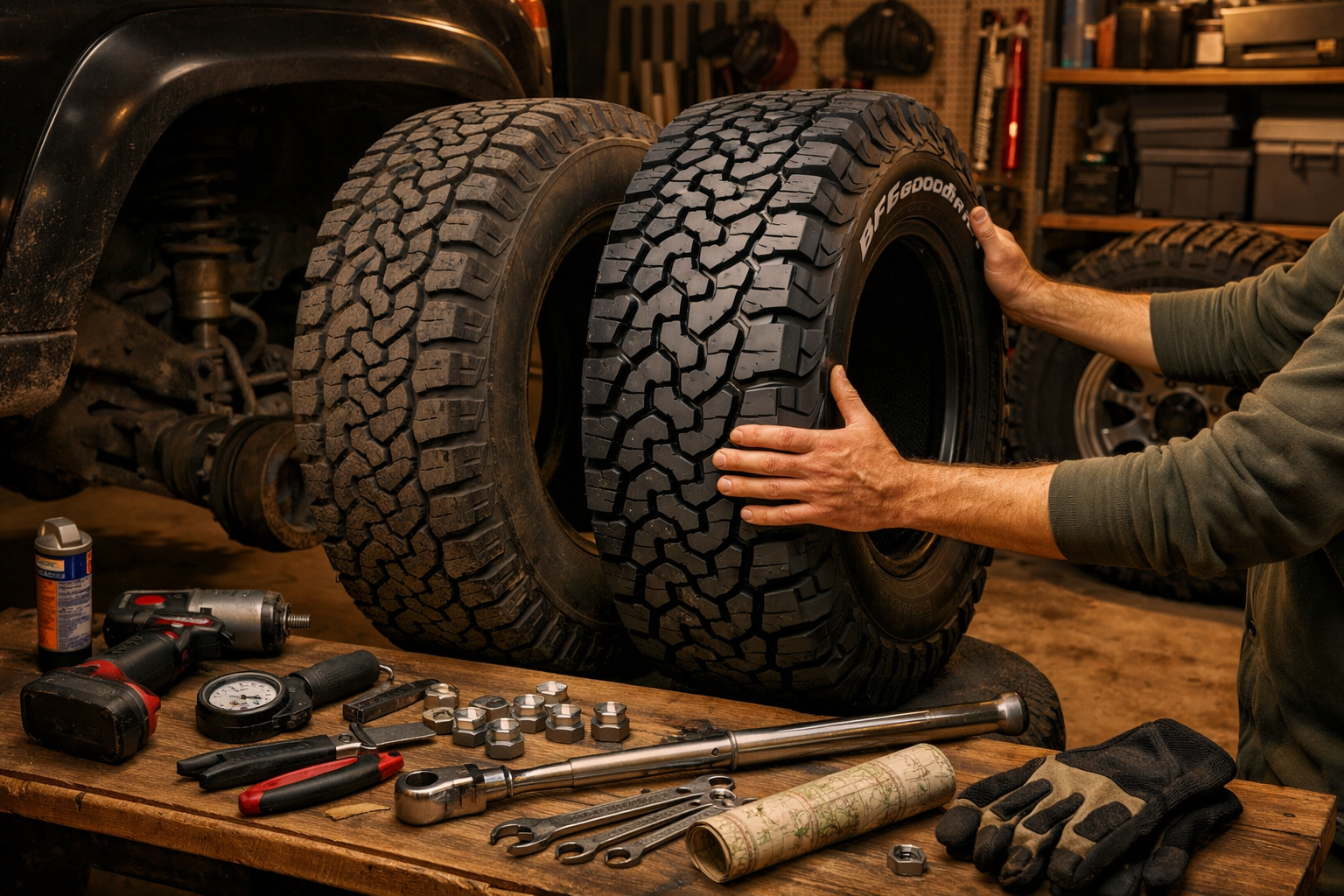
This year marks 50 years of the BFGoodrich All-Terrain T/A — one of the most copied tire designs in truck history. I’ve mounted hundreds of sets in my shop, from Tacoma trail rigs to full-size F-250 workhorses. In this guide, I’ll walk you through smart truck tire selection, real-world 4×4 tire tips, and how to decide if the BFGoodrich All-Terrain T/A is right for your build.
What You’ll Need
- Tools: Tire pressure gauge (digital preferred), tread depth gauge, tape measure, vehicle owner’s manual
- Parts/Materials: Set of 4 tires ($900–$1,800 depending on size), new valve stems ($20), optional TPMS service kit ($40)
- Time: 1 hour at a tire shop; 2–3 hours DIY with tire machine and balancer
- Difficulty: 🔧🔧 (selection is easy, mounting requires equipment)
- Dealer Cost: $1,600–$2,400 installed vs DIY Cost: $1,000–$1,800 — You Save: $400–$600
Why This Matters (Off Road Tires Guide Basics)
Tires are the only thing between your differential and the dirt. Pick wrong, and you’ll get poor traction, worse fuel economy, and uneven wear that eats a $1,200 set in 25,000 miles.
I’ve seen aggressive mud tires slapped on daily-driven trucks that never leave pavement. Result? Road noise like a C-130 and 2–3 MPG loss. On the flip side, mild highway tires in rocky terrain lead to sidewall punctures that leave you stranded 20 miles from cell service.
Most all-terrain tires last 40,000–60,000 miles with proper rotation every 5,000–7,500 miles (check your manufacturer schedule). Skip rotations and you’ll be buying tires a year early. That’s real money.
Before You Start
⚠️ WARNING: Never crawl under a vehicle supported only by a jack. If you’re checking clearance or suspension travel, use properly rated jack stands on a flat surface.
Before ordering tires, check your door jamb sticker for factory size and load rating. Then confirm clearance — especially if you drive something like the 2026 Subaru Baja or a Tacoma with a leveling kit.
Don’t DIY tire mounting unless you have a tire machine and balancer. I’ve seen guys try with pry bars. That’s how you bend wheels and wreck beads.
If you’re building a serious overland rig — like the folks importing classics using our Import JDM Land Cruiser guide — tire load rating and sidewall strength matter more than looks.
Step-by-Step Guide
- Know Your Driving Split
Be honest. Are you 80% highway, 20% trail? Or rock crawling every weekend? The BFGoodrich All-Terrain T/A KO3 (current generation) is ideal for mixed use.
Pro Tip: If you commute daily, prioritize road manners and wet traction ratings. - Choose the Right Tire Type
All-Terrain (A/T): Balanced on/off road.
Mud-Terrain (M/T): Maximum traction, louder, faster wear.
Highway-Terrain (H/T): Best fuel economy, weakest off-road.
In 20 years of wrenching, I’ve seen M/T tires wear out in 30,000 miles on pavement-only trucks. - Select Proper Size
Stock size keeps speedometer accurate and avoids rubbing. Upsizing (like going from 265/70R17 to 285/70R17) may require trimming or lift.
Consult your owner’s manual for approved sizes. Incorrect sizing can trigger ABS or traction control issues. - Check Load Rating
Load C, D, and E ratings indicate sidewall strength. E-load tires are tougher but ride stiffer.
Half-ton trucks (F-150, Silverado 1500) often do fine with Load C unless towing heavy. - Compare Real-World Performance
The BFGoodrich All-Terrain T/A stands out for 3-ply sidewalls and snow rating (3PMSF). That matters if you see winter trails.
For snow-heavy regions, also check our guide on snow tires in mild winters. - Factor in Fuel Economy
Aggressive tread = more rolling resistance. Expect 1–3 MPG drop with heavier A/T or M/T tires. The EPA explains rolling resistance basics at EPA.gov.
Common Mistakes to Avoid
- Buying for looks only. I’ve seen this in the shop a hundred times. Big lugs look cool but roar on the highway and wear unevenly.
- Ignoring load rating. Under-rated tires overheat and fail under towing loads.
- Skipping rotations. Uneven wear kills expensive tires fast.
- Forgetting spare tire match. A mismatched spare can damage differentials on 4×4 systems.
- Not checking recalls. Always verify tire recalls at NHTSA.gov.
When to Call a Professional
If you’re changing tire size significantly, adding a lift, or recalibrating TPMS, a pro shop is worth it. Expect $25–$40 per tire for mounting and balancing in 2025 pricing.
Ask the shop:
- Are you road-force balancing these?
- Will you torque lug nuts to manufacturer spec?
- Is TPMS service included?
Red flag? An impact gun hammering lug nuts without a torque wrench. That’s how studs snap.
If you’re new to vehicle safety standards, ASE-certified techs (learn more at ASE.com) are worth seeking out.
Recommended Products
- BFGoodrich All-Terrain T/A KO3: Best balance of durability and road comfort. What I’d run on a daily-driven 4Runner.
- Falken Wildpeak A/T4W: Slightly more aggressive, often $100–$200 cheaper per set.
- Goodyear Wrangler Duratrac RT: Great winter traction, louder ride.
- Milton Digital Tire Gauge ($25): Accurate pressure checks extend tire life.
If you’re still comparing options, our original off road tires guide: Choose BFGoodrich All Terrain breaks down more side-by-side details.
Do This
- Match tire type to real driving habits
- Rotate every 5,000–7,500 miles
- Check load rating before buying
- Verify torque after installation (consult manual)
Don’t Do This
- Upsize without checking clearance
- Mix tire types on a 4×4
- Ignore road noise complaints from your spouse
- Overinflate chasing better MPG
Choosing the right rubber isn’t about flexing in the parking lot — it’s about traction, safety, and not wasting $1,500. Use this off road tires guide to match your driving style, climate, and truck setup. The BFGoodrich All-Terrain T/A has earned its 50-year reputation, but the best tire is the one that fits how you actually drive.
You’ve got this. Do the homework, ask smart questions, and don’t let anyone upsell you into something you don’t need. Drop your truck and tire size in the comments if you want my take. Stay safe under there, and remember — a $20 repair manual saves a $2,000 repair bill.