
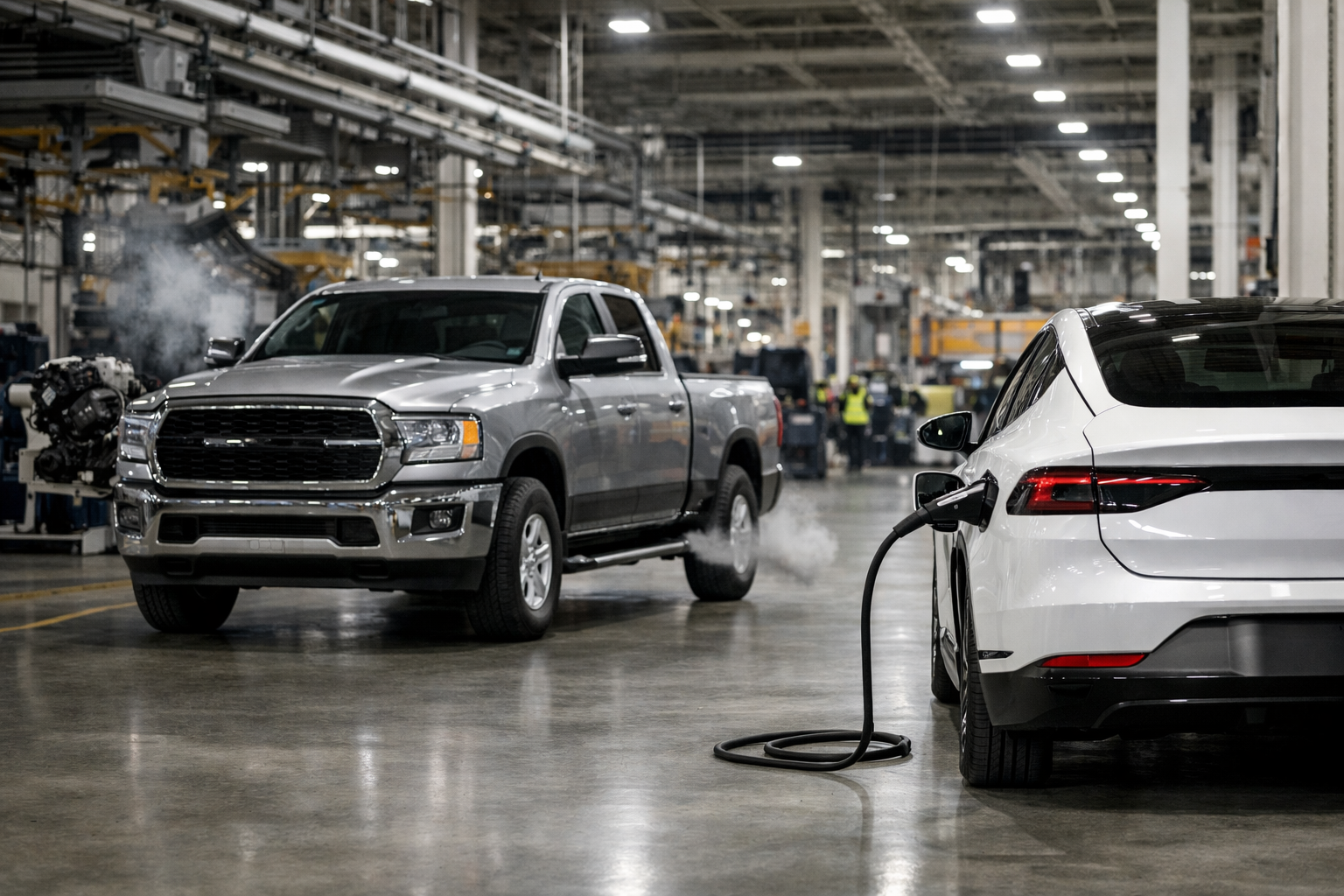
Stellantis confirmed on February 12, 2026, that it will expand diesel engine offerings across several European models for the 2026 and 2027 model years, marking what many are calling the Stellantis diesel return. The move comes as EV demand growth cools across key EU markets and hybrid sales surge, according to industry data compiled by ACEA and reported by Reuters.
However, this is not a wholesale retreat from electrification. Stellantis says it remains committed to its Dare Forward 2030 strategy, which targets 100% battery-electric passenger car sales in Europe by 2030. The reality is more nuanced: diesel is being repositioned as a compliance and profitability bridge while the EV market recalibrates.
The Headlines
- What: Stellantis is expanding diesel engine availability in select European models
- Who: Stellantis brands including Peugeot, Citroën, Opel, and Fiat
- When: Announced February 12, 2026; rollout begins late 2026
- Impact: Signals a strategic hedge as EV adoption slows in parts of Europe
- Key Number: EV sales growth in the EU slowed to single digits in 2025, per ACEA data
What Happened
Stellantis told investors last week that it will extend production of its latest Euro 6e-compliant diesel engines and reintroduce diesel variants in several compact and midsize vehicles, including Peugeot 308, Opel Astra, and select light commercial vans. Additionally, executives confirmed that certain plants in France and Germany will maintain diesel capacity through at least 2028.
According to company statements, the decision reflects “strong and sustained customer demand in key fleet and rural markets.” Bloomberg reports that fleet operators in Germany and Italy continue to favor diesel for its range and lower real-world fuel consumption, particularly in high-mileage applications.
“We are responding pragmatically to market signals,” Stellantis CEO Carlos Tavares said during a February earnings call, according to Reuters. “Electrification remains our direction, but customers must come with us.”
Notably, the engines in question are updated 1.5- and 2.0-liter turbodiesels designed to meet the EU’s stricter Euro 6e-bis standards, which take effect in stages beginning mid-2026, per the European Commission. Stellantis did not disclose exact production volumes but said capacity would be “aligned with demand.”
Why It Matters
The Stellantis diesel return lands at a pivotal moment for the European auto market. EU battery-electric vehicle (BEV) market share plateaued around the mid-teens in 2025, according to ACEA data, while hybrid sales climbed sharply. Germany, Europe’s largest auto market, saw EV incentives reduced in 2024, which dampened demand.
Meanwhile, automakers are facing a cost squeeze. Battery prices have moderated from their 2022 peak but remain volatile, according to the International Energy Agency. Therefore, diesel—already amortized, already compliant—can generate higher margins in certain segments, especially fleet vans and compact crossovers.
For consumers, the diesel vs EV debate is becoming more practical than ideological. If you drive 25,000 kilometers a year on highways, a modern diesel can still offer lower total cost of ownership than a BEV with higher upfront pricing and uncertain residuals. In contrast, urban commuters with home charging continue to benefit from EV operating costs and tax incentives.
Importantly, this is not happening in isolation. We’ve seen similar recalibrations across the industry, from Mercedes walking back some aggressive electrification messaging to Ford scaling EV production plans in Europe. Having covered three product cycles, I can tell you this pattern is familiar: ambitious EV timelines meet real-world demand curves.
The Bigger Picture
The internal combustion comeback narrative needs context. Europe still plans to ban the sale of new internal combustion passenger cars by 2035, with some allowances for e-fuels. However, the path between 2026 and 2035 is proving uneven.
According to the International Energy Agency, Europe remains one of the fastest-growing EV markets globally, but growth rates have normalized after pandemic-era surges and heavy subsidies. Furthermore, charging infrastructure expansion varies widely by country, creating regional disparities.
Stellantis is hedging against that unevenness. The company operates 14 brands in Europe and must balance regulatory compliance with profitability. Its U.S. operations face different pressures, including fuel economy rules overseen by EPA.gov, but Europe is where diesel still carries cultural and economic weight.
Interestingly, this recalibration mirrors other technology reversals in the industry. Just as automakers are reintroducing buttons after touchscreen overload—see our analysis on why physical controls are returning—manufacturers are rediscovering that consumer behavior doesn’t always move at Silicon Valley speed.
What the Competition Is Doing
Volkswagen Group has taken a more balanced approach. While pushing ID-branded EVs, VW continues to offer TDI engines in Golf, Passat, and commercial vehicles. In fact, VW’s strategy relies heavily on plug-in hybrids to bridge the gap.
Mercedes-Benz, by contrast, has publicly doubled down on EV-first branding but quietly maintained diesel options in Europe for C-Class and E-Class models. Meanwhile, BMW continues to invest in efficient diesel powertrains alongside its Neue Klasse EV platform.
Toyota sits in a different camp entirely. It has largely avoided diesel in passenger cars and focused on hybrids—a strategy that’s paying off as consumers pivot toward lower-risk electrification. Our review of the 2026 Honda Civic Sport Hybrid shows how compelling that middle ground can be in practice.
The winner in this environment may not be the boldest EV player but the most flexible. Stellantis, VW, and BMW all retain multi-powertrain portfolios. Pure EV challengers, as explored in our look at Chinese automakers vs legacy brands, face different cost structures and policy dependencies.
What It Means for You
If you’re shopping in Europe in 2026, you’ll have more diesel choices than many analysts predicted two years ago. That likely means sharper pricing and competitive lease offers, particularly in fleet-heavy segments.
However, diesel residual values remain a question mark as the 2035 ban approaches. Therefore, buying rather than leasing could carry long-term risk if regulatory timelines tighten or urban restrictions expand.
Additionally, expect automakers to emphasize “clean diesel” messaging, highlighting lower CO2 emissions compared with older models. But remember: local NOx regulations and city access rules can change quickly, especially in Paris, Milan, and Madrid.
For U.S. buyers, the impact is indirect. The Stellantis diesel return underscores that global EV adoption is not linear. That could influence future product allocations and investment priorities, especially if European profits help fund North American electrification.
What to Watch Next
First, monitor 2026 EU EV sales data. If BEV market share rebounds above 20%, this diesel expansion may prove temporary. Conversely, continued stagnation could encourage other automakers to follow suit.
Second, watch battery pricing trends. According to the IEA, sustained cost declines are essential for price parity. Without them, diesel and hybrid models will retain a cost advantage in many segments.
Finally, keep an eye on regulatory adjustments. The European Commission has faced pressure from member states to ease interim CO2 targets. Any flexibility could extend the internal combustion comeback further into the decade.
The Upside
- More powertrain choice for consumers in 2026–2028
- Potentially lower prices and better lease deals
- Improved, cleaner diesel technology meeting latest standards
- Financial cushion for automakers funding EV development
The Concerns
- Mixed signals could slow EV adoption momentum
- Regulatory uncertainty around 2030–2035 targets
- Residual value risks for diesel buyers
- Potential reputational damage in climate-focused markets
The Stellantis diesel return is less about nostalgia and more about pragmatism. Automakers are discovering that transitions at continental scale rarely follow straight lines. Over the next two to five years, expect more hedging, more hybridization, and fewer absolute declarations about the end of combustion.
Ultimately, the companies that survive—and thrive—will be those that read demand accurately rather than chasing headlines. Stellantis is betting that flexibility beats ideology. The European auto market will decide whether that bet pays off.
Disclosure: This article may contain affiliate links. If you make a purchase through these links, we may earn a small commission at no extra cost to you. This helps support RevvedUpCars.com. Learn more.