
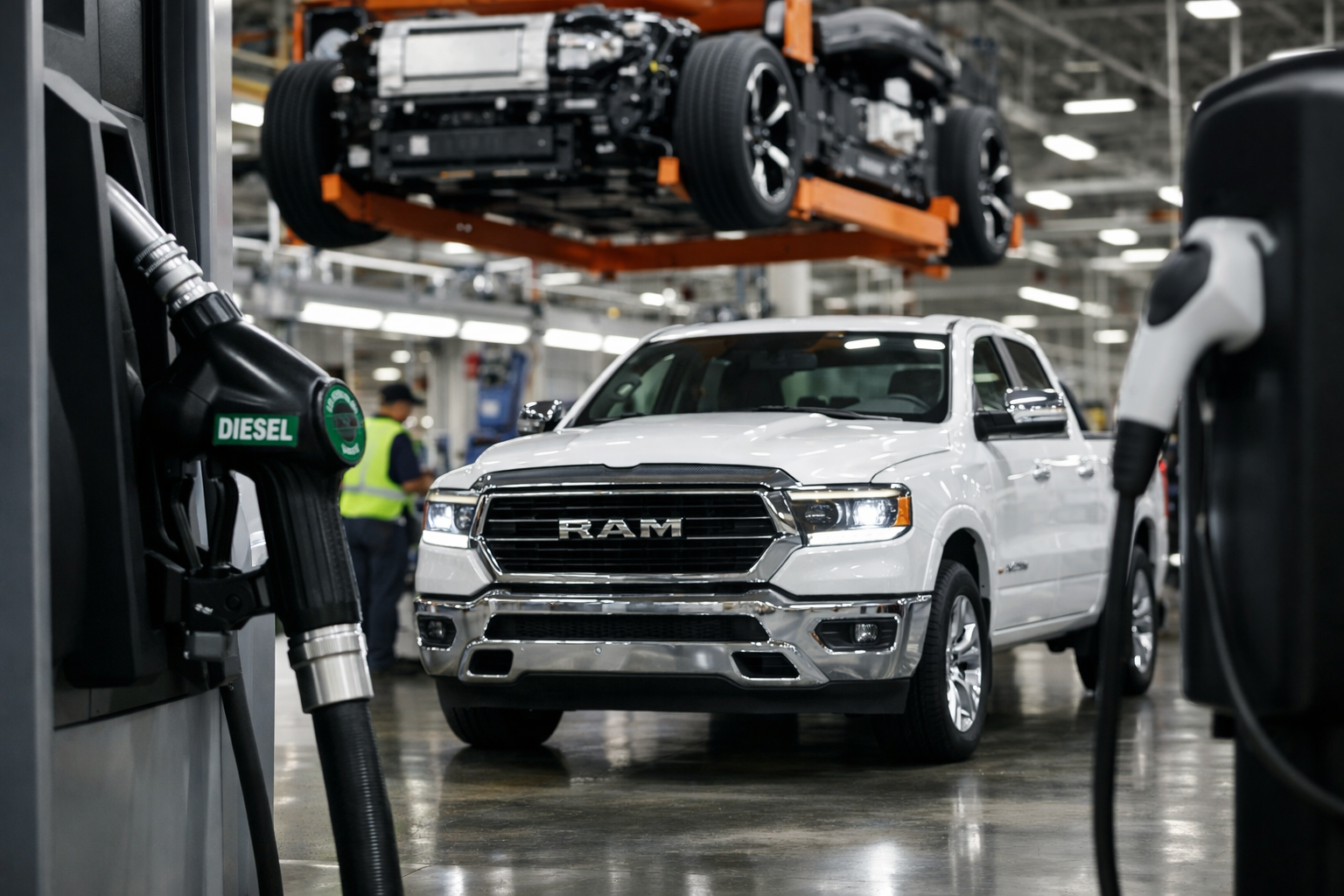
Stellantis confirmed on February 12, 2026 that it will expand diesel engine production for several European models starting later this year—a decision that puts the Stellantis diesel return squarely at the center of the EV slowdown debate. The company says renewed customer demand and softer-than-expected electric vehicle growth in key markets like Germany and Italy drove the move.
This isn’t a full retreat from electrification. Stellantis still plans to launch more than 25 new battery-electric models globally by 2027, according to prior product roadmaps. But bringing diesel back into the spotlight in 2026 signals that the EV transition in Europe is proving more uneven—and more politically fragile—than automakers predicted three years ago.
The Headlines
- What: Stellantis will boost diesel engine production for select European models amid slower EV demand
- Who: Stellantis brands including Peugeot, Citroën, Opel, and Fiat
- When: Production increases begin in late 2026
- Impact: More diesel options for European buyers as EV adoption plateaus
- Key Number: EV market share growth in Europe slowed to low single digits in 2025, according to industry data cited by Reuters
What Happened
Stellantis executives said during a February earnings call that diesel engine output at several European plants will increase in the second half of 2026. The move affects compact and midsize vehicles across Peugeot, Opel/Vauxhall, and Fiat—segments where diesel historically accounted for more than 40% of sales in some markets before Dieselgate.
According to Reuters, European EV growth cooled significantly in 2025 after years of double-digit expansion. Incentive cuts in Germany and reduced subsidies in France contributed to a plateau in battery-electric registrations. Stellantis cited “customer choice and profitability balance” as reasons to maintain multiple powertrains.
“We remain fully committed to electrification, but we will respond pragmatically to market demand,” a Stellantis spokesperson said, according to company statements.
The company has not disclosed exact production targets, but analysts at Bloomberg Intelligence estimate diesel-equipped variants could account for 20–30% of select model mix in 2026 if demand trends continue. That’s far below pre-2015 levels, but higher than many expected for this stage of the transition.
Why It Matters
The Stellantis diesel return matters because it underscores a broader recalibration happening across the industry. Europe’s EV market share reached roughly 15–18% in 2025, depending on the country, but growth slowed as energy prices, charging infrastructure gaps, and subsidy rollbacks reshaped consumer math.
Diesel engines, particularly modern Euro 6d-compliant units, still offer 15–20% better highway fuel economy than comparable gasoline engines. For high-mileage drivers, especially in rural regions with limited charging networks, that efficiency translates into lower total cost of ownership—at least until 2030 CO₂ targets tighten further.
There’s also a profitability angle. According to Stellantis’ SEC filings and earnings reports, internal combustion models currently deliver higher margins than entry-level EVs in Europe. Battery costs have fallen—BloombergNEF estimates pack prices around $100–120 per kWh in 2025—but small EVs remain challenging to price competitively without incentives.
For consumers, this means more choice in 2026. But it also signals that the path to all-electric dominance won’t be linear. We’ve seen similar recalibrations in other segments, like the internal combustion persistence debate around high-performance models—think of Mercedes’ controversial four-cylinder AMG shift covered in our analysis of the C63 Four-Cylinder: Mercedes Misread Fans.
The Bigger Picture
To understand the Stellantis diesel return, you have to go back to 2015. Dieselgate accelerated regulatory scrutiny and eroded public trust, pushing automakers toward aggressive electrification. The EU’s Fit for 55 package and 2035 combustion phase-out target set a clear direction, backed by emissions standards published by the European Environment Agency.
But policy doesn’t automatically equal consumer readiness. Charging infrastructure deployment varies widely across member states, and grid constraints remain a concern in parts of Eastern and Southern Europe. According to the International Energy Agency, EV sales growth in advanced markets slowed in 2025 compared to 2022–2023 highs.
There’s a non-obvious twist here: modern diesel engines, with particulate filters and SCR systems, have dramatically lower NOx and particulate emissions than their predecessors. The environmental gap between a Euro 6d diesel and a gasoline hybrid is narrower than many headlines suggest—though lifecycle CO₂ still favors EVs where grids are clean.
At the same time, Stellantis isn’t abandoning EVs. The company continues to invest billions in battery plants through ACC and in dedicated EV platforms like STLA Medium and STLA Large. The strategy looks less like a reversal and more like hedging—a recognition that automotive industry trends in 2026 are defined by flexibility, not dogma.
What the Competition Is Doing
Stellantis isn’t alone in adjusting pace. Volkswagen Group, which commands roughly 25% of the European market, recently reiterated its commitment to EVs but delayed certain model launches to align with demand, according to Bloomberg. VW continues offering diesel options in core models like the Passat and Tiguan.
BMW has taken a “power of choice” approach, maintaining gasoline, diesel, plug-in hybrid, and EV variants on shared platforms. In 2025, BMW reported that EVs represented about 15% of its global sales, but diesel remained significant in Europe.
Mercedes-Benz, meanwhile, is pushing high-end EVs like the AMG Electric SUV: 1,000+ HP 2026 Review, while still offering diesel in core E-Class and GLC models in select markets. The strategy mirrors Stellantis’: electrify where margins and demand justify it, retain combustion where customers still buy.
The real wildcard is Chinese automakers. As we explored in Chinese Automakers vs Legacy Brands: Should You Care?, brands like BYD and SAIC are pushing aggressively into Europe with competitively priced EVs. If they gain share, legacy automakers may face even more pressure to balance profitability with compliance.
What It Means for You
If you’re a European buyer in 2026, you’ll likely see diesel options stick around longer than expected—particularly in compact SUVs and family hatchbacks. That could mean lower upfront prices compared to EVs and better long-distance efficiency.
However, resale value risk is real. With the EU’s 2035 ban on new combustion sales still on the books, diesel vehicles purchased today may face steeper depreciation later this decade. Urban low-emission zones could also tighten restrictions before 2030.
For high-mileage drivers without reliable home charging, diesel may remain the pragmatic choice in the near term. But if you have access to subsidies and charging infrastructure, an EV still offers lower operating costs over five years in many markets, according to analyses from energy agencies and automaker TCO studies.
The key is to separate politics from practicality. The Stellantis diesel return doesn’t mean EVs are failing. It means the transition is uneven—and your personal driving pattern matters more than headlines.
What to Watch Next
First, watch EU regulatory developments. Any adjustment to 2030 or 2035 targets would immediately reshape product planning across Europe.
Second, monitor battery pricing and infrastructure rollout. If pack costs drop below $90 per kWh and fast-charging density improves, diesel’s cost advantage narrows quickly.
Third, pay attention to 2026 sales data. If EV market share rebounds above 20% in major markets, the diesel bump could prove temporary. If not, we may see other automakers quietly extend combustion lifecycles as well.
The Upside
- More powertrain choice for consumers in 2026
- Higher short-term profitability for Stellantis
- Lower upfront costs for high-mileage drivers
- Flexibility amid uncertain EV demand
The Concerns
- Potential conflict with long-term EU climate targets
- Resale value risks for diesel buyers
- Mixed messaging on electrification commitments
- Exposure to future regulatory tightening
Having covered multiple product cycles, I’ve seen this pattern before: bold electrification timelines meet economic reality, and automakers hedge. The Stellantis diesel return isn’t a retreat—it’s a reminder that transitions in the auto industry happen in waves, not headlines. The next two years will determine whether diesel’s comeback is a footnote—or a meaningful pause in Europe’s electric march.