
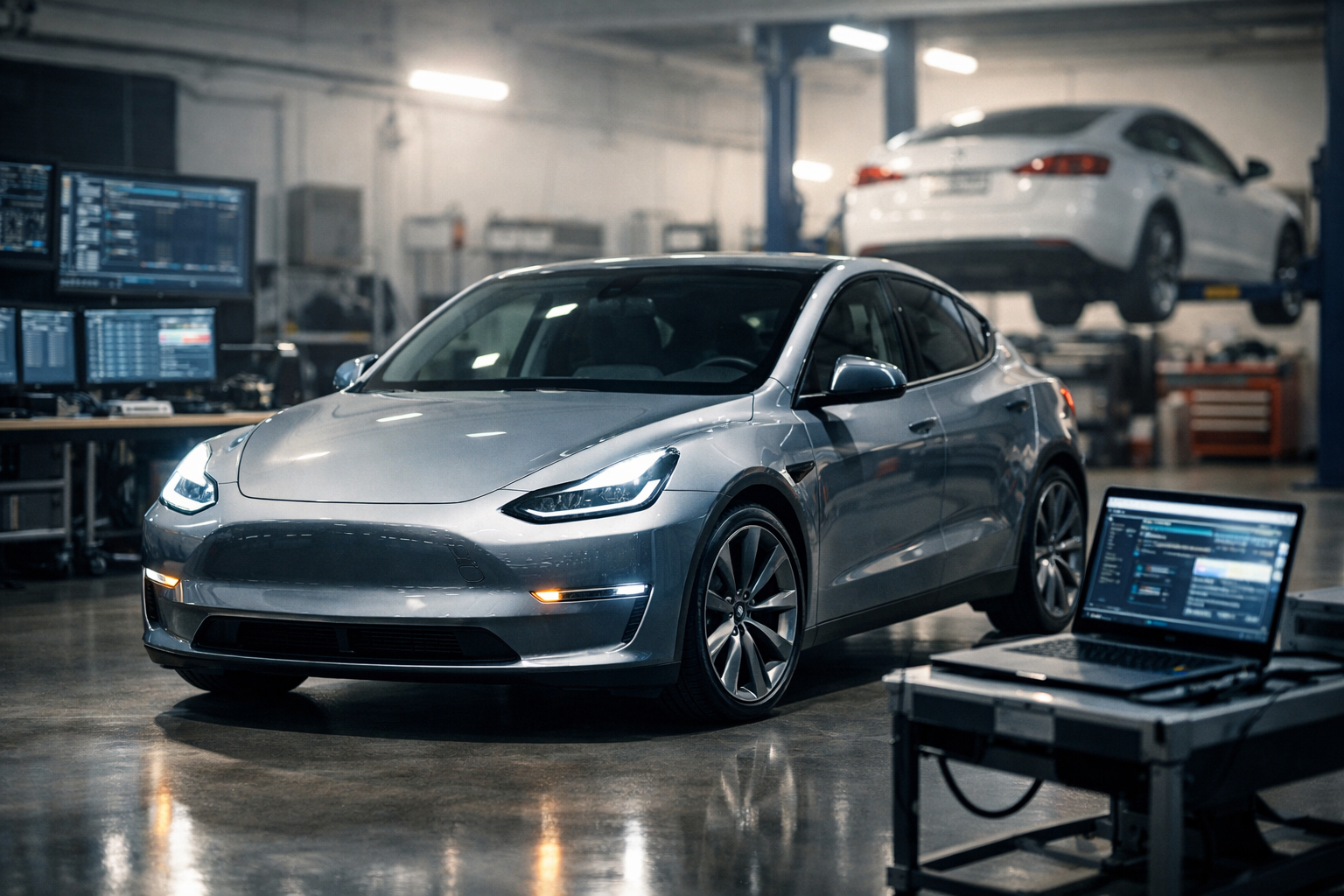
Your car now needs bug fixes. Let that sink in.
We’ve reached the point where EV software recalls are as common as oil changes used to be, except instead of a greasy technician with a wrench, it’s a silent over-the-air update pushed at 2 a.m. While that sounds futuristic, the recent Nio recall and similar cases from Tesla, Ford, and even Volkswagen prove something uncomfortable: vehicle software reliability is becoming the industry’s new Achilles’ heel.
If you’re spending starting around $45,000 on a 2025 electric SUV, you don’t expect it to behave like a beta version of Windows. Yet here we are, rebooting our cars like smartphones and crossing our fingers that the next update doesn’t disable half the dashboard.
Why EV Software Recalls Are Suddenly Everywhere
Traditional recalls used to mean faulty airbags, misrouted fuel lines, or brake hoses that chafed themselves into oblivion. Now? It’s glitchy driver-assistance systems, battery management software errors, or infotainment screens that freeze like they’ve seen a ghost.
The Nio recall in late 2025 reportedly affected tens of thousands of vehicles due to a software issue that could miscalculate battery state-of-charge under certain conditions. That’s not a squeaky trim piece—that’s range estimation, the digital heartbeat of an EV. And when your car promises 300 miles but panics at 40%, trust evaporates faster than a V12 in a drought.
Tesla has issued multiple over-the-air updates classified as recalls by the NHTSA, often addressing Autopilot behavior or warning light logic. Ford’s Mustang Mach-E and F-150 Lightning have both had software-related campaigns. Volkswagen’s ID.4? Ditto. This isn’t a Chinese-only problem, despite what some comment sections would have you believe.
The Nio Recall and What It Tells Us
Nio’s issue wasn’t about hardware failure—it was code. A few lines written in an office somewhere caused a potential misread of battery data. In a combustion car, a software hiccup might mess with your radio presets. In an EV, it can influence charging curves, thermal management, and power delivery.
I’ve driven dozens of EVs, from the Tesla Model Y (starting around $44,000, check manufacturer website for latest pricing) to the Hyundai Ioniq 5 and BMW i4. They’re brilliant machines, but they rely on millions of lines of code. When that code goes rogue, you’re not just annoyed—you’re stranded.
Here’s the controversial bit: software recalls aren’t necessarily a sign of bad engineering. Sometimes they’re evidence of ambition. Nio, Tesla, and even Mercedes with its 1,000+ hp electric SUV (see our AMG Electric SUV review) are pushing the envelope. But ambition without bulletproof testing is just expensive chaos.
Over-the-Air Updates: Blessing or Band-Aid?
Over-the-air (OTA) updates are the EV world’s favorite buzzword. Manufacturers love to say your car “gets better over time.” Sometimes it does—improved range algorithms, smoother throttle mapping, quicker UI response.
But here’s the rub: OTA also makes it easier to ship unfinished software. Imagine if Porsche released a 911 with brakes that worked “better in version 2.1.” We’d riot. Yet when an EV’s driver-assistance system needs patching, we shrug and plug in.
Vehicle software reliability should mean stability on day one, not a promise of future competence. As we argued in Why Touchscreens Went Too Far in Cars, the industry’s obsession with digitizing everything has consequences. When your door handles, climate controls, and braking regen are mediated by code, every bug matters.
Are EVs Actually Less Reliable?
Hot take: mechanically, EVs are often more reliable than combustion cars. No oil changes, fewer moving parts, no turbochargers cooking themselves to death. The average EV has roughly 20 moving parts in the drivetrain versus 2,000 in a typical ICE car.
But software is the new complexity. A 2026 Tesla Model 3, Ford Mustang Mach-E, or Nio ET5 contains multiple control units managing battery packs of 70–100 kWh, producing anywhere from 280 to 500 horsepower. That’s supercar thrust governed by code. If the code stumbles, the whole experience wobbles.
Compared to a Toyota RAV4 or Mazda CX-5—like we discussed in our CX-5 vs RAV4 comparison—EVs are technological marvels. But they’re also rolling laptops. And laptops crash.
The Regulatory Gray Area
Here’s where it gets spicy. When is a software update a “recall,” and when is it just an improvement? Regulators like NHTSA increasingly classify certain OTA fixes as official recalls, even if no parts are replaced.
That means EV software recalls are becoming more visible, not necessarily more frequent. Transparency has improved, but perception has worsened. If you see five recall notices for your 2025 EV, even if four are minor software tweaks, confidence takes a hit.
Contrast that with legacy automakers who are still catching up on software integration. As we explored in Chinese Automakers vs Legacy Brands, newer players often treat software as core DNA. Old-school brands sometimes bolt it on like an afterthought—and that’s when things really unravel.
What This Means for Buyers in 2026
If you’re shopping for a 2025 or 2026 EV—say a Hyundai Ioniq 6 (starting around $43,000), a Tesla Model Y, or a Nio ES6 in global markets—you need to ask different questions than you would for a gas car.
- How often does the brand issue OTA updates?
- Are updates seamless or dealership-required?
- What’s the track record for vehicle software reliability?
- Does the car remain drivable if a system glitches?
Check the manufacturer’s official site, like Nio’s global website, for recall notices and software policies. Also search NHTSA’s recall database by VIN. It’s not paranoia—it’s due diligence.
The Bigger Picture: Cars as Code
We’re witnessing a fundamental shift. Cars used to be mechanical objects with electrical accessories. Now they’re software platforms with wheels.
That’s not inherently bad. The Ferrari Luce and Tesla Roadster comparison we covered in Ferrari Luce vs Tesla shows just how transformative software-defined performance can be. Instant torque, adaptive suspension logic, launch control algorithms—this is wizardry.
But wizardry needs discipline. If EV software recalls become the norm, the industry risks normalizing mediocrity. We shouldn’t accept glitchy ADAS systems the way we accept phone app crashes. A car weighs 4,500 pounds and does 0–60 mph in 3.5 seconds. Stakes are slightly higher than a frozen Instagram feed.
Pros
- Over-the-air fixes can resolve issues without dealership visits
- Software updates can improve range, performance, and features
- Greater transparency from regulators like NHTSA
- Fewer mechanical failures compared to ICE vehicles
Cons
- Growing number of EV software recalls affects buyer confidence
- Critical systems increasingly dependent on complex code
- Risk of manufacturers shipping unfinished software
Verdict: The New Normal, But Not the New Excuse
EV software recalls are becoming normal—yes. But they shouldn’t become acceptable.
The Nio recall, Tesla’s frequent OTA campaigns, and similar cases across Ford, VW, and Mercedes signal a maturing industry still learning how to balance speed and stability. Vehicle software reliability will define the winners of the next decade more than horsepower or range ever will.
Cars have always needed maintenance. Now they need patches. The question isn’t whether software recalls are the new normal—it’s whether automakers can make them rare enough that we stop noticing.
Frequently Asked Questions
What are EV software recalls?
EV software recalls are official manufacturer campaigns to fix coding issues that may affect safety or performance. Many are resolved via over-the-air updates without physical repairs, but they’re still tracked by regulators like NHTSA.
Was the Nio recall a hardware problem?
No, the recent Nio recall involved a software issue related to battery management calculations. The fix was deployed through updated code rather than replacing physical components.
Are EV software recalls more common than traditional recalls?
Software-related recalls are increasing in visibility, especially for EVs. However, many are minor updates. Traditional vehicles still experience hardware recalls for brakes, airbags, and engines.
How can I check for EV software recalls on my vehicle?
You can search your vehicle’s VIN on NHTSA.gov or the manufacturer’s official website. Most brands also notify owners directly through apps or email when updates are available.