
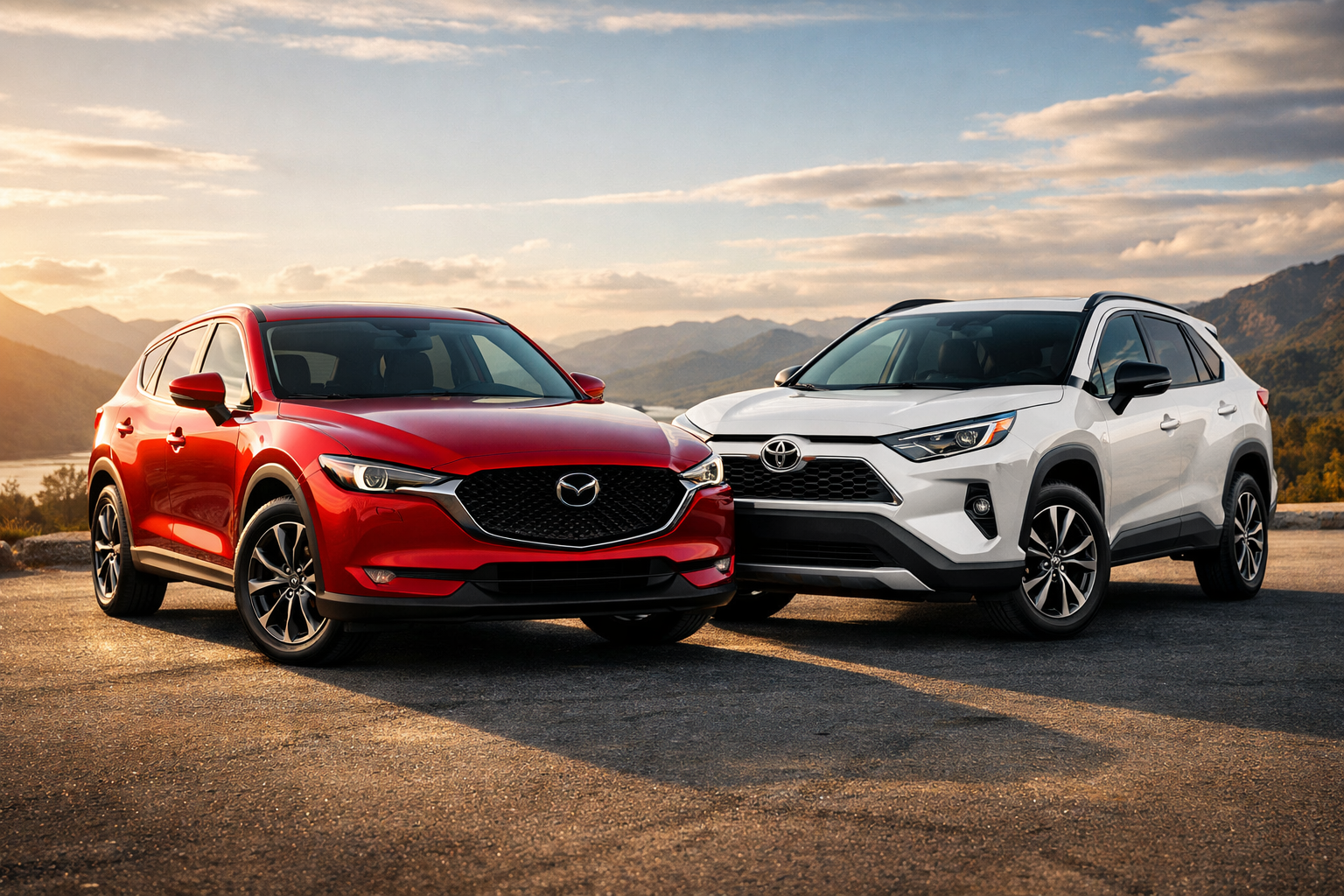
Here’s a controversial take: if you actually enjoy driving, the Toyota RAV4 might bore you to tears.
That’s awkward, because it’s America’s best-selling SUV, shifting well over 400,000 units a year. But sales charts don’t measure steering feel or throttle response. And in the great Mazda CX-5 vs Toyota RAV4 debate, enthusiasts keep sneaking back to the Mazda like it’s the secret menu item at your favorite burger joint.
So why does one of these compact SUVs still win hearts in 2026, even when the other wins spreadsheets? Let’s dig in.
Quick Specs
- Starting Price: CX-5 around $29,000 / RAV4 around $28,500 (check manufacturer website for latest pricing)
- Engine: 2.5L NA or 2.5L Turbo (CX-5) / 2.5L NA or 2.5L Hybrid (RAV4)
- Power: Up to 256 hp (CX-5 Turbo) / 203 hp gas, 219 hp hybrid (RAV4)
- 0-60 mph: ~6.5 sec (CX-5 Turbo) / ~8.0 sec gas, ~7.4 sec hybrid (RAV4)
- Fuel Economy: Up to 22/27 mpg (CX-5 Turbo) / Up to 41/38 mpg hybrid
The Contenders
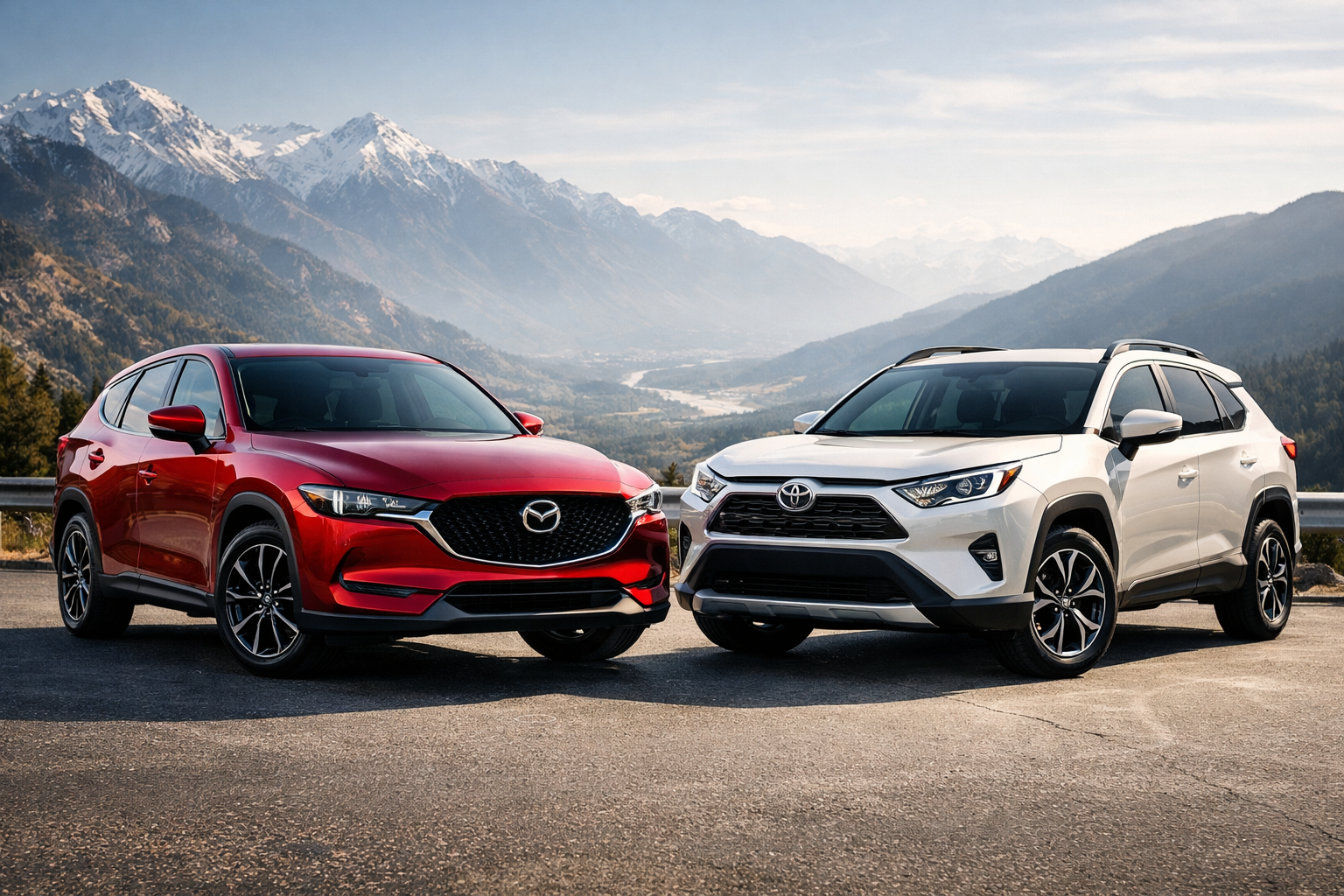
The 2025–2026 Mazda CX-5 is the enthusiast’s compact SUV. It starts at approximately $29,000 and tops out north of $40,000 in Signature trim with a 256-hp turbocharged 2.5-liter engine. It’s been around a while, but Mazda keeps polishing it like a favorite leather jacket.
The 2026 Toyota RAV4 starts slightly lower, around $28,500 for the gas model, and climbs past $39,000 for hybrid trims. You get 203 hp from the standard 2.5-liter four-cylinder or 219 hp combined in the hybrid. If you care about fuel economy, the hybrid’s 41 mpg city rating (per FuelEconomy.gov) is basically witchcraft.
They’re cross-shopped with the Honda CR-V, Hyundai Tucson, Subaru Forester, and even the Nissan Rogue. But only one of them makes you take the long way home.
Design Face-Off
The CX-5 looks like it wandered in from a luxury brand’s design studio after hours. Long hood, tight surfacing, slim headlights—it’s got presence. Park it next to a BMW X3 and it doesn’t look like the rental-spec cousin.
The RAV4? It’s gone full Tonka truck. Chunky cladding, aggressive angles, and enough fake skid plate to survive exactly zero boulders. Some people love the rugged cosplay; I find it trying a bit too hard.
Hot take: the CX-5 will age better. Mazda’s “Kodo” design language is clean and cohesive, while the RAV4’s origami-on-pre-workout look could feel dated in five years.
Interior & Tech
Slide into the CX-5 and you’re greeted by stitched leather, real metal trim, and switchgear that clicks with satisfying precision. It feels expensive, even at $32,000. Mazda’s infotainment still uses a rotary controller instead of going full tablet-on-dash, which I applaud after ranting about how touchscreens went too far in cars.
The RAV4’s interior is functional and durable, but it’s hardly special. Hard plastics lurk below the beltline, and while the latest 10.5-inch touchscreen is clear and quick, it’s still a bit Fisher-Price compared to the Mazda’s understated elegance.
Space is where Toyota fights back. The RAV4 offers about 37.6 cubic feet of cargo space behind the rear seats versus roughly 30.9 in the CX-5. If you’re hauling strollers, Labradors, or IKEA regrets, that difference matters.
Performance
This is where the Mazda CX-5 vs Toyota RAV4 conversation gets spicy.
The base CX-5’s 187-hp engine is fine—adequate, even—but the 256-hp turbo transforms it. Zero to 60 mph in about 6.5 seconds is properly quick for a compact SUV. More importantly, the steering has actual feel, and the chassis doesn’t flop about like a Labrador in a swimming pool.
The RAV4 gas model does 0-60 in roughly 8.0 seconds, and it feels every bit of that. The hybrid is quicker at around 7.4 seconds, but the CVT-like e-CVT transmission delivers power with all the drama of a microwave timer. Efficient? Yes. Engaging? Not remotely.
I’ve driven dozens of SUVs in this class, and the CX-5 is the only one that genuinely reminds me of a slightly lifted hatchback. It corners flatter than a CR-V, feels more planted than a Forester, and doesn’t isolate you from the road like a Tucson.
Fuel Economy & Running Costs
If you commute 50 miles a day, the RAV4 Hybrid is the financial genius here. Up to 41 mpg city and 38 highway means fewer fuel stops and more smug satisfaction. Over 15,000 miles a year, that can mean hundreds saved versus the CX-5 Turbo’s 22/27 mpg.
Mazda’s naturally aspirated CX-5 does better, around 24/30 mpg, but it still can’t touch Toyota’s hybrid wizardry. And Toyota’s long-standing reputation for reliability—backed by solid scores from NHTSA safety data and historical dependability—adds peace of mind.
If your SUV is an appliance, the RAV4 Hybrid is the energy-efficient fridge with an A+++ rating. The CX-5 Turbo is the gas stove that makes cooking more fun.
Value Breakdown
On paper, Toyota wins. Slightly lower starting price, better resale, outstanding hybrid economy. For families comparing monthly payments, it’s the rational choice.
But value isn’t just dollars per mile. In the Mazda CX-5 vs Toyota RAV4 debate, the CX-5 gives you near-luxury materials and genuinely engaging dynamics for thousands less than an entry-level Audi Q5 or Lexus NX. That’s a bargain in enthusiast terms.
And let’s not forget buying experience. Tools like modern car buying software are streamlining the process, but when you finally drive both back-to-back, the Mazda’s personality is obvious within two corners.
| Spec | Mazda CX-5 | Toyota RAV4 |
|---|---|---|
| Starting Price | $29,000 | $28,500 |
| Power | Up to 256 hp | 203 hp (219 hp hybrid) |
| 0-60 mph | ~6.5s (Turbo) | ~8.0s gas / ~7.4s hybrid |
| MPG/Range | Up to 24/30 mpg | Up to 41/38 mpg (hybrid) |
| Cargo Space | 30.9 cu ft | 37.6 cu ft |
| Warranty | 3 yr/36,000 mi | 3 yr/36,000 mi |
Pros
- CX-5: Best-in-class driving dynamics
- CX-5: Premium interior feel for the money
- RAV4: Outstanding hybrid fuel economy
- RAV4: More cargo space and strong resale value
Cons
- CX-5: Tight rear seat and smaller cargo area
- RAV4: Bland driving experience
- RAV4: Interior materials feel cheaper in lower trims
The Winner
If you view your SUV as a tool—something to move kids, groceries, and golden retrievers with minimal fuss—the RAV4 Hybrid is brilliant. It’s efficient, practical, and about as risky as ordering vanilla ice cream.
But in the Mazda CX-5 vs Toyota RAV4 showdown, the CX-5 still wins over enthusiasts. It’s the one you glance back at in the parking lot. The one that makes a freeway on-ramp feel like an event rather than an obligation.
The Toyota is the sensible choice. The Mazda is the one with a pulse. And life’s too short to drive something that doesn’t have one.
Frequently Asked Questions
Which is better in the Mazda CX-5 vs Toyota RAV4 comparison?
The CX-5 is better for driving enjoyment and interior quality. The RAV4, especially the hybrid, wins on fuel economy (up to 41 mpg city) and cargo space. Your priorities determine the better choice.
Is the Mazda CX-5 more reliable than the Toyota RAV4?
Toyota has a longer track record for bulletproof reliability. Mazda scores well in recent reliability studies, but historically the RAV4 has the edge in long-term dependability and resale value.
Does the RAV4 Hybrid feel faster than the CX-5?
The RAV4 Hybrid is quicker than the base CX-5, hitting 0-60 in about 7.4 seconds. However, the CX-5 Turbo is significantly faster at roughly 6.5 seconds and feels more responsive.
Which SUV has more cargo space?
The Toyota RAV4 offers about 37.6 cubic feet behind the rear seats, compared to roughly 30.9 cubic feet in the CX-5. Families needing maximum space will appreciate the RAV4’s larger trunk.