
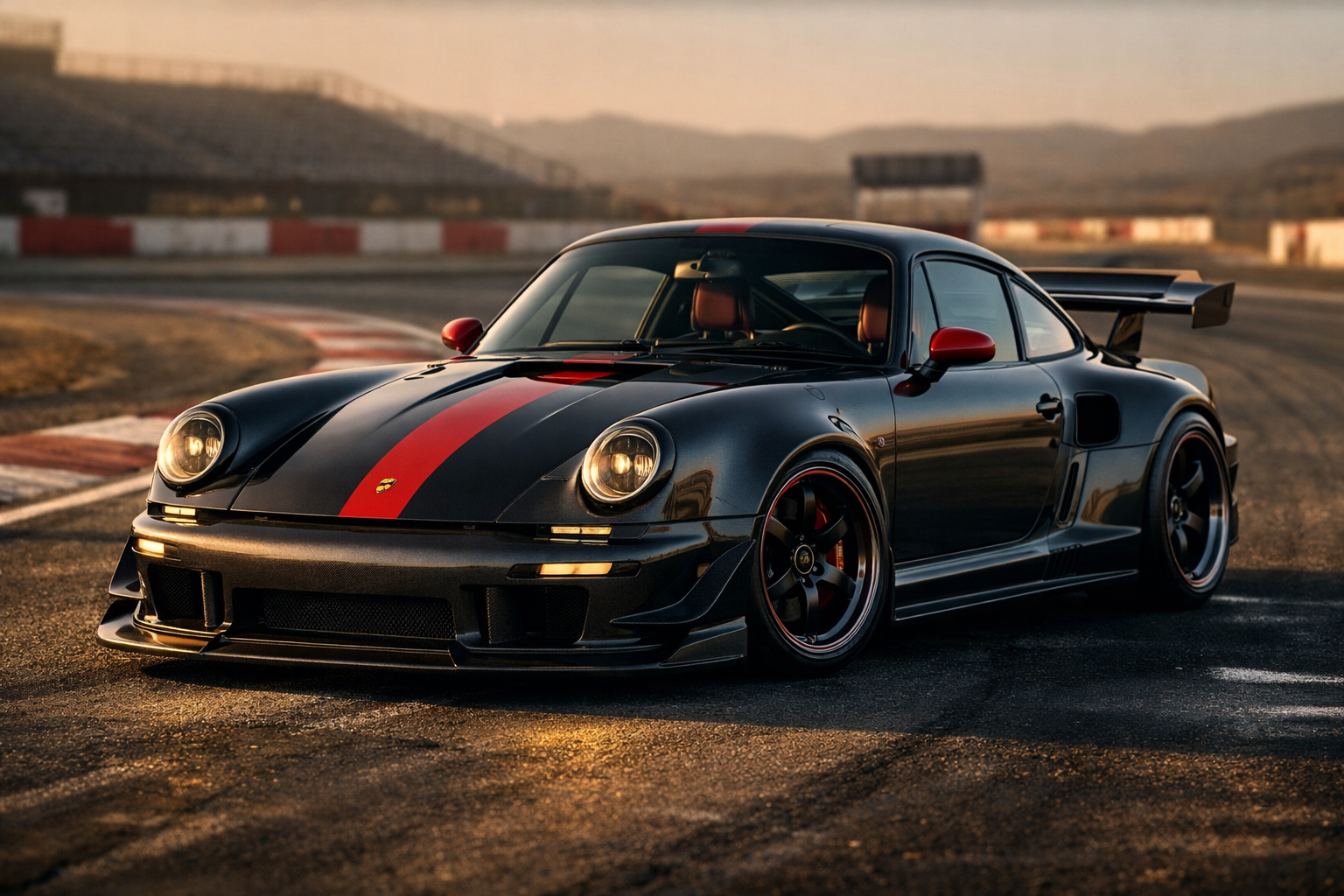
I’m going to say this quietly so the accountants don’t hear me: the Singer DLS Turbo might be the most thrilling 911 ever built, full stop. Yes, even more than a 992 GT3 RS with more wings than a Red Bull fridge. On track, this 700-horsepower reimagined 964 feels like Stuttgart’s greatest hits album played through a £50,000 valve amp, then turned up until the neighbors call the police.
Why does this matter right now? Because while the industry is busy bolting fake V10 noises onto electric sedans and calling it “emotional engagement,” Singer has gone the opposite direction and delivered something brutally, gloriously real. The Singer DLS Turbo ‘The Sorcerer’ isn’t nostalgia cosplay; it’s a masterclass in how to evolve a legend without strangling its soul. And after a full day lapping it hard, I’m convinced this thing rewrites what a restomod can be.
I’ve driven dozens of fast 911s, from 997 Turbos to the lunatic 992 GT3 RS, and I came in skeptical. Seven hundred horsepower in a short-wheelbase, air-cooled-ish 964 sounds like a recipe for hedge-trimming. Instead, what I found was control, clarity, and a level of driver involvement that makes modern supercars feel like PlayStation controllers.
Quick Specs
- Starting Price: approximately $3,000,000 (check manufacturer website for latest pricing)
- Engine: 3.8L twin-turbo flat-six
- Power: approximately 700 hp / 650 lb-ft
- 0-60 mph: approximately 2.5 seconds
- Fuel Economy: Not EPA-rated; expect low-teens mpg if you’re gentle
Design & First Impressions
The first time you see The Sorcerer in the metal, it looks like a 964 that’s been bench-pressed by Thor. The carbon bodywork is wider, angrier, and yet somehow still elegant, with turbo intakes that look functional because they absolutely are. Unlike some restomods that scream for attention, this one whispers, then punches you in the chest.
Hot take: Singer’s design discipline puts Porsche’s own Sonderwunsch program to shame. Where modern Turbo models like the 992 Turbo S feel overstyled, this feels distilled. Park it next to a Gunther Werks 993, a Ruf CTR Anniversary, or even a Pagani Utopia, and the Singer still draws the crowd.
Interior & Tech
Inside, it’s vintage 911 done by someone with obsessive-compulsive disorder and impeccable taste. Hand-stitched leather, exposed carbon, magnesium switchgear, and gauges that move like Swiss watches on espresso. There’s no massive touchscreen shouting at you about “user profiles,” and thank God for that.
You do get modern telemetry and track data logging, cleverly hidden because Singer understands restraint. This cabin proves you don’t need 17 ambient lighting modes to feel special, a point I’ve argued before when discussing tech overload in modern performance cars like in this Audi interior debate.
Driving Experience
On track, the Singer DLS Turbo is an exercise in controlled violence. Boost comes in hard but not stupidly, with throttle response sharper than a chef’s knife despite the turbos. The six-speed manual has a mechanical honesty that makes PDK feel like typing with autocorrect.
Steering is the real witchcraft here. It’s hydraulic, alive, and chatty in a way that makes even brilliant modern racks feel numb. Compared to a 992 GT3 RS, a Ferrari 296 GTB, or a McLaren 750S, this thing communicates like it’s plugged directly into your nervous system.
Here’s the controversial bit: it’s more fun than most hypercars at half the speed. Yes, a Pininfarina Battista will annihilate it in a drag race, but it won’t make you laugh inside your helmet mid-corner. Speed is easy; engagement is rare.
Brakes, Chassis & Track Manners
The carbon-ceramic brakes are monstrous, hauling the car down lap after lap without fade or drama. Suspension tuning is firm but readable, not spine-snapping, and it lets you lean on the car rather than tiptoe around physics. This isn’t a museum piece; it begs to be abused.
Compared to hardcore track toys like the Donkervoort P24 RS or a stripped-out GT3 Cup car, the Singer is friendlier without being dull. You can explore the limits without fearing a multi-million-dollar mistake every time the rear steps out.
Fuel Economy & Running Costs
If you’re asking about fuel economy, you’re missing the point, but let’s be adults. It’s not EPA-rated, and real-world driving will likely land you somewhere around 12–15 mpg if you’re behaving. Driven properly on track, it drinks fuel like a V8 muscle car at a burnout contest.
Maintenance will be eye-watering but not shocking at this level. Singer’s build quality is exceptional, and owners I’ve spoken to report fewer issues than some Italian exotics. For general efficiency benchmarks, you can look at FuelEconomy.gov, but this car lives outside those spreadsheets.
Practicality
There’s a frunk, technically, and you could fit a helmet bag and a soft overnight case. Ride quality on the road is surprisingly tolerable, better than a GT3 RS, worse than a Turbo S. This is not a daily, unless your daily commute involves apexes.
Safety ratings? It’s a low-volume, bespoke vehicle, so don’t expect NHTSA stars. You can browse NHTSA.gov all you like, but this car answers to physics, not bureaucracy.
Value vs Competitors
At around $3 million, the Singer DLS Turbo ‘The Sorcerer’ sounds insane until you consider the alternatives. A Bugatti Chiron is north of $3.5 million and feels clinically fast. A Ruf CTR Anniversary is similarly priced but less bespoke. A modern GT3 RS is “cheap” at $240,000 and utterly soulless by comparison.
This is art you can drive, unlike some retro-inspired exercises that feel half-baked, such as certain limited-run concepts I’ve criticized before, including the Bertone Runabout. Singer earns its price by delivering depth, not hype.
Pros
- Unmatched steering feel and driver engagement
- Exquisite build quality and materials
- Genuinely usable track performance
- Timeless design with modern capability
Cons
- Eye-watering price of entry
- Not emissions or EPA rated
- Limited availability and long build times
The Singer DLS Turbo isn’t trying to be the fastest, the smartest, or the most socially responsible. It’s trying to be the best possible version of a 911 for people who actually drive, and on track, it succeeds spectacularly. If this is sorcery, burn the rulebook and hand me the spellbook.
For more details straight from the source, visit Singer Vehicle Design.