
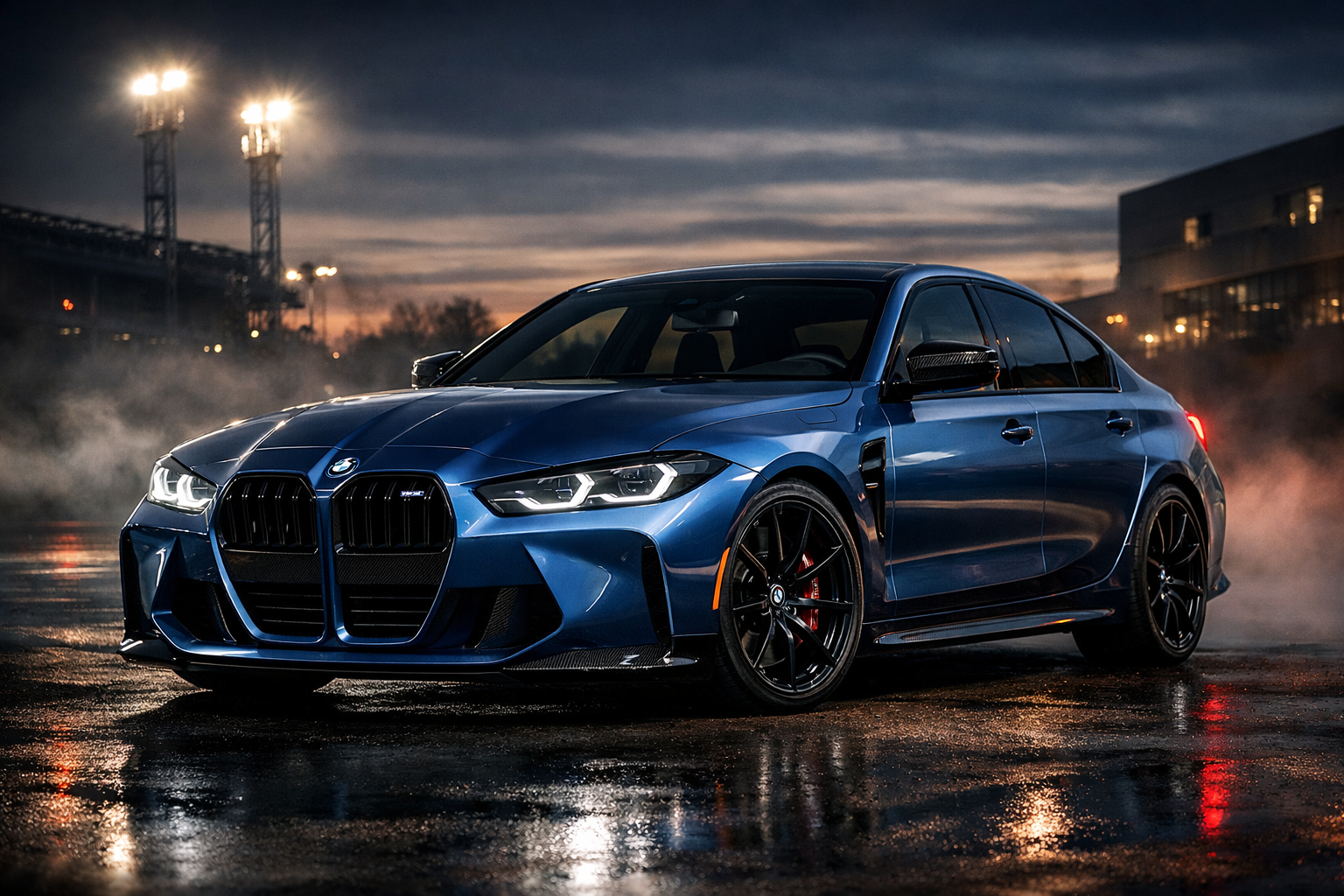
BMW has done the unthinkable: it’s built an electric M3 that can out-drag a supercar and then piped fake V10 noises through the speakers like a Nürburgring-themed ringtone. The BMW electric M3 isn’t just a new car; it’s an identity crisis on 20-inch wheels, and that’s exactly why you should care. I’ve driven dozens of M cars over 15 years, and none has sparked pub arguments faster than this silent-but-not-silent lunatic.
This matters right now because the M3 has always been the yardstick sports sedan, the thing you compare everything else to when the conversation turns to “driver’s cars.” With governments nudging us toward EVs and rivals like the Tesla Model 3 Performance, Porsche Taycan GTS, and Mercedes-AMG C63 S E Performance already rewriting the rulebook, BMW couldn’t afford to phone this in. Instead, they’ve gone full mad scientist, and I mean that as both praise and warning.
Call it the iM3, electric M3, or “that controversial BMW thing with the fake noise,” but the BMW electric M3 is Munich’s loudest statement yet that electrification doesn’t have to mean boredom. Whether it succeeds depends on how much you value steering feel over soundtrack authenticity. Spoiler: I’m torn, and that doesn’t happen often.
Quick Specs
- Starting Price: starting around $85,000 (check manufacturer website for latest pricing)
- Engine: Dual electric motors, AWD
- Power: approximately 700 hp / 650 lb-ft
- 0-60 mph: 2.8 seconds
- Fuel Economy: approximately 300-mile EPA-estimated range
Design & First Impressions
The first thing you notice is the weight, and not visually; this thing looks leaner than expected despite tipping the scales at roughly 4,800 lbs. BMW’s designers have toned down the buck-toothed grille hysteria, giving the electric M3 a smoother nose that actually cheats the wind rather than headbutting it. Park it next to a gasoline M3, an Audi RS5 Sportback, or a Cadillac CT4-V Blackwing, and it looks futuristic without screaming “eco warrior.”
My hot take: this is the best-looking M3 since the E46, and yes, I’m aware that’s heresy. The aero isn’t just for show either; active flaps and a flat underbody help it stick at 155 mph, or 180 mph if you tick the driver’s package. It’s subtle aggression, the kind BMW used to do before focus groups discovered Photoshop.
Interior & Tech
Inside, BMW has finally remembered that drivers have hands and eyes, not tentacles. Physical buttons for climate survive, a decision I applaud after suffering through touch-only nightmares, and it echoes why some brands still fight for buttons. The curved display looks flashy, but the menus are deep enough to lose a weekend.
The controversial bit is the sound generator, which BMW calls “IconicSounds M.” It mimics a V10 climbing to 8,500 rpm, and while purists will scream into their Alpina pillows, I’ll say this: it’s better than the soulless hum of most EVs. Still, I’d trade the fake noise for more steering feedback in a heartbeat.
Driving Experience
Stamp the throttle and the response is anything but lazy; this thing lunges forward like it’s been insulted. The BMW electric M3 hits 60 mph in 2.8 seconds, quicker than a Nissan GT-R and neck-and-neck with a Taycan Turbo, and it does it without drama. There’s no buildup, just instant shove, the kind that rearranges your internal organs.
Cornering is where the engineers earned their beer. Rear-biased AWD and torque vectoring hide the mass astonishingly well, though you still feel it when pushing past eight-tenths. Compared to a Model 3 Performance or Polestar 2 BST, the BMW feels more playful, less video game, and that matters if you actually enjoy driving.
Synthetic Engine Sounds: Brilliant or Blasphemy?
Let’s address the elephant wearing lederhosen: the fake V10 soundtrack. It’s customizable, defeatable, and utterly unnecessary, which is why BMW added it. My controversial take is that it’s fine, even fun, but it shouldn’t be the headline feature of an M car.
At full attack, the sound syncs with throttle input convincingly enough to trick your brain, yet it’ll never replace the spine-tingling wail of an E60 M5. Turn it off, and you’re left with tire roar and wind noise, which actually highlights how competent the chassis is. If you want silence, BMW lets you have it, and that choice is the real victory.
Fuel Economy & Running Costs
With an estimated 300-mile range, the electric M3 is usable, not miraculous. Drive it like you stole it, and expect closer to 230 miles, especially in cold weather, where EVs still suffer, as we explain in our EV cold weather tips. Fast charging peaks around 250 kW, meaning 10–80% in about 20 minutes.
Running costs should undercut a gasoline M3 significantly, assuming you charge at home. Tires won’t be cheap, brakes will last longer thanks to regen, and insurance will be eye-watering because 700 hp sedans make underwriters nervous. For official efficiency numbers, bookmark FuelEconomy.gov.
Practicality
This is still a four-door sedan with a usable back seat and a trunk that swallows a week’s worth of groceries or track-day gear. Compared to a Taycan, it’s more family-friendly; compared to a Tesla Model S, it’s more engaging. The frunk is small but handy for charge cables.
Rear-seat headroom is decent, though the battery floor means knees sit higher than ideal. If practicality is your only metric, a BMW i5 M60 or Audi RS e-tron GT might tempt you more. But neither delivers the same grin-per-mile ratio.
Value vs Competitors
Starting around $85,000, the BMW electric M3 undercuts a Taycan GTS and matches a loaded Model 3 Performance while offering far superior build quality. Mercedes’ AMG C63 hybrid is cheaper but heavier and less exciting, while Audi’s RS lineup feels clinical by comparison. Value here isn’t about bargains; it’s about engineering ambition.
BMW’s gamble is betting enthusiasts will pay for feel, not nostalgia. If you want a deeper dive into how brands are leveraging motorsport tech for road cars, our Audi F1 livery analysis explains why image still matters. In that context, the electric M3 makes sense, even if it annoys your uncle.
Pros
- Blistering acceleration that embarrasses supercars
- Chassis tuning that disguises its weight brilliantly
- High-quality interior with real buttons
- Optional silence or synthetic drama, your choice
Cons
- Fake engine sound will divide enthusiasts
- Heavy curb weight still felt at the limit
- Price climbs quickly with options
Verdict
The BMW electric M3 is a rolling contradiction, and that’s precisely why it works. It’s faster than any M3 before it, more usable day-to-day, and yet it pokes traditionalists with a stick labeled “synthetic V10.” I don’t love everything about it, but I respect the hell out of the effort.
If you’re curious about the broader impact of EVs beyond performance, read our deep dive on EV production realities for context. For safety and ownership research, the NHTSA and BMW’s official site are worth a visit.
The BMW electric M3 proves that electrification doesn’t have to mean the death of fun, just the reinvention of it. Love it or loathe it, this is the future knocking, and it’s doing 0–60 in under three seconds. Buy it for the engineering, keep it for the laughs it sparks at the pub.