
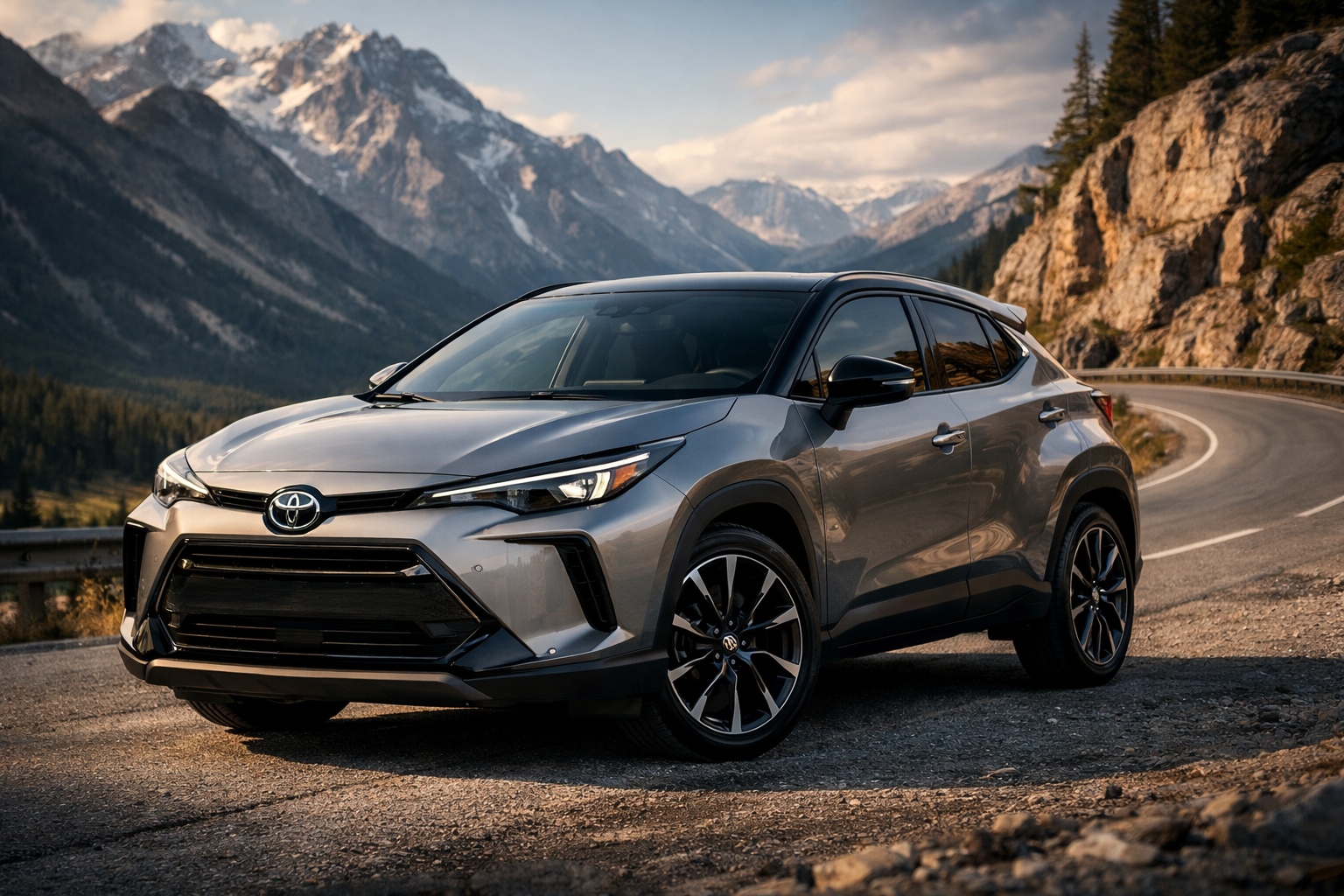
The first time I saw the new C-HR in person, it wasn’t in some studio under moody lighting—it was sitting in a grocery store parking lot, glinting in late-afternoon sun like a concept car that accidentally made production. The old one looked like it was trying too hard. This one looks like it finally figured out who it is.
After a week and 600 miles behind the wheel, I can say this confidently: the 2026 Toyota C-HR review you’re reading right now isn’t about a quirky afterthought in Toyota’s lineup. It’s about a compact SUV that finally grew up—and might just be one of the smartest hybrid buys under $35,000.
Moreover, in a world where compact crossovers blur together like rental car lot déjà vu, the new hybrid C-HR actually has a personality. The real question is whether that personality translates into something you’ll enjoy every single day—or whether you should just default to a Corolla Cross or Honda HR-V and call it a day.
Key Specs
- Starting Price: Around $28,000 (check manufacturer website for latest pricing)
- As-Tested Price: $34,200
- Engine: 2.0L Hybrid I4 + electric motor
- Power: 196 hp (combined)
- 0-60 mph: ~7.8 seconds
- Fuel Economy: 45/41/43 mpg (city/hwy/combined)
- Transmission: e-CVT
- Drivetrain: FWD (AWD expected on select trims)
- Curb Weight: ~3,300 lbs
- Cargo Space: 25.5 cu ft (behind rear seats)
Design & First Impressions
Toyota didn’t just facelift the old C-HR—they torched it and started over. The 2026 model borrows heavily from the Prius and bZ design language, with sharp creases, a floating roof, and those boomerang LED signatures that look like they were sketched with a scalpel.
In person, it sits lower and wider than a Corolla Cross, and that makes a difference. Meanwhile, the sloping roofline gives it a coupe-SUV vibe without the cartoonish awkwardness of the old model. Park it next to a Hyundai Kona or Chevy Trax, and the Toyota looks a half-class more expensive.
However, I’ll say this: the two-tone paint is mandatory. The monotone colors make it look a bit bulbous. In contrast, a white or red body with a black roof turns it into a mini-Lexus NX from 20 feet away.
Notably, the stance is tighter and more planted than before. Short overhangs, 18- or 19-inch wheels, and actual wheel arch presence give it a purposeful look. It no longer screams “design experiment.” It whispers, “I’ve been to the gym.”
Interior & Technology
Slide inside and the improvement is even more dramatic. The old C-HR felt like a Hot Topic lounge with bad visibility. The new one feels like a scaled-down Prius—clean, modern, and surprisingly airy.
Additionally, the 12.3-inch infotainment screen is sharp and responsive, running Toyota’s latest system with wireless Apple CarPlay and Android Auto. It boots quickly, doesn’t lag, and—praise be—keeps physical climate controls. I shouldn’t have to dig through a menu to change fan speed while merging onto the freeway.
The digital gauge cluster is configurable and crisp, though not quite Audi-level theatrical. Meanwhile, Toyota Safety Sense comes standard, including adaptive cruise and lane tracing assist. For official crash data, keep an eye on NHTSA as ratings update.
Material quality punches above its price. Soft-touch panels where your elbows rest, tight stitching on the dash, and no obvious cost-cutting in the door cards. However, rear headroom is merely adequate for six-footers thanks to that sloping roof. Cargo space at 25.5 cubic feet beats the Kona but trails the boxier Subaru Crosstrek.
Behind the Wheel: Driving Experience
Here’s where this 2026 Toyota C-HR review gets interesting.
Under the hood sits Toyota’s 2.0-liter hybrid setup making 196 horsepower. On paper, that doesn’t scream excitement. In reality, it feels brisk because of the instant electric torque off the line. It jumps away from traffic lights with a quiet shove, like a barista who’s had one too many espressos.
Yes, it uses an e-CVT. Yes, it drones if you floor it. However, Toyota’s latest tuning is far less rubber-bandy than the old days. Under moderate throttle, it feels natural and linear. Floor it, and you get the familiar steady RPM hum—but it’s smoother than the Corolla Cross Hybrid.
Now let’s talk chassis. The TNGA-C platform—shared with the Corolla and Prius—gives it a low center of gravity and real composure. Turn-in is sharp for a compact SUV. The steering has actual weight and decent feedback, something I can’t say about the numb Honda HR-V.
Moreover, body roll is controlled without beating you up. On a twisty back road outside Monterey, it didn’t beg for mercy. It didn’t understeer into oblivion either. It just… flowed. No, it’s not a Mazda CX-30 in terms of steering purity. The 911 remains the yardstick for steering feel, obviously. But among mainstream hybrids? This is near the top.
Ride quality strikes a smart balance. Over broken pavement, it absorbs impacts with a muted thud instead of a crash. Meanwhile, highway cruising at 75 mph is impressively quiet, with minimal wind noise. I’ve driven 40-plus compact SUVs, and this is one of the few that didn’t leave me fatigued after three hours.
Fuel Economy & Running Costs
The EPA estimates 45 mpg city and 41 mpg highway, combined 43 mpg. You can verify official figures at FuelEconomy.gov. In my mixed driving—some spirited canyon runs, plenty of freeway—I averaged 42 mpg. That’s Prius-adjacent efficiency in a taller package.
Furthermore, it runs happily on regular 87-octane. Insurance should be reasonable given Toyota’s safety suite and modest power output. Maintenance? It’s a Toyota hybrid. These systems have proven durable for decades.
If you’re debating hybrid versus full EV, especially with charging headaches in apartments, read our Hybrid vs Electric 2026 guide. For most urban commuters, the C-HR’s no-plug simplicity makes more sense than chasing public chargers.
Additionally, with ongoing price fluctuations tied to global trade, our Auto Tariffs Impact guide is worth a look before signing paperwork. Compact SUV margins are tight, and pricing can shift quickly.
Practicality & Daily Living
At 25.5 cubic feet behind the rear seats, cargo space is solid but not class-leading. I fit two carry-on suitcases, a camera bag, and a backpack with room to spare. Fold the seats down and you get enough space for a weekend IKEA run—just don’t expect RAV4 levels of cavernous.
Visibility is much improved over the old C-HR. Thinner pillars and a larger rear window help, though the sloped hatch still limits over-the-shoulder views. Fortunately, the standard backup camera and available 360-degree view system make parking painless.
Rear seats accommodate two adults comfortably. Three will complain. Child seats fit easily thanks to wide-opening doors. Meanwhile, the low load floor makes it pet-friendly—I tossed my retriever in back and he approved, tail wagging like it was Laguna Seca victory lane.
For road trips, the hybrid system’s range—over 500 miles on a tank—means fewer fuel stops than most gas-only rivals. That’s underrated convenience.
How It Stacks Up: Competitive Comparison
The obvious rivals? Honda HR-V, Hyundai Kona Hybrid, and Subaru Crosstrek.
Against the HR-V, the C-HR wins on power and fuel economy. The Honda feels underpowered and less engaging. However, the HR-V offers more rear space and Honda’s typically excellent packaging.
Versus the Hyundai Kona Hybrid, it’s closer. The Kona looks edgy and offers similar efficiency. In contrast, the Toyota feels more refined in ride quality and interior materials. I’d trust the Toyota’s long-term durability more, too.
Then there’s the Subaru Crosstrek. It offers standard AWD and more ground clearance, making it better for snow and light trails. However, it can’t touch the C-HR’s fuel economy. If you never leave pavement, the Toyota makes more financial sense.
| Spec | 2026 Toyota C-HR | Honda HR-V | Subaru Crosstrek |
|---|---|---|---|
| Starting Price | $28,000 | $26,000 | $27,000 |
| Power | 196 hp | 158 hp | 152-182 hp |
| 0-60 mph | ~7.8s | ~9.5s | ~8.4s |
| MPG/Range | 43 mpg | 28 mpg | 29 mpg |
| Cargo Space | 25.5 cu ft | 24.4 cu ft | 19.9 cu ft |
| Warranty | 3 yr/36,000 mi | 3 yr/36,000 mi | 3 yr/36,000 mi |
The Good
- Excellent real-world fuel economy (42+ mpg)
- Sharp styling that stands out in the segment
- Balanced ride and handling for a compact SUV
- Modern, intuitive infotainment system
- Strong value under $35,000
The Bad
- Rear headroom limited for taller passengers
- e-CVT can drone under hard acceleration
- No standard AWD on base trims
- Cargo space trails boxier rivals
So here’s the bottom line of this 2026 Toyota C-HR review: Toyota finally made a compact SUV that feels intentional, not experimental. It’s efficient without being dull, stylish without being obnoxious, and practical without being a penalty box.
Would I take it to a track day at Laguna Seca? No—I have other bad financial decisions for that. But as a daily driver that won’t bore you and won’t punish your wallet, the C-HR has officially grown up. And honestly, that might be exactly what most buyers need.
Disclosure: This article may contain affiliate links. If you make a purchase through these links, we may earn a small commission at no extra cost to you. This helps support RevvedUpCars.com. Learn more.