
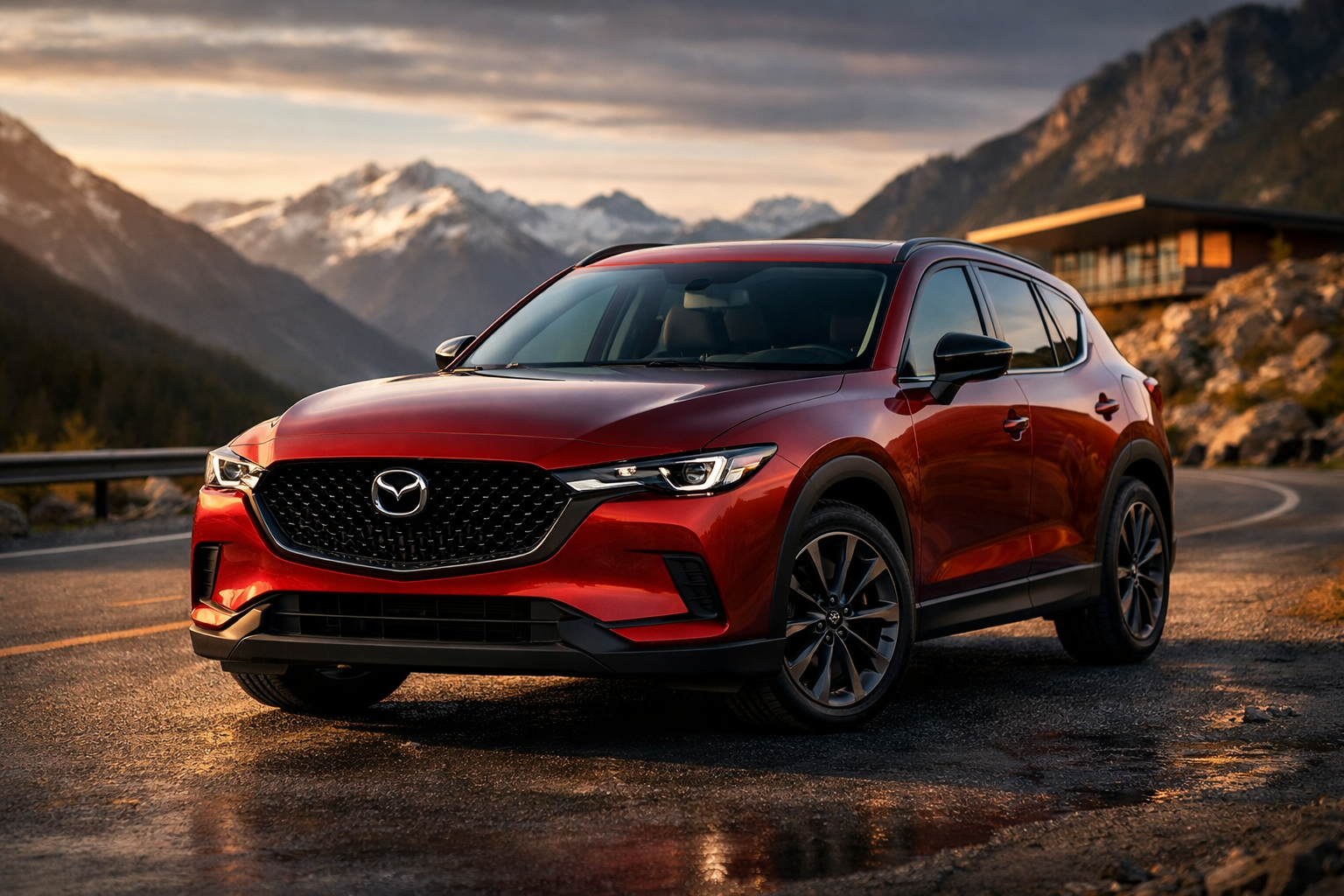
The first thing I noticed wasn’t the paint or the grille—it was my right hand hovering awkwardly over thin air. For a decade, the Mazda CX-5 trained us like Pavlov’s dogs to reach for that rotary controller on the center console. Now? It’s gone. The 2026 Mazda CX-5 stares back at you with a big, unapologetic touchscreen like it’s been binge-watching Tesla tutorials.
And here’s the thing: I think it’s the right move. Bold? Yes. Risky? Absolutely. But after a day carving canyon roads and slogging through L.A. traffic, I’m convinced this compact SUV just leveled up in ways that matter. The question isn’t whether the knob is dead—it’s whether the CX-5 still has the magic that made it the enthusiast’s choice in a sea of beige crossovers.
Key Specs
- Starting Price: Around $30,000 (check manufacturer website for latest pricing)
- As-Tested Price: $37,000 (estimated)
- Engine: 2.5L Naturally Aspirated I4 / 2.5L Turbo I4
- Power: 187 hp (NA) / 256 hp & 320 lb-ft (Turbo on premium)
- 0-60 mph: 8.1 seconds (NA) / 6.5 seconds (Turbo)
- Fuel Economy: Up to 24/30/26 mpg (city/hwy/combined)
- Transmission: 6-speed automatic
- Drivetrain: FWD or AWD
- Curb Weight: Approx. 3,700 lbs
- Cargo Space: 30.9 cu ft (behind rear seats)
Design & First Impressions
Visually, Mazda didn’t torch the blueprint. The CX-5 still looks like it’s mid-pounce, all stretched hood and tight surfacing. However, the front fascia gets slimmer headlights and a wider grille that pulls it closer to the CX-90’s family face. In darker colors—Machine Gray or Soul Red—it looks properly premium, not “rental-spec SUV.”
Notably, the proportions remain the best in the segment. Park it next to a Toyota RAV4 or Honda CR-V and the Mazda still looks like it hit the gym. The RAV4 leans rugged; the CR-V leans sensible. The CX-5? It leans athletic. I’ve driven 40-plus compact SUVs, and this is still the only one that looks like it might enjoy a track day.
Furthermore, wheel designs are sharper this year, especially on Turbo trims. Skip the base 17s if you can; the 19-inch alloys fill the arches properly without wrecking ride quality. Mazda understands stance, and stance matters.
CX-5 Interior Redesign: Touchscreen Takes Over
Let’s talk about the elephant in the cabin: the Mazda touchscreen replacing the rotary controller. The new 12.3-inch display sits higher and closer to your natural sightline. In contrast to the old system—which forced you to scroll like you were cracking a safe—this one responds instantly to taps and swipes.
Moreover, wireless Apple CarPlay and Android Auto come standard on most trims, and the interface is finally intuitive enough that you don’t need a YouTube tutorial. After years of defending Mazda’s “eyes-on-the-road” philosophy, I’ll admit it: this is better. If you’re curious why physical controls are making a comeback elsewhere, read our take on why physical controls in EVs are back—Mazda smartly keeps real knobs for climate and volume.
Material quality remains a CX-5 strong suit. Soft-touch dash, tight stitching, real metal trim on upper trims—this thing punches above its price. In fact, I’d take this cabin over a base BMW X1 without blinking. The seats are supportive in that firm, Germanic way, and after three hours behind the wheel, my back didn’t file a complaint.
Rear seat space is adequate, not cavernous. Taller adults will brush knees if the front seats are set for NBA forwards. However, cargo space at 30.9 cubic feet beats the Subaru Forester and nearly matches the Hyundai Tucson. For safety specifics, check NHTSA.gov for the latest ratings.
Behind the Wheel: Driving Experience
Here’s where the 2026 Mazda CX-5 either earns your respect or loses it. Thankfully, it still knows how to dance.
The 2.5-liter naturally aspirated engine is adequate—smooth, linear, and about as exciting as oatmeal. However, the 2.5-liter turbo is the one you want. With 320 lb-ft on premium fuel, it surges forward with a thick midrange punch. It’s not hot-hatch quick, but 6.5 seconds to 60 mph in a family crossover feels properly brisk.
The 6-speed automatic? Old school. While rivals run 8- or 10-speeds or CVTs, Mazda sticks to its guns. And you know what? I respect it. Shifts are crisp, predictable, and free of rubber-band nonsense. Not everything needs more gears.
Steering feel remains the benchmark in this class. It’s weighted naturally, with actual feedback through the rim—something the numb CR-V and video-game-light Tucson can’t claim. Through a set of tightening canyon esses, the front end bites cleanly, and the chassis rotates with gentle throttle input. It reminds me why I fell for this SUV years ago at Laguna Seca during a manufacturer event.
Ride quality strikes a near-perfect balance. It’s firm enough to control body roll yet compliant over broken pavement. In contrast, the RAV4 can feel jittery, and the Forester leans more. The CX-5 feels tied down, cohesive, engineered by people who care.
Hot take: I’d rather drive this than some entry-level luxury crossovers that cost $10,000 more. Badge snobs, fight me.
Fuel Economy & Running Costs
EPA estimates hover around 24/30/26 mpg for most AWD models. In real-world mixed driving, I saw 25 mpg with a heavy right foot. The turbo demands premium for full power, though it’ll run on regular with reduced output. For official numbers, check FuelEconomy.gov.
Additionally, maintenance costs should remain reasonable. Mazda’s naturally aspirated engines are proven workhorses, and the turbo has matured over several years. Insurance tends to undercut luxury rivals, and resale values historically hold strong.
If you’re worried about long-term complexity, this isn’t some over-softwared EV waiting for a patch—see our thoughts on EV software recalls if you want that rabbit hole. The CX-5 feels refreshingly mechanical.
Practicality & Daily Living
At 30.9 cubic feet behind the second row, the CX-5 swallows a Costco run without complaint. Fold the seats and you’re north of 59 cubic feet—enough for bikes with wheels off or a weekend IKEA spree. The load floor is low, and the hatch opening is wide.
Visibility is solid forward, slightly pinched over the shoulder thanks to thick C-pillars. However, the 360-degree camera on upper trims makes tight parking easy. The turning radius is tight enough for urban life, and the brake pedal has that progressive, confidence-inspiring feel I obsess over.
For families, rear doors open wide enough for child seats without chiropractor bills. Additionally, if you’re hauling a four-legged co-pilot, check out our guide to spec your pet friendly SUV for tips on keeping claws off that nice leather.
How It Stacks Up: Competitive Comparison
Against the Honda CR-V, the Mazda wins on driving dynamics and interior richness. The Honda counters with better rear-seat space and available hybrid efficiency. If you want sensible, buy the Honda. If you want to feel something, buy the Mazda.
Versus the Toyota RAV4, the CX-5 feels more refined and far less noisy. The RAV4 Hybrid demolishes it on fuel economy, though, and Toyota’s reputation for bulletproof reliability still carries weight.
Meanwhile, the Hyundai Tucson offers futuristic styling and more tech for the money. However, its steering feels artificial, and the driving experience lacks cohesion. The Mazda feels engineered; the Hyundai feels configured.
| Spec | Mazda CX-5 | Honda CR-V | Toyota RAV4 |
|---|---|---|---|
| Starting Price | $30,000 | $31,000 | $30,500 |
| Power | 187–256 hp | 190 hp | 203 hp |
| 0-60 mph | 6.5–8.1s | 7.9s | 7.8s |
| MPG/Range | 26 mpg | 28 mpg | 27 mpg |
| Cargo Space | 30.9 cu ft | 39.3 cu ft | 37.6 cu ft |
| Warranty | 3 yr/36,000 mi | 3 yr/36,000 mi | 3 yr/36,000 mi |
The Good
- Best-in-class steering feel and chassis balance
- Premium interior materials for the price
- New touchscreen is faster and more intuitive
- Turbo engine delivers strong midrange punch
- Attractive, athletic exterior design
The Bad
- Rear seat space trails key rivals
- No hybrid option (yet)
- 6-speed auto lacks extra gears for efficiency
- Turbo requires premium for full performance
The 2026 Mazda CX-5 didn’t reinvent itself—it refined itself. By ditching the controller and embracing a proper touchscreen, it modernized the one part that felt stubbornly old-school. More importantly, it kept the steering feel, chassis poise, and driver-first attitude that made it special.
In a world where most compact SUVs are appliances, the 2026 Mazda CX-5 still feels like it was tuned by someone who enjoys apexes. And if you’re anything like me—someone who sneaks the long way home just to string together a few corners—that matters more than any knob ever could.
Disclosure: This article may contain affiliate links. If you make a purchase through these links, we may earn a small commission at no extra cost to you. This helps support RevvedUpCars.com. Learn more.