
The first time I mashed the throttle in the 2026 Kia K4 GT-Line Turbo, the nose lifted just enough to make me grin. Not torque-steer mayhem, not EV-style instant shove—just a clean, eager surge that reminded me why I still love a good turbo four. The steering had actual weight, the chassis took a set mid-corner, and for a moment I forgot I was in a compact sedan that starts around $27,000.
Here’s the thesis: this might be the new benchmark for the sporty compact sedan under $30K. Not the fastest, not the fanciest—but the one that blends fun, tech, and value better than anything else right now. And yes, that includes the Honda Civic.
After a week flogging it on canyon roads and commuting through soul-crushing traffic, I’ve got opinions. Strong ones. Because I’ve driven 40-plus compact sedans over the years, and very few have balanced daily livability with actual driver engagement like this.
Key Specs
- Starting Price: Around $27,000 (check manufacturer website for latest pricing)
- As-Tested Price: Around $30,500
- Engine: 1.6L Turbocharged I4
- Power: 190 hp / 195 lb-ft
- 0-60 mph: ~7.1 seconds
- Fuel Economy: 26/36/29 mpg (city/hwy/combined)
- Transmission: 8-speed automatic
- Drivetrain: FWD
- Curb Weight: ~3,150 lbs
- Cargo Space: 14.6 cu ft
Design & First Impressions
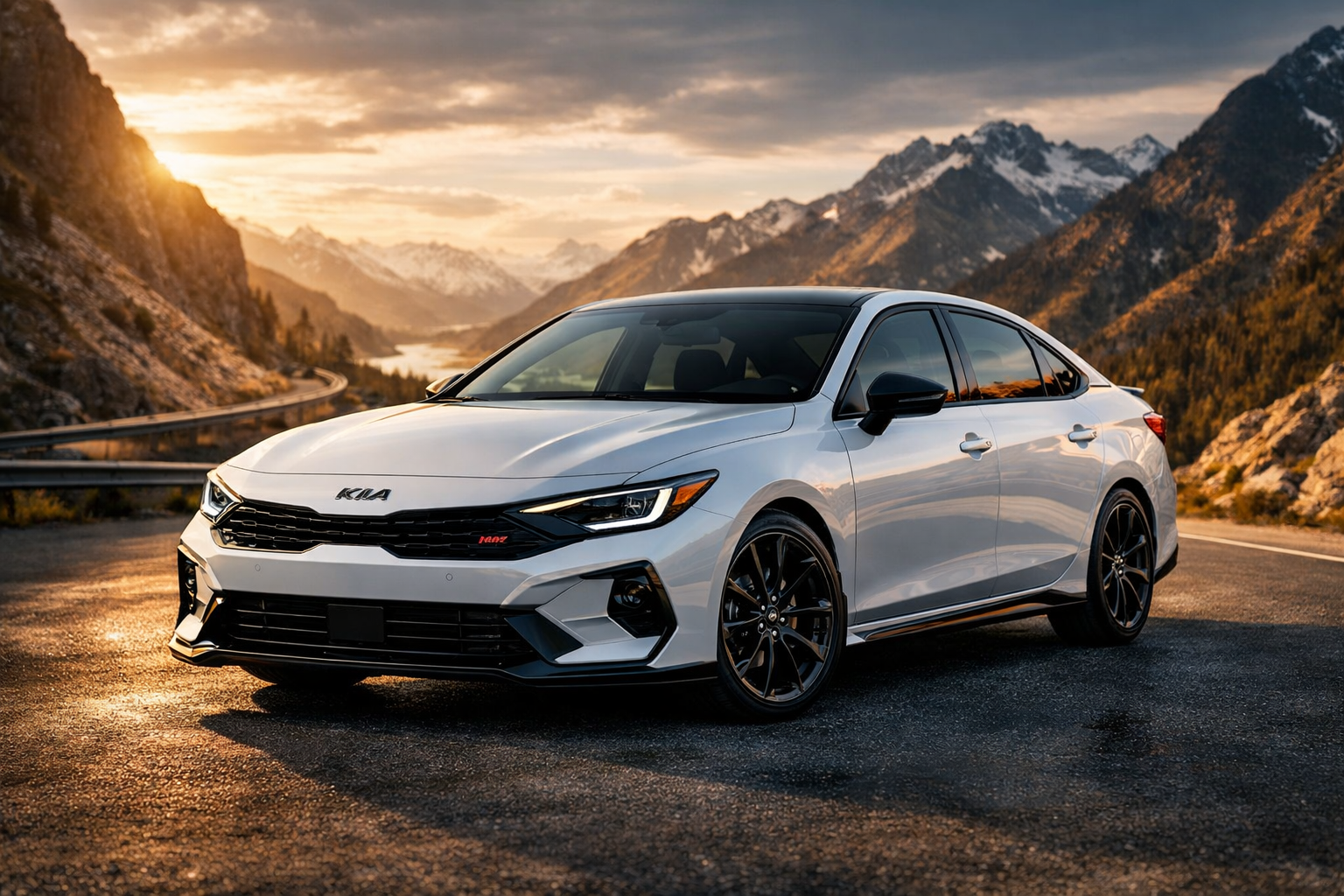
In photos, the K4 looks like Kia let the design team off the leash after a triple espresso. In person, it’s even more dramatic. The fastback roofline, vertical LED lighting, and sharp creases make the Civic look conservative and the Corolla almost anonymous.
However, it’s not just shock value. The proportions work. The long wheelbase pushes the wheels toward the corners, and the GT-Line trim adds gloss black accents and 18-inch wheels that actually fill the arches properly. In contrast to the last Forte, this feels like Kia skipped a generation and went straight to “junior Stinger.”
Additionally, the color palette matters here. The deep blue and the metallic gray flatter the car’s angular bodywork. Go white, and you lose some of that drama. This is a car that deserves to look a little loud.
Interior & Technology
Slide inside, and the K4 immediately feels more expensive than its price tag suggests. The sweeping dual-screen setup stretches across the dash like something out of a segment above. Materials are a mix of soft-touch surfaces and harder plastics lower down—but crucially, everything you touch regularly feels solid.
Moreover, Kia didn’t bury basic functions in touchscreen hell. After we’ve seen how touchscreens went too far in cars, it’s refreshing to have physical climate toggles and real buttons for key functions. The infotainment system is quick, crisp, and supports wireless Apple CarPlay and Android Auto without drama.
In fact, the tech suite rivals cars $5,000 more expensive. You get a configurable digital cluster, adaptive cruise, lane-keeping assist, blind-spot monitoring, and forward collision avoidance. For official safety data, check NHTSA.gov once full ratings are published.
Rear seat space is the real surprise. Thanks to the longer wheelbase, legroom is genuinely adult-friendly. I’m 6 feet tall and could sit behind myself without negotiating a peace treaty with the front seatback.
Behind the Wheel: Driving Experience of the 2026 Kia K4 GT-Line Turbo
Now we get to the good stuff. The 1.6-liter turbo makes 190 horsepower and 195 lb-ft of torque, and it delivers it with a smooth, linear shove. There’s a hint of old-school turbo lag below 2,000 rpm—like the engine clearing its throat before singing—but once it’s on boost, it pulls cleanly to redline.
Meanwhile, the 8-speed automatic deserves praise. Shifts are crisp in Sport mode and unobtrusive in traffic. Unlike the CVT in the Corolla, it doesn’t drone. And compared to the Civic’s CVT in non-Si trims, it feels more mechanical and engaging.
However, the real magic is in the chassis tuning. The steering has actual feedback—not Porsche 911 levels (nothing is), but enough texture to tell you what the front tires are doing. I pushed it through a familiar canyon loop, and the front end bit eagerly, with minimal body roll and predictable understeer at the limit.
In fact, I’d argue this is more fun than the standard Civic Sport. If you want hybrid efficiency with surprising fun, check out our 2026 Honda Civic Sport Hybrid review. But if you want a traditional turbo punch and a slightly edgier personality, the Kia takes it.
Ride quality strikes a sweet spot. It’s firm enough to control body motion but compliant over broken pavement. On the highway, it tracks straight and feels stable at 80 mph. Wind noise is present but not intrusive—certainly quieter than older Kia compacts.
Fuel Economy & Running Costs
The EPA estimates 26 mpg city and 36 mpg highway, which aligns with what I saw during mixed driving. For official numbers, visit FuelEconomy.gov. Drive it hard, and you’ll dip into the mid-20s. Cruise gently, and 34–35 mpg is realistic.
Notably, the engine runs happily on regular 87-octane fuel. That’s a win over some turbo competitors that demand premium for peak performance. Over five years, that adds up.
Additionally, Kia’s warranty remains one of the best in the business: 5-year/60,000-mile basic and 10-year/100,000-mile powertrain. Honda and Toyota simply can’t match that coverage.
Practicality & Daily Living
With 14.6 cubic feet of trunk space, the K4 sits near the top of the class. I fit two carry-on suitcases, a backpack, and a duffel without playing Tetris. The wide trunk opening helps, though the sloping rear glass slightly limits vertical space.
Visibility is generally good forward, but the thick rear pillars create minor blind spots. Thankfully, blind-spot monitoring comes standard on the GT-Line Turbo. Parking is easy thanks to a tight turning radius and clear camera resolution.
Furthermore, this is a genuinely usable daily driver. The rear doors open wide enough for child seats, and the ride won’t punish you on a long road trip. It’s not trying to be a hot hatch hero—it’s a balanced compact turbo sedan that knows its mission.
How It Stacks Up: Competitive Comparison
Let’s talk rivals: Honda Civic Sport, Toyota Corolla SE, and Mazda3 2.5 S. These are the heavy hitters.
The Civic remains the benchmark for steering precision and overall polish. However, it gets pricey quickly, and the non-Si trims rely on a CVT that dulls the fun. The Corolla is reliable and efficient, but dynamically? It’s competent, not thrilling.
Meanwhile, the Mazda3 brings upscale interior vibes and optional AWD. But it’s tighter in the rear seat and can get expensive fast. Therefore, the Kia undercuts them on price while offering comparable—or better—performance and tech.
| Spec | Kia K4 GT-Line Turbo | Honda Civic Sport | Mazda3 2.5 S |
|---|---|---|---|
| Starting Price | $27,000 | $25,500 | $24,000 |
| Power | 190 hp | 158 hp | 191 hp |
| 0-60 mph | ~7.1s | ~8.5s | ~7.5s |
| MPG/Range | 29 mpg | 31 mpg | 30 mpg |
| Cargo Space | 14.6 cu ft | 14.8 cu ft | 13.2 cu ft |
| Warranty | 5 yr/60,000 mi | 3 yr/36,000 mi | 3 yr/36,000 mi |
The Good
- Strong turbo performance with minimal lag
- Balanced ride and handling
- Spacious rear seat for the class
- Excellent warranty coverage
- Sharp, distinctive styling
The Bad
- No manual transmission option
- Some hard plastics in lower cabin
- Front-wheel drive only
- Styling may be too bold for some buyers
The 2026 Kia K4 GT-Line Turbo isn’t perfect. I still wish Kia offered a manual, and a bit more steering feel would elevate it from “very good” to “great.” But at this price point, it hits a sweet spot that’s hard to ignore.
Ultimately, if you’re cross-shopping a 2026 Kia K4 GT-Line Turbo against a Civic or Corolla, drive the Kia last. Because once you feel that turbo spool and that chassis settle into a fast sweeper, you might just sign on the dotted line before your inner rational adult catches up.
Disclosure: This article may contain affiliate links. If you make a purchase through these links, we may earn a small commission at no extra cost to you. This helps support RevvedUpCars.com. Learn more.